1 of 4

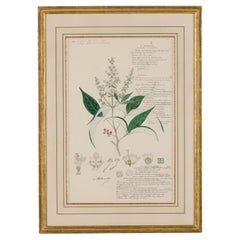
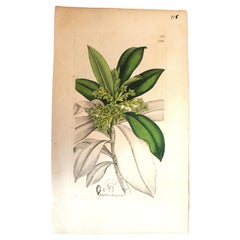
Original 1750s Antique Botanical Print of Vitex from The Garderner’s Dictionary

$180List Price

You May Also Like

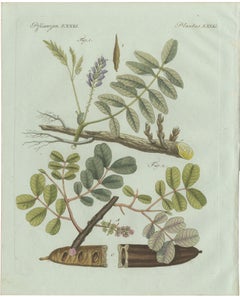
Original Antique Botanical Print of Licorice and Carob by Bertuch, 1805

Original Antique Botanical Print of Licorice and Carob by Bertuch, 1805

Located in Langweer, NL

Original Antique Botanical Print of Licorice and Carob by Bertuch, 1805 Original antique hand-colored copper engraving depicting two historically important useful plants, Licorice a...

Category

Antique Early 19th Century German Neoclassical Prints

Materials

Paper
Original Antique Botanical Print of Rubber and Gum Arabic Trees by Bertuch, 1802

Original Antique Botanical Print of Rubber and Gum Arabic Trees by Bertuch, 1802

Located in Langweer, NL

Original Antique Botanical Print of Rubber and Gum Arabic Trees by Bertuch, 1802 Original antique hand-colored copper engraving depicting two economically important tropical trees, ...

Category

Antique Early 19th Century German Neoclassical Prints

Materials

Paper
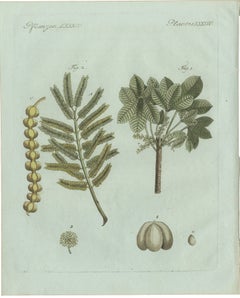
Original Antique Botanical Print of Manna Ash and Sarsaparilla by Bertuch, 1805

Original Antique Botanical Print of Manna Ash and Sarsaparilla by Bertuch, 1805

Located in Langweer, NL

Original Antique Botanical Print of Manna Ash and Sarsaparilla by Bertuch, c. 1805 Original antique hand-colored copper engraving depicting the Manna Ash and Sarsaparilla, published...

Category

Antique Early 19th Century German Neoclassical Prints

Materials

Paper
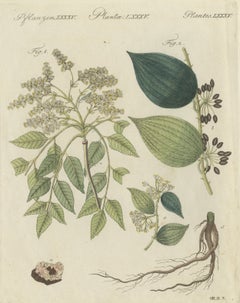
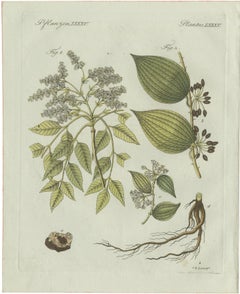
Manna Ash and Sarsaparilla Medicinal Plants, Antique Bertuch Print, circa 1805

Manna Ash and Sarsaparilla Medicinal Plants, Antique Bertuch Print, circa 1805

Located in Langweer, NL

This antique botanical print from Bertuch's Bilderbuch shows two medicinal plants of the old apothecary, the manna ash and sarsaparilla. The heading reads Pflanzen LXXXV and the plate carries the Vienna mark VIII.B.3 in the lower margin. Figure 1 is read as the manna ash, Fraxinus ornus, a branch with toothed pinnate leaves and dense sprays of creamy flowers, with a lump of the sweet dried sap, called manna, drawn at the foot as item a. Figure 2 is a sarsaparilla, Smilax, with a prickly climbing stem, broad heart shaped leaves with curved veins, clusters of dark berries, a flowering shoot and the long root used in medicine. Both drugs were imported in quantity around 1800, manna from Calabria and Sicily and sarsaparilla from Central and South America, and the plate shows children the living plants behind the jars on the apothecary shelf...

Category

Antique Early 19th Century Austrian Prints

Materials

Paper

19th Century Victorian Watercolor Botanical Drawing of Vitex Altissima

19th Century Victorian Watercolor Botanical Drawing of Vitex Altissima

Located in Queens, NY

American Victorian (19th Century) watercolor, ink, and pencil botanical drawing depicting a Vitex Altissima plant in green tones against a beige background, matted in a beveled parce...

Category

Antique 19th Century American Victorian Paintings

Materials

Paint

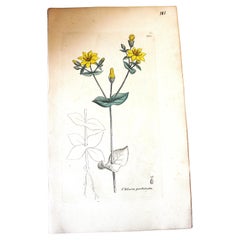
Early 19th Century Botanical Engraving by John Curtis

Early 19th Century Botanical Engraving by John Curtis

Located in Seaford, GB

Early 19th Century Botanical Engraving by John Curtis – Hand Coloured Natural History Plate An original early 19th-century hand-coloured botanical engraving from the celebrated natural history publications of John Curtis (1791–1862), one of Britain’s most respected botanical and entomological illustrators. This beautifully detailed plate illustrates a flowering plant in scientific profile, showing bloom structure, leaves, buds, and root system with precision typical of early Victorian natural history illustration. Curtis’s work bridges science and art — created for study, yet prized today for its elegance and balance. These engravings formed part of the golden age of British botanical publishing, when artists collaborated with engravers and colourists to produce plates that were both accurate and visually refined. Each impression was printed from an engraved plate and then carefully coloured by hand, meaning no two examples are ever exactly identical. The composition has the clarity collectors seek: • Central botanical specimen • Naturalistic colour palette • Fine line engraving • Period scientific titling This makes it ideal as a single framed piece or as part of a gallery wall of antique botanical studies. About John Curtis John Curtis was a leading figure in British natural history illustration. He is best known for British Entomology and botanical works that combined taxonomic accuracy with graceful composition. His engravings are held in major museum collections and remain highly collectible in the decorative arts market. Period Early 19th century, circa 1820–1840. Technique Copperplate engraving with original hand colouring on laid paper. Condition Good antique condition consistent with age. Light toning and minor handling marks may be present, as expected with early 19th-century works on paper. Please see the images. Why Collect Curtis Botanical Prints...

Category

Antique Early 19th Century British George III Prints

Materials

Paper

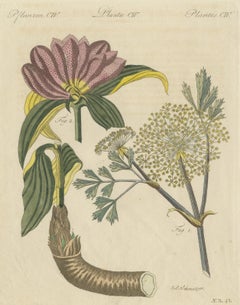
Galbanum and Hungarian Gentian, Antique Bertuch Print, circa 1805

Galbanum and Hungarian Gentian, Antique Bertuch Print, circa 1805

Located in Langweer, NL

This antique botanical print from Bertuch's Bilderbuch shows two medicinal plants, galbanum and the Hungarian gentian. The heading reads Pflanzen CIV and the plate is signed by the V...

Category

Antique Early 19th Century Austrian Prints

Materials

Paper

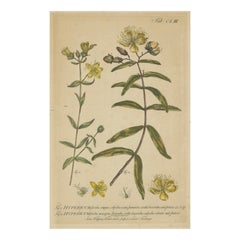
Exquisite 1755 St. John's Wort Botanical Engraving by Philip Miller

Exquisite 1755 St. John's Wort Botanical Engraving by Philip Miller

Located in Langweer, NL

A copper engraving of Hypericum plants, commonly known as St. John's Wort, from Philip Miller's influential work, *Figures of the Most Beautiful, Useful and Uncommon Plants Described...

Category

Antique 1750s Prints

Materials

Paper

Early 19th Century Botanical Engraving by John Curtis

Early 19th Century Botanical Engraving by John Curtis

Located in Seaford, GB

Early 19th Century Botanical Engraving by John Curtis – Hand Coloured Natural History Plate An original early 19th-century hand-coloured botanical engraving from the celebrated natural history publications of John Curtis (1791–1862), one of Britain’s most respected botanical and entomological illustrators. This beautifully detailed plate illustrates a flowering plant in scientific profile, showing bloom structure, leaves, buds, and root system with precision typical of early Victorian natural history illustration. Curtis’s work bridges science and art — created for study, yet prized today for its elegance and balance. These engravings formed part of the golden age of British botanical publishing, when artists collaborated with engravers and colourists to produce plates that were both accurate and visually refined. Each impression was printed from an engraved plate and then carefully coloured by hand, meaning no two examples are ever exactly identical. The composition has the clarity collectors seek: • Central botanical specimen • Naturalistic colour palette • Fine line engraving • Period scientific titling This makes it ideal as a single framed piece or as part of a gallery wall of antique botanical studies. About John Curtis John Curtis was a leading figure in British natural history illustration. He is best known for British Entomology and botanical works that combined taxonomic accuracy with graceful composition. His engravings are held in major museum collections and remain highly collectable in the decorative arts market. Period Early 19th century, circa 1820–1840. Technique Copperplate engraving with original hand colouring on laid paper. Condition Good antique condition consistent with age. Light toning and minor handling marks may be present, as expected with early 19th-century works on paper. Please see the images. Why Collect Curtis Botanical Prints...

Category

Antique Early 19th Century British George III Prints

Materials

Paper

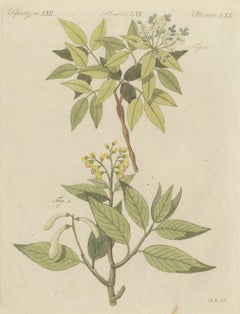
Two Flowering Tree Branches, Antique Bertuch Print, circa 1805

Two Flowering Tree Branches, Antique Bertuch Print, circa 1805

Located in Langweer, NL

This antique botanical print comes from the Vienna edition of Bertuch's Bilderbuch and shows two flowering tree branches under the heading Pflanzen LXX, with the Vienna mark VI.B.37 ...

Category

Antique Early 19th Century Austrian Prints

Materials

Paper