Want more images or videos?
Request additional images or videos from the seller.

Two Flowering Tree Branches, Antique Bertuch Print, circa 1805

$204.65
£153.20
€180VAT Included
CA$288.83
A$297.80
CHF 167.91
MX$3,811.64
NOK 1,935.95
SEK 2,024.89
DKK 1,372.88

About the Item

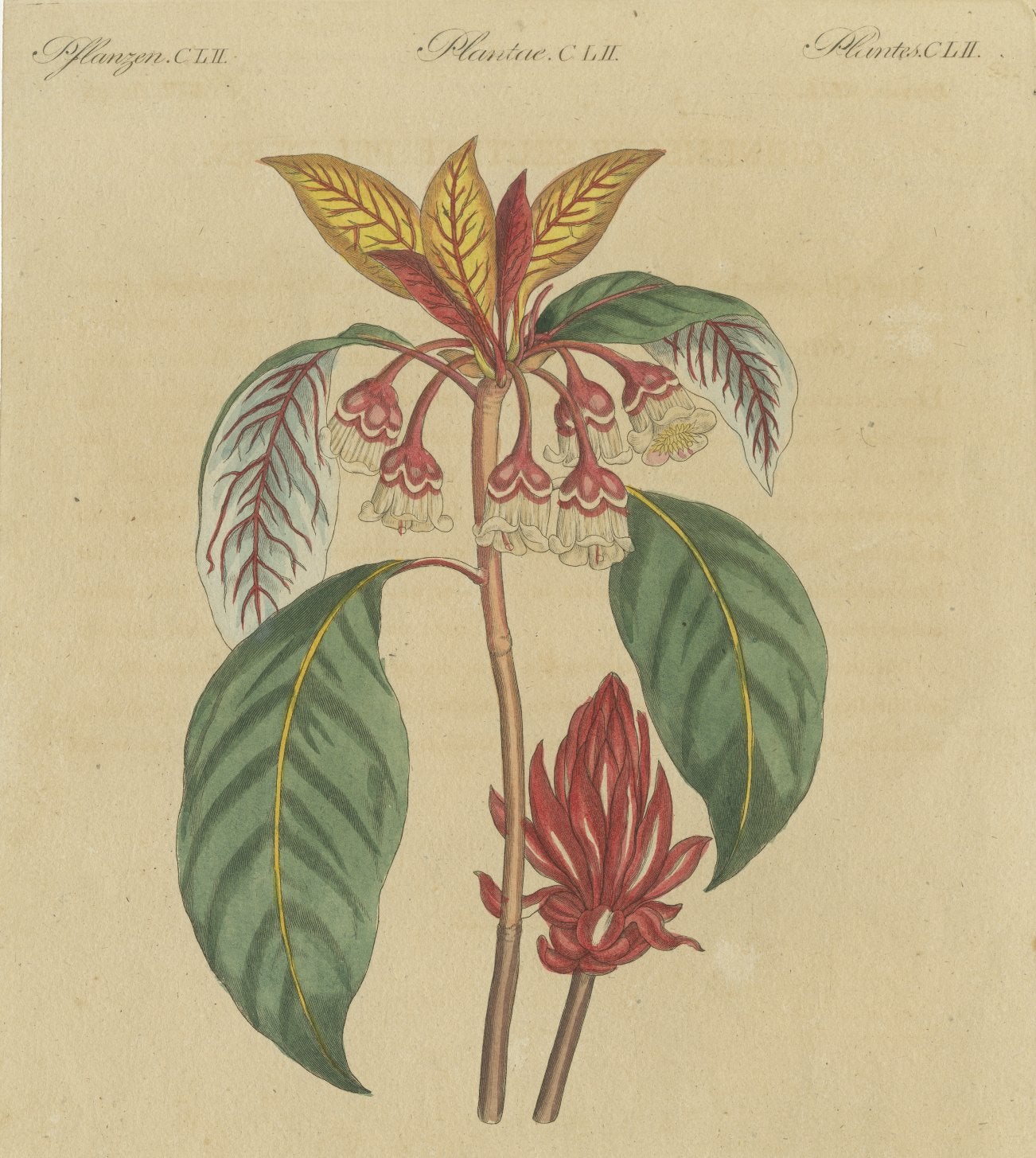
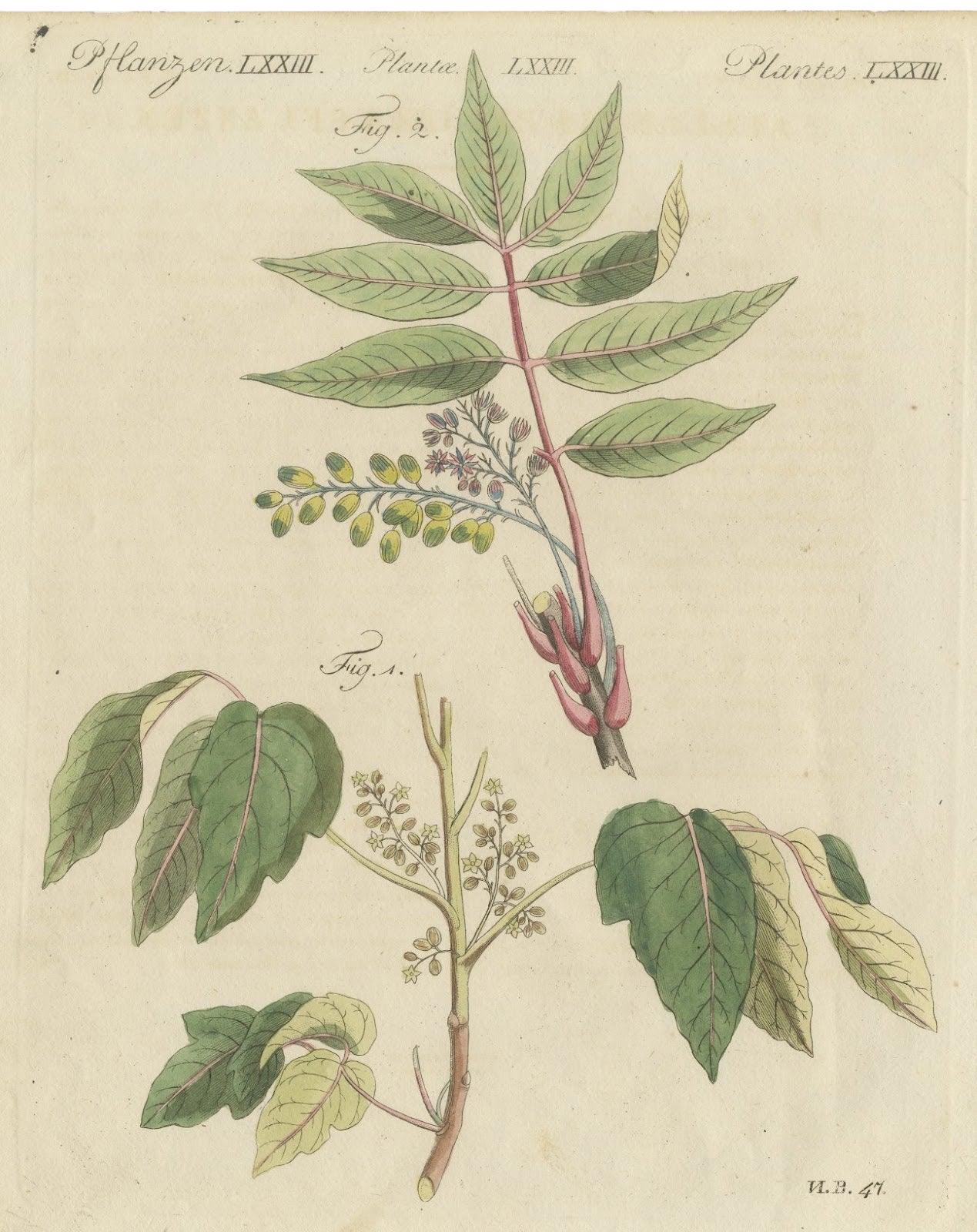
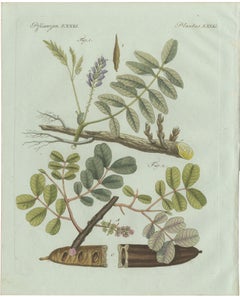
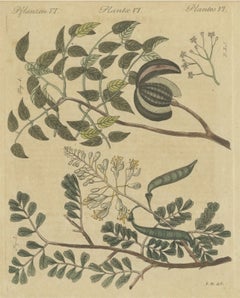
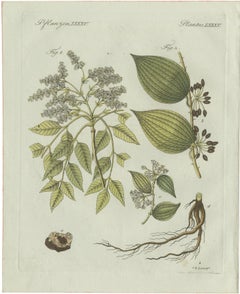
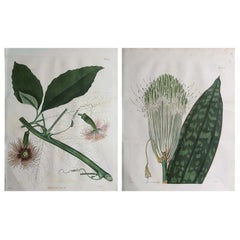
This antique botanical print comes from the Vienna edition of Bertuch's Bilderbuch and shows two flowering tree branches under the heading Pflanzen LXX, with the Vienna mark VI.B.37 at lower right. The specific plants are not yet established and are described here only from what the plate shows. Figure 1 is a branch with toothed, pointed leaves, a spray of small yellow flowers with red stamens, and a pair of pale elongated winged fruits. Figure 2 is a branch with smooth pinnate leaves and a rounded head of small white flowers among bluish berries. The companion text leaf that would name them is not present, and the identification will be confirmed before the plate is offered. Friedrich Justin Bertuch (1747 to 1822) began his Bilderbuch fuer Kinder in Weimar in 1790 as a picture encyclopaedia for young readers, and over four decades it grew to almost 1,200 plates on plants, animals, peoples, antiquities and the sciences. Its success led to other editions, and this sheet comes from the Vienna edition published by Anton Pichler as the Bilderbuch zum Nutzen und Vergnuegen der Jugend, with text in German and French. The Vienna plates were newly engraved after the Weimar originals, keep the Weimar subject numbering in a heading in German, Latin and French, and carry a volume and plate number in the lower margin, here the mark VI.B.37. Vienna volume VI follows Weimar volume III, which appeared in 1798, so this plate was published no earlier than that. The plate is a copper engraving with original hand colour, as the Vienna volumes were issued coloured. A plate like this suits a kitchen, study or garden room, and it hangs well in a group with other Bertuch botanical sheets of the same size. For a collector it is also a neat example of how the Bilderbuch travelled beyond Weimar in the years around 1800. The sheet is in good condition for its age, with light toning, a small stain in the lower margin and minor wear at the right edge; the image is clean and fresh. This is an original antique print, not a modern reproduction. This item is sold unframed. Any framed or interior images are shown for presentation and inspiration only, unless the listing explicitly states that the item is sold framed.
  • Dimensions:
    Height: 9.85 in (25 cm)Width: 7.88 in (20 cm)
  • Materials and Techniques:
    Paper,Engraved
  • Place of Origin:
  • Period:
  • Date of Manufacture:
    1801
  • Condition:
    Good condition for its age. Light toning; a small brown stain in the lower margin, minor wear and a small nick at the right edge, and a faint pencil note.
  • Seller Location:
    Langweer, NL
  • Reference Number:
    Seller: BG-14336-61stDibs: LU3054352218552

More From This Seller

View All
Original Antique Botanical Print of Rubber and Gum Arabic Trees by Bertuch, 1802

Original Antique Botanical Print of Rubber and Gum Arabic Trees by Bertuch, 1802

Located in Langweer, NL

Original Antique Botanical Print of Rubber and Gum Arabic Trees by Bertuch, 1802 Original antique hand-colored copper engraving depicting two economically important tropical trees, ...

Category

Antique Early 19th Century German Neoclassical Prints

Materials

Paper

Mahogany Tree and Logwood, Antique Bertuch Print, circa 1805

Mahogany Tree and Logwood, Antique Bertuch Print, circa 1805

Located in Langweer, NL

This antique botanical print from Bertuch's Bilderbuch shows the mahogany tree and logwood, two West Indian trees prized in Europe for cabinet wood and dye. The heading reads Pflanze...

Category

Antique Early 19th Century Austrian Prints

Materials

Paper

Flowering Shrub with Red Blossom, Antique Bertuch Print, circa 1815

Flowering Shrub with Red Blossom, Antique Bertuch Print, circa 1815

Located in Langweer, NL

This antique botanical print comes from the Vienna edition of Bertuch's Bilderbuch and shows a flowering shrub under the heading Pflanzen CLII, with the Vienna mark XVI B 39. The pla...

Category

Antique Early 19th Century Austrian Biedermeier Prints

Materials

Paper

Tamarind and Pistachio Nut Tree, Antique Bertuch Print, circa 1805

Tamarind and Pistachio Nut Tree, Antique Bertuch Print, circa 1805

Located in Langweer, NL

This antique botanical print from Bertuch's Bilderbuch shows the tamarind and the pistachio, two trees grown for their edible pods and nuts. The heading reads Pflanzen XVIII and the ...

Category

Antique Early 19th Century Austrian Prints

Materials

Paper

Original Antique Botanical Print of Licorice and Carob by Bertuch, 1805

Original Antique Botanical Print of Licorice and Carob by Bertuch, 1805

Located in Langweer, NL

Original Antique Botanical Print of Licorice and Carob by Bertuch, 1805 Original antique hand-colored copper engraving depicting two historically important useful plants, Licorice a...

Category

Antique Early 19th Century German Neoclassical Prints

Materials

Paper

Manna Ash and Sarsaparilla Medicinal Plants, Antique Bertuch Print, circa 1805

Manna Ash and Sarsaparilla Medicinal Plants, Antique Bertuch Print, circa 1805

Located in Langweer, NL

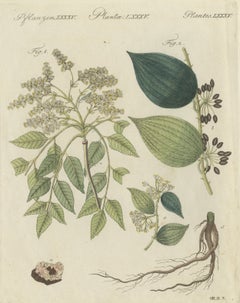
This antique botanical print from Bertuch's Bilderbuch shows two medicinal plants of the old apothecary, the manna ash and sarsaparilla. The heading reads Pflanzen LXXXV and the plate carries the Vienna mark VIII.B.3 in the lower margin. Figure 1 is read as the manna ash, Fraxinus ornus, a branch with toothed pinnate leaves and dense sprays of creamy flowers, with a lump of the sweet dried sap, called manna, drawn at the foot as item a. Figure 2 is a sarsaparilla, Smilax, with a prickly climbing stem, broad heart shaped leaves with curved veins, clusters of dark berries, a flowering shoot and the long root used in medicine. Both drugs were imported in quantity around 1800, manna from Calabria and Sicily and sarsaparilla from Central and South America, and the plate shows children the living plants behind the jars on the apothecary shelf...

Category

Antique Early 19th Century Austrian Prints

Materials

Paper

You May Also Like

Early 19th Century Botanical Engraving by John Curtis

Early 19th Century Botanical Engraving by John Curtis

Located in Seaford, GB

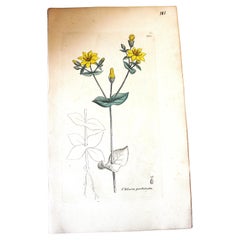
Early 19th Century Botanical Engraving by John Curtis – Hand Coloured Natural History Plate An original early 19th-century hand-coloured botanical engraving from the celebrated natural history publications of John Curtis (1791–1862), one of Britain’s most respected botanical and entomological illustrators. This beautifully detailed plate illustrates a flowering plant in scientific profile, showing bloom structure, leaves, buds, and root system with precision typical of early Victorian natural history illustration. Curtis’s work bridges science and art — created for study, yet prized today for its elegance and balance. These engravings formed part of the golden age of British botanical publishing, when artists collaborated with engravers and colourists to produce plates that were both accurate and visually refined. Each impression was printed from an engraved plate and then carefully coloured by hand, meaning no two examples are ever exactly identical. The composition has the clarity collectors seek: • Central botanical specimen • Naturalistic colour palette • Fine line engraving • Period scientific titling This makes it ideal as a single framed piece or as part of a gallery wall of antique botanical studies. About John Curtis John Curtis was a leading figure in British natural history illustration. He is best known for British Entomology and botanical works that combined taxonomic accuracy with graceful composition. His engravings are held in major museum collections and remain highly collectable in the decorative arts market. Period Early 19th century, circa 1820–1840. Technique Copperplate engraving with original hand colouring on laid paper. Condition Good antique condition consistent with age. Light toning and minor handling marks may be present, as expected with early 19th-century works on paper. Please see the images. Why Collect Curtis Botanical Prints...

Category

Antique Early 19th Century British George III Prints

Materials

Paper

Lemon, botanical flower engraving with original hand-colouring, 1816

Lemon, botanical flower engraving with original hand-colouring, 1816

Located in Melbourne, Victoria

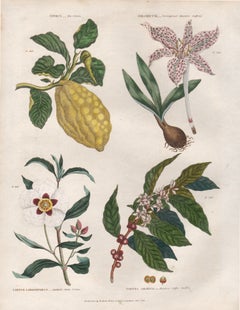
'Citrus, Colchium, Cistus Ladaniferus, Coffea Arabica' English botanical engraving with original hand-colouring. 1816 From Thomas Green's 'Universal Herbal, or Botanical, Medical, ...

Category

1810s Other Art Style Still-life Prints

Materials

Engraving

Pair of Large Scale Original Antique Botanical Prints. Curtis. Dated 1826

Pair of Large Scale Original Antique Botanical Prints. Curtis. Dated 1826

Located in St Annes, Lancashire

Wonderful pair of botanical prints Lithographs after drawings by Curtis Original hand color Published by S.Curtis. Dated 1826 Unframed. Free shipping

Category

Antique 1820s English Georgian Prints

Materials

Paper

Early 19th Century Botanical Engraving by John Curtis

Early 19th Century Botanical Engraving by John Curtis

Located in Seaford, GB

Early 19th Century Botanical Engraving by John Curtis – Hand Coloured Natural History Plate An original early 19th-century hand-coloured botanical engraving from the celebrated natural history publications of John Curtis (1791–1862), one of Britain’s most respected botanical and entomological illustrators. This beautifully detailed plate illustrates a flowering plant in scientific profile, showing bloom structure, leaves, buds, and root system with precision typical of early Victorian natural history illustration. Curtis’s work bridges science and art — created for study, yet prized today for its elegance and balance. These engravings formed part of the golden age of British botanical publishing, when artists collaborated with engravers and colourists to produce plates that were both accurate and visually refined. Each impression was printed from an engraved plate and then carefully coloured by hand, meaning no two examples are ever exactly identical. The composition has the clarity collectors seek: • Central botanical specimen • Naturalistic colour palette • Fine line engraving • Period scientific titling This makes it ideal as a single framed piece or as part of a gallery wall of antique botanical studies. About John Curtis John Curtis was a leading figure in British natural history illustration. He is best known for British Entomology and botanical works that combined taxonomic accuracy with graceful composition. His engravings are held in major museum collections and remain highly collectible in the decorative arts market. Period Early 19th century, circa 1820–1840. Technique Copperplate engraving with original hand colouring on laid paper. Condition Good antique condition consistent with age. Light toning and minor handling marks may be present, as expected with early 19th-century works on paper. Please see the images. Why Collect Curtis Botanical Prints...

Category

Antique Early 19th Century British George III Prints

Materials

Paper

The Oleaceae - Lithograph by Vincenzo Tenore - 1870s

The Oleaceae - Lithograph by Vincenzo Tenore - 1870s

By Vincenzo Tenore

Located in Roma, IT

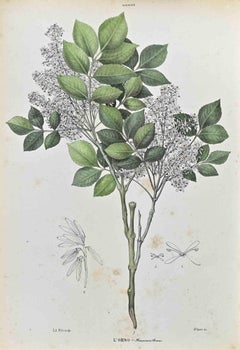
Lithograph hand watercolored. Plate from "Atlante di Botanica popolare ossia Illustrazione di Piante Notevoli di ogni famiglia" (Atlas of popular botany or illustration of notable p...

Category

1870s Modern Figurative Prints

Materials

Lithograph

Flowering Cotton Plant: 18th Century Hand-colored Weinmann Botanical Engraving

Flowering Cotton Plant: 18th Century Hand-colored Weinmann Botanical Engraving

By Johann Wilhelm Weinmann

Located in Alamo, CA

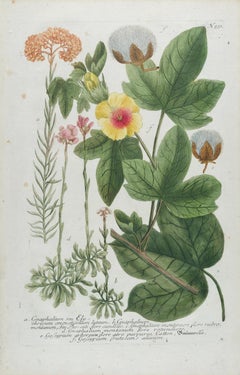
This striking hand-colored botanical mezzotint and line engraving is entitled "Gnaphalium, Gossypium (Cotton Plant)". It is plate 551 in Johann Weinmann's monumental publication "Phy...

Category

Mid-18th Century Naturalistic Still-life Prints

Materials

Engraving, Mezzotint