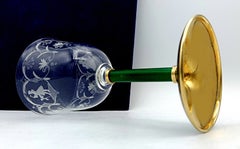
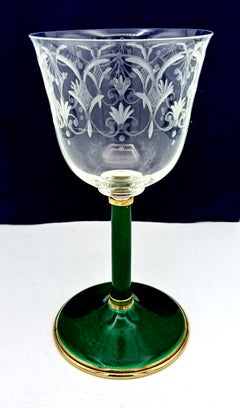
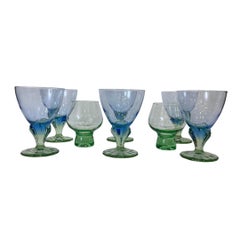
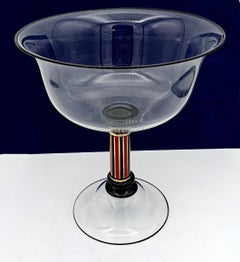
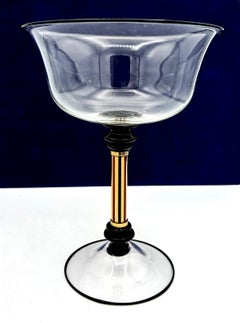
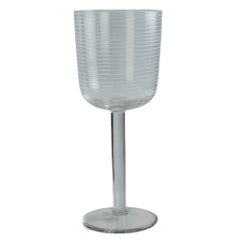
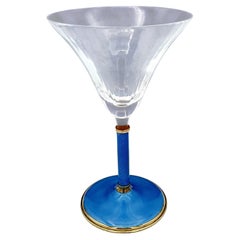
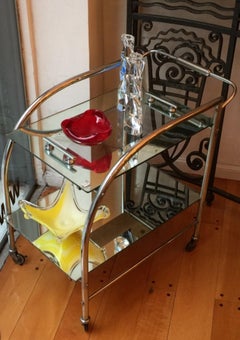
Murano, 1930, Italian. Attributed to Paolo Venini Technique Pulegoso
By Paolo Venini
Located in Ciudad Autónoma Buenos Aires, C
Technique Bullicante
Controlled and symmetrical bubbles.
The glass remains completely transparent, but inside it houses uniform and perfectly aligned rows of bubbles (a grid or three-dimensional pattern). It offers a deep sense of symmetry and optical order.
It is a purely mechanical and artisanal process. The molten glass is pressed firmly into a metal mold that has spikes or points
carved in relief. These points leave small holes in the glass. Immediately after, that piece is submerged in a new layer of liquid glass. By covering the piece, the air trapped in the holes cannot escape and is sealed like a perfect bubble. The process can be repeated several times to create multiple layers of symmetrical bubbles.
It gained strong popularity in the 1930s thanks to the master Archimede Seguso.
Scalloped Ribs / Fluted Rims / Scalloped Edges
• Description:
The wavy, scalloped outer edges or "fins" running along the sides of the piece.
• Technique:
While the glass is still hot and malleable, the artisan applies additional glass ribbons and sequentially pinches them with hand pliers to create that sculptural, serrated crest or lace-like edge.
Venini ( Technique Pulegoso )
Pulegoso technique A type of glass characterized by countless irregular air bubbles (pulighe) within the vitreous wall, which deliberately obscure its transparency. It is obtained by pouring substances such as petrol into the pot, which produce a boiling over of the glass in fusion.
Attributed to Venini
Early life and education
Venini was born in the town of Cusano near Milan, Italy. After serving in the Royal Italian Army in World War I, he trained as a lawyer and began his practice in Milan. He soon developed an acquaintance with Giacomo Cappellin, a native of Venice who owned a Milan antiques...
Category
1930s Art Deco Vintage Italian Crystal Serveware