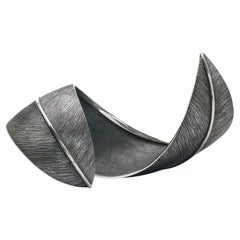
Square Leaves Bracelet in Sterling Silver by Kirsten Muenster Jewelry.
Dimensions: W 6 x H 2 cm.
Materials: Sterling silver with silky brushed finish; smooth high-polished edges
Sizing: Standard wrist or upper arm
The unique shape of the Square Leaves Bracelet makes it feel like wearing a small sculpture. Organic, plump, and substantial, each angle of the piece reveals a different carving of elegantly rendered leaves dripping with dew. The brushed finish carries a silky texture, while the smooth, high-polished edges add striking contrast.
Cast in sterling silver using the lost-wax method, the bracelet begins as a wax model hand-carved at the bench. The square shape works two ways: low on the wrist like a bangle, or pushed up onto the arm where the square form feels secure and comfortable. Kirsten wears hers as an upper arm piece when writing or typing, since it does not move around or push against the wrist.
Kirsten's sculptural jewelry is known for its hand-carved Organic Architecture, where the structural mass of Brutalism meets the asymmetry and slow weathering of the natural world. Every piece begins as a wax carved by hand in her San Francisco studio, then cast in bronze, silver, or gold through the lost-wax process. No CAD. No shared catalog of parts. No two stones alike.
Stones are sourced for their unusual inclusions, color and cut rather than carat or clarity. Patinas continue to evolve with age. The work is a celebration of nature coupled with a commitment to originality. Pieces are produced one of a kind or in small runs, and for galleries and design rooms, the work reads as object before accessory.
About the artist
Kirsten Muenster's unusual statement pieces blur the line between jewelry, sculpture, and object. Working in her San Francisco studio, she hand-carves in wax and casts in bronze, silver, and 10k gold using the lost-wax method. Made in limited editions or one-of-a-kind, each piece is hand finished and signed by the artist.
A fourth-generation metalsmith, Muenster works from a single underlying logic she terms Organic Architecture, finding the same structural sense in pods, seedheads, and plant systems as in Brutalist buildings, and translating both into original abstracted forms rather than literal castings. The work draws on wabi-sabi principles: imperfection, asymmetry, the trace of process, and slow-design principles.