Want more images or videos?
Request additional images or videos from the seller.

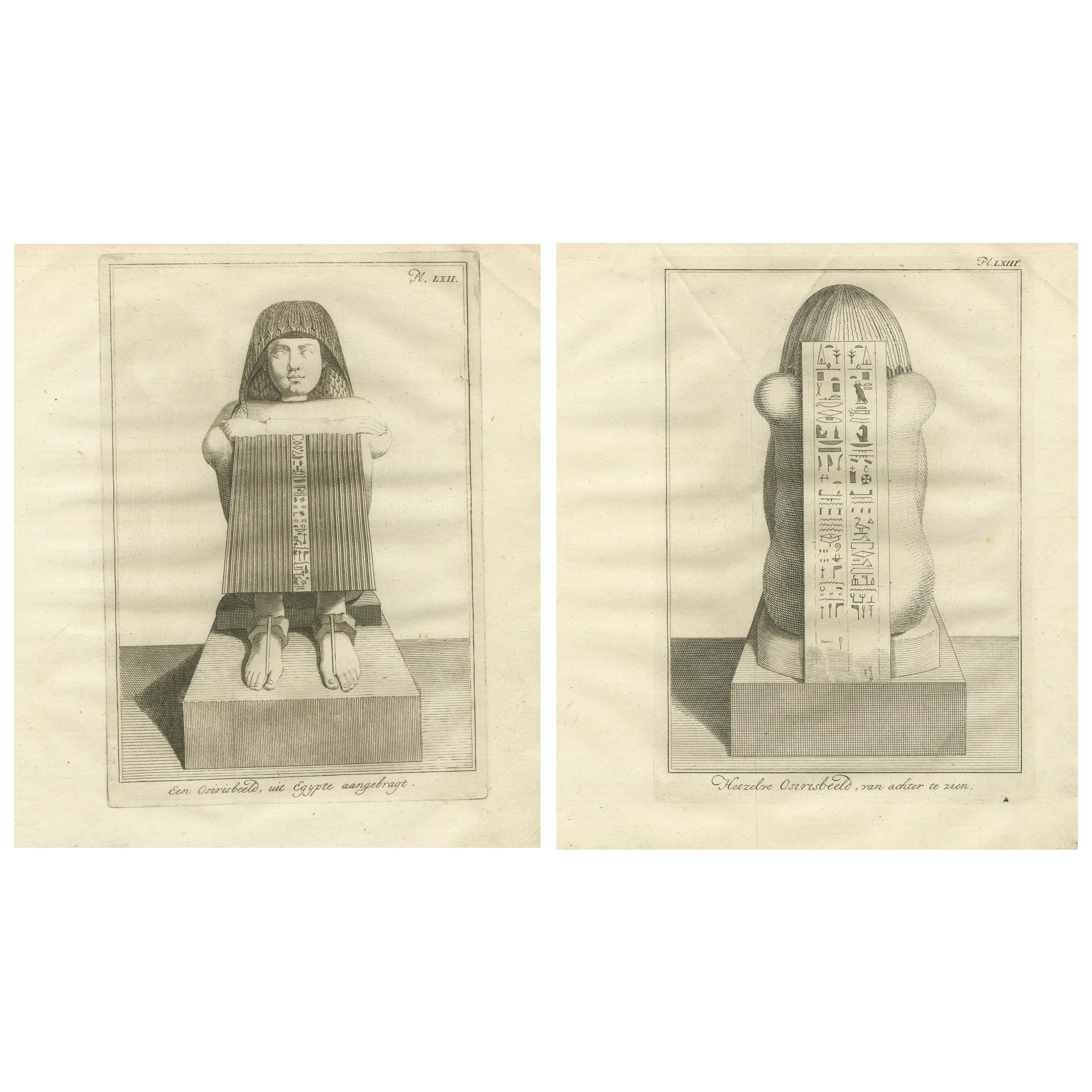
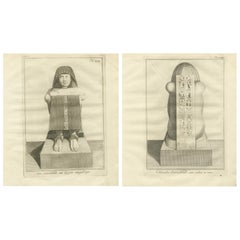
Egyptian Seated Scribe Statue with Hieroglyphs – Front and Profile Views, c.1776

$330.57per set
£246.83per set
€290per setVAT Included
CA$462.26per set
A$470.71per set
CHF 272.37per set
MX$6,207.04per set
NOK 3,045.58per set
SEK 3,242.67per set
DKK 2,210.73per set

About the Item

Egyptian Seated Scribe Statue with Hieroglyphs – Front and Profile Views This pair of antique engravings depicts a striking Egyptian statue of a seated figure, likely a scribe or priest, shown from both the front and the side. The artwork captures the ancient tradition of sculpting high-ranking individuals in a contemplative, seated pose with knees drawn up and arms resting across them—a form commonly found in Late Period and Ptolemaic Egyptian statuary. In the left plate (Pl. LXIX), the front view shows a figure seated in a tightly compacted pose, arms folded over the knees. The body is partially enclosed by a curved tablet or sarcophagus surface inscribed with dense hieroglyphic text. The figure wears a tripartite wig, and the serene facial expression, combined with the precision of the hieroglyphs, evokes the devotional and administrative role such figures often held in temple or tomb settings. This form is typical of so-called "cube statues," which were designed for placement in shrines and served both commemorative and ritual purposes. The right plate (Pl. LXXI) offers a side view of the same sculpture, giving insight into the three-dimensional form and sculptural depth. The careful rendering of the wig's stylized strands and the compact body form demonstrates the engraver's attention to detail and fidelity to the original artifact. The bare back and sculpted limbs reflect both naturalism and symbolism—the seated posture communicates both humility and vigilance in the presence of the gods. These engravings originate from an 18th-century Dutch publication devoted to the monuments and antiquities of Egypt. The inscription in Dutch beneath the prints reads: “Een Isisbeeld uit Egypte aangebragt, van voren te zien” (An Isis statue brought from Egypt, seen from the front) and “Een Isisbeeld uit Egypte aangebragt van de zijde en van achter te zien” (An Isis statue brought from Egypt, seen from the side and behind), indicating the figure was believed to represent the goddess Isis, although the iconography more closely resembles a priest or high-ranking official. Condition: Very good condition for the age. Strong impression and clean paper with only minor age-toning. Small edge wrinkles and minor spotting, mostly in the margins. Folding line as issued. Please examine the images carefully. Framing Tips: This pair would be ideal for side-by-side display in matching black or giltwood frames with a wide off-white or ivory mat. This will highlight the symmetrical composition and scholarly character of the engravings. Technique: Engraving Maker: Anonymous, Dutch, circa 1750–1770
  • Dimensions:
    Height: 10.75 in (27.3 cm)Width: 9.85 in (25 cm)Depth: 0.01 in (0.2 mm)
  • Sold As:
    Set of 2
  • Materials and Techniques:
    Paper,Engraved
  • Place of Origin:
  • Period:
  • Date of Manufacture:
    1776
  • Condition:
    Condition: Very good condition for the age. Strong impression and clean paper with only minor age-toning. Small edge wrinkles and minor spotting, mostly in the margins. Folding line as issued. Please examine the images carefully.
  • Seller Location:
    Langweer, NL
  • Reference Number:
    Seller: BG-14102-42, -431stDibs: LU3054346049742

More From This Seller

View All
Egyptian Shabti Figurine Depicted from Three Angles, c.1776

Egyptian Shabti Figurine Depicted from Three Angles, c.1776

Located in Langweer, NL

Egyptian Shabti Figurine Depicted from Three Angles, c.1776 This antique engraving, Plate LXXVI, presents a detailed study of an ancient Egyptian shab...

Category

Antique Late 18th Century Dutch Prints

Materials

Paper

Bust of Egyptian Pharaoh Osymandias, Thebes – Front and Rear Views, c.1776

Bust of Egyptian Pharaoh Osymandias, Thebes – Front and Rear Views, c.1776

Located in Langweer, NL

Bust of Egyptian Pharaoh Osymandias, Thebes – Front and Rear Views, c.1776 Description: This antique engraving features the upper portion of a colossal statue identified as Osymandi...

Category

Antique Late 18th Century Dutch Prints

Materials

Paper

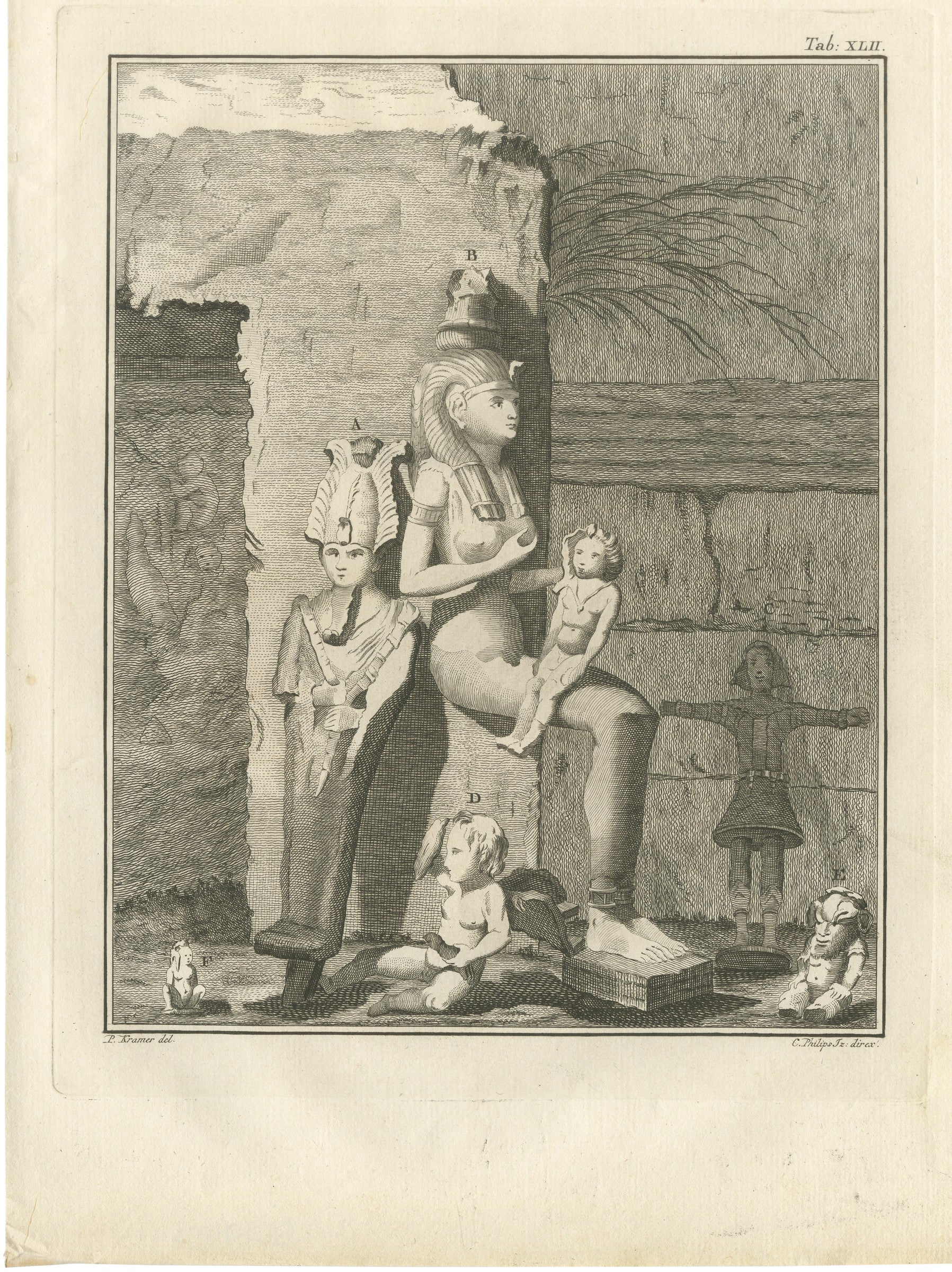
Ancient Egyptian Statues and Figures, Antique Niebuhr Print, 1776

Ancient Egyptian Statues and Figures, Antique Niebuhr Print, 1776

Located in Langweer, NL

This is an original antique copper engraving from 1776, plate XLII of the first volume of Carsten Niebuhr's Voyage en Arabie. The plate prints no caption; it shows a group of statues...

Category

Antique Late 18th Century Dutch Prints

Materials

Paper

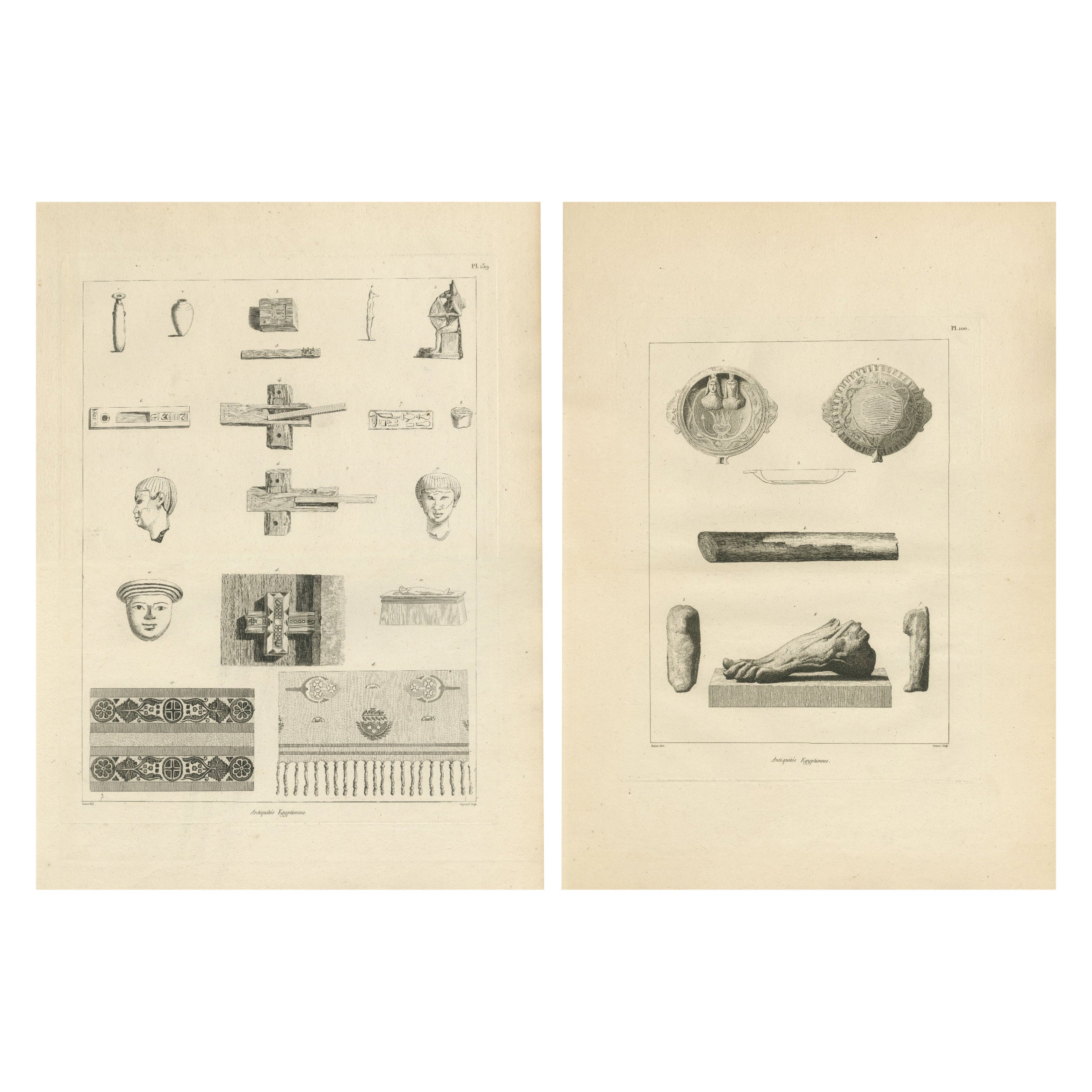
Napoleon’s Egypt: Ancient Artefacts and Sculptural Fragments, 2 Engravings, 1802

Napoleon’s Egypt: Ancient Artefacts and Sculptural Fragments, 2 Engravings, 1802

Located in Langweer, NL

Egyptian Antiquities – Objects, Reliefs and Sculptural Fragments, Set of Two Engravings, c.1802 This curated set of two finely engraved plates presents a systematic visual survey of...

Category

Antique Early 19th Century French Prints

Materials

Paper

You May Also Like

Ancient Roman Statue - Original Etching by  G.Furlanetti - 18th Century

Ancient Roman Statue - Original Etching by G.Furlanetti - 18th Century

Located in Roma, IT

Ancient Roman Statue, from the series "Antiquities of Herculaneum", is an original etching on paper realized by G.Furlanetti in the 18th century. Signed on the plate on the lower ri...

Category

18th Century Old Masters Figurative Prints

Materials

Etching

Grand Tour Statue of Pharaoh Hatshepsut After the Ancient Model

Grand Tour Statue of Pharaoh Hatshepsut After the Ancient Model

Located in Montreal, QC

Grand Tour statue of Pharaoh Hatshepsut after the ancient model. Hatshepsut was the fifth pharaoh of the Eighteenth Dynasty of Egypt and was the second historically confirmed female pharaoh, the first being Sobekneferu. The authentic ancient sculpture of Hatshepsut is located in Deir el-Bahri, Thebes, Egypt. Cast painted plaster. Provenance: The Collection of Charles de Beistegui, Château de Groussay. Charles de Beistegui (1894-1970), an enigmatic interior decorator whose passport was Spanish and whose wealth came from his family’s Mexican silver mines. Beistegui to indulge himself in the homes he decorated, such as his Chateau de Groussay...

Category

Antique Early 1900s Egyptian Egyptian Figurative Sculptures
Materials

Plaster

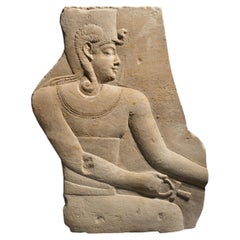
Ancient Egypt, Parietal relief with the enthroned figure of the god Harpocrates

Ancient Egypt, Parietal relief with the enthroned figure of the god Harpocrates

Located in BARCELONA, ES

Parietal relief of a temple or chapel with the enthroned figure of the god Harpocrates. Ptolemaic Period, 332 – 30 BC. Limestone 40 cm height Provenance - Private Collection, Mr....

Category

Antique 15th Century and Earlier Egyptian Egyptian Figurative Sculptures

Materials

Limestone

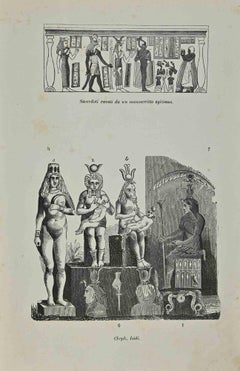
Uses and Customs - Egyptian Deities - Lithograph - 1862

Uses and Customs - Egyptian Deities - Lithograph - 1862

Located in Roma, IT

Uses and Customs - Egyptian Deities is a lithograph on paper realized in 1862. The artwork belongs to the Suite Uses and customs of all the peoples of the universe: " History of the...

Category

1860s Modern Figurative Prints

Materials

Lithograph

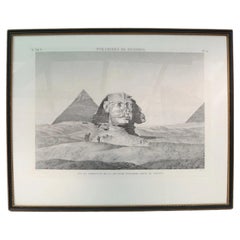
Chalcographie du Louvre Sphinx and Pyramid Engraving, Description de l'Égypte

Chalcographie du Louvre Sphinx and Pyramid Engraving, Description de l'Égypte

Located in Nottingham, GB

Finely rendered in deep intaglio line work, this large framed engraving presents the Great Sphinx of Giza rising from windblown sands, with the Second Pyramid towering in the distanc...

Category

Early 20th Century Prints

Materials

Glass, Wood, Paper

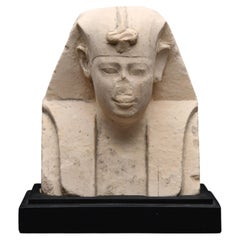
Ancient Egyptian Limestone Sculptor's Model, Early Ptolemaic Period

Ancient Egyptian Limestone Sculptor's Model, Early Ptolemaic Period

Located in Beverly Hills, CA

Heads of a king, like this one, became popular in the Late and Ptolemaic periods and may have been used as models for sculptors or votive offerings. In the form of a bust of a pharao...

Category

Antique 15th Century and Earlier Egyptian Egyptian Sculptures and Carvings

Materials

Limestone