
Want more images or videos?
Request additional images or videos from the seller.

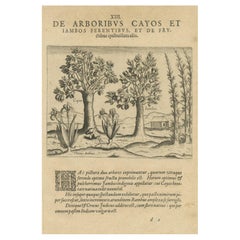
Cashew and Rose Apple Trees with Pepper and Crocus Indicus – de Bry, 1600

$205.62
£153.48
€180VAT Included
CA$287.39
A$292.58
CHF 169.39
MX$3,862.86
NOK 1,893.48
SEK 2,020.49
DKK 1,377.14

About the Item

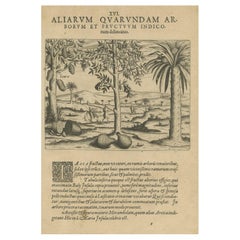
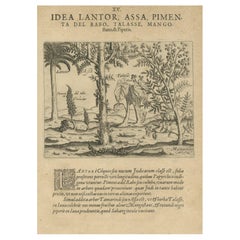
Cashew and Rose Apple Trees with Pepper and Crocus Indicus – de Bry, 1600 Exotic early engraving from Johann and Israel de Bry’s illustrated edition of Jan Huygen van Linschoten’s travel accounts, showing the tropical trees Cajus (Cashew tree) and Iambos (Rose Apple tree). To the right is a pepper plant climbing up bamboo canes, while in the foreground the Crocus Indicus is depicted. The detailed composition is accompanied by descriptive German text that highlights the value and beauty of these fruits and plants in India. This copper engraving was published in Frankfurt in 1600 by W. Richter as part of the monumental series “Vierder Theil der Orientalischen Indien.” De Bry’s series brought exotic landscapes, peoples, and flora to a European audience at the dawn of global exploration. These images, based on the accounts of Linschoten and other travelers, played a key role in shaping Europe’s understanding of the East Indies and their wealth of natural resources. The illustration not only reflects contemporary botanical curiosity but also the commercial significance of tropical plants. Pepper was one of the most coveted spices in the European market, while cashew and rose apple were admired both for their fruits and exotic origins. Prints like these combined visual appeal with educational purpose, serving as early records of species unfamiliar to most Europeans. Today, they are considered valuable works of both art and cultural history, representing the Age of Discovery’s blending of science, exploration, and trade. Condition report: Strong impression on laid paper. Minor toning and faint age browning in the margins, as usual. Plate mark clearly visible. Reverse blank. Framing tips: A dark wooden or ebony frame with a cream or ivory mount would emphasize the engraving’s historic detail. Alternatively, a green or muted red mount would highlight the botanical subject matter and bring out the exotic theme. Technique: Copper engraving Maker: Johann & Israel de Bry, Frankfurt am Main, 1600
  • Dimensions:
    Height: 9.06 in (23 cm)Width: 6.97 in (17.7 cm)Depth: 0 in (0.02 mm)
  • Materials and Techniques:
    Paper,Engraved
  • Place of Origin:
  • Period:
    1600-1609
  • Date of Manufacture:
    circa 1600
  • Condition:
    Condition report: Fair to Good. Strong impression on laid paper. A few creases, minor toning and faint age browning in the margins, as usual. Plate mark clearly visible. Reverse blank. Margins cut short.
  • Seller Location:
    Langweer, NL
  • Reference Number:
    Seller: BG-13748-1341stDibs: LU3054346299372

More From This Seller

View All
Exotic Flora of the Indies: The Cajus and Jambos Trees Copper Engraved in 1601

Exotic Flora of the Indies: The Cajus and Jambos Trees Copper Engraved in 1601

Located in Langweer, NL

Title: "Exotic Flora of the Indies: The Cajus and Jambos Trees in De Bry's 1601 Engraving" Description: This detailed engraving by Theodore de Bry, dating back to 1601, beautifully illustrates two tropical trees, the Cajus and the Jambos, both renowned for their delectable fruits in the regions of India. The Cajus tree, likely referring to what is known today as the cashew, is depicted with its distinctive fruit that dangles below the swollen pedicel, commonly called the cashew apple. The Jambos tree, with its lush, dense foliage and abundant fruiting, could be related to the rose apple, known for its fragrant, rose-scented fruit. Included in the scene is a depiction of the Indian Crocus, adding a touch of the diverse understory vegetation of the tropical climate. The image conveys a peaceful coexistence with nature, as indicated by a modest dwelling in the background, suggesting the integration of these trees into the daily lives of the local inhabitants for both nourishment and commerce. The text is in Latin, and here is the English translation: "In this picture, two trees are shown, each of which bears the most excellent and noble fruit. The best of these is called the Jambos, native to the region, which the inhabitants call Cayos. On this tree, nothing of note is bestowed. Moreover, this also represents a marvelous spectacle, in which the slow-growing cane bamboo surrounds itself. Finally, the Indian Crocus has been added, which blooms with its native flower; which is widespread throughout all of India." De Bry's engravings were pivotal in bringing the natural wealth of the New World and the East Indies to the European imagination. His work not only served as an artistic endeavor but also as an educational tool that fed the European appetite for knowledge about the vast diversity of the world's flora and fauna. This engraving, with its precision and attention to botanical detail, remains a significant historical record of the natural world as seen through the lens of the early modern European...

Category

Antique Early 17th Century Dutch Prints

Materials

Paper

Tropical Abundance: The Jackfruit and Palm Trees in De Bry's 1601 Engraving

Tropical Abundance: The Jackfruit and Palm Trees in De Bry's 1601 Engraving

Located in Langweer, NL

"Tropical Abundance: The Jackfruit and Palm Trees in De Bry's 1601 Engraving" Description: This remarkable 1601 engraving by Theodore de Bry illustrates the lush vegetation of India...

Category

Antique Early 17th Century Dutch Prints

Materials

Paper

Verdant Wonders: Exotic Trees and Spices of India in De Bry's 1601 Illustration

Verdant Wonders: Exotic Trees and Spices of India in De Bry's 1601 Illustration

Located in Langweer, NL

Title: "Verdant Wonders: Exotic Trees and Spices of India in De Bry's 1601 Illustration" Description: This striking 1601 engraving by Theodore de Bry, titled "IDEA LANTOR, ASSA, PIM...

Category

Antique Early 17th Century Dutch Prints

Materials

Paper

Spices of the Tropics: Cinnamon and Cassia in De Bry's 1601 Illustration

Spices of the Tropics: Cinnamon and Cassia in De Bry's 1601 Illustration

Located in Langweer, NL

Title: "Spices of the Tropics: Cinnamon and Cassia in De Bry's 1601 Illustration" Description: This 1601 engraving by Theodore de Bry offers a detailed look at the spice-bearing tre...

Category

Antique Early 17th Century Dutch Prints

Materials

Paper

De Bry Indian Botanical Engravings – Coconut, Bamboo & Cashew Trees, c.1598

De Bry Indian Botanical Engravings – Coconut, Bamboo & Cashew Trees, c.1598

Located in Langweer, NL

Set of Three De Bry Botanical Engravings of Indian Trees and Fruits, c.1598 – Coconut, Bamboo, and Cashew Description: A rare and beautifully matching set of three original copper e...

Category

Antique 16th Century German Prints

Materials

Paper

Botanical Marvels of India: Bamboo and Durian in De Bry's 1601 Copper Engraving

Botanical Marvels of India: Bamboo and Durian in De Bry's 1601 Copper Engraving

Located in Langweer, NL

This 1601 engraving by Theodore de Bry, a master engraver and publisher of the late Renaissance period, depicts the flora of India with a remarkable degree of detail and artistry. The print is titled "DE ALGA SEV ARVNDINE INDICA, BAMBVS DICTA, ITEM DE arbore radicosa: & tandem de arbore Duryeons," which translates to "About the Seaweed or Reed of India, called Bamboo, also about the root tree: and finally about the Duryeons tree." In the illustration, we see a lush depiction of a bamboo grove, with its characteristic tall and slender form, showcasing the plant's extensive root system and dense foliage. To the left, there is a tree bearing large, round fruits, likely the durian, labeled here as "Duryeons." The durian is known for its distinctive size, unique aroma, and spiky husk. The image captures both the exotic appeal and the utilitarian value of these plants, which were of great interest to European audiences unfamiliar with such tropical vegetation. The visual composition conveys the tropical abundance and biodiversity of the Indian subcontinent. De Bry's engravings like this were highly sought after in Europe for their exotic subject matter and served to educate and fascinate the European public about the natural wonders of the world beyond their borders. As a historical document, this engraving provides insight into the botanical knowledge and the artistic conventions of the period, making it a valuable piece for both its historical significance and its aesthetic beauty. De Bry's work is renowned for its attention to detail, and this print is a testament to his ability to capture the essence of exotic lands and their natural abundance. His engravings were among the first visual records to reach Europe from the New World and the East, fueling curiosity and fascination with distant lands. This particular piece is not only a work of art but also a historical document, offering insight into the botanical wealth of India as seen through the eyes of early modern Europeans...

Category

Antique Early 17th Century Dutch Prints

Materials

Paper

You May Also Like

Basilius Besler Botanical Engraving, Hortus Eystettensis, Early 17th Century

Basilius Besler Botanical Engraving, Hortus Eystettensis, Early 17th Century

By Basilius Besler

Located in Stockholm, SE

An original hand-colored botanical engraving from Basilius Besler’s Hortus Eystettensis, published in Nuremberg in 1613. Executed at the transition between Renaissance naturalism and...

Category

Antique 17th Century German Baroque Decorative Art

Materials

Paper