Want more images or videos?
Request additional images or videos from the seller.

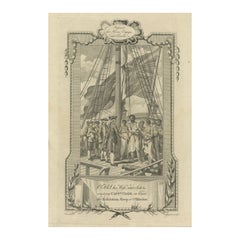
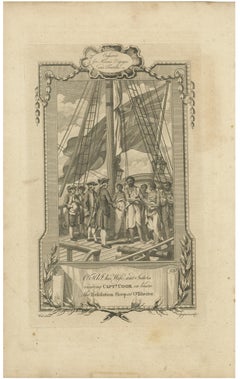
Captain Cook Tahiti Visit Engraving, Otaheite Natives, Pacific, c.1785

$239.89
£179.60
€211VAT Included
CA$338.64
A$349.14
CHF 196.67
MX$4,467.66
NOK 2,269.36
SEK 2,373.62
DKK 1,609.32

About the Item

Captain Cook Tahiti Visit Engraving, Otaheite Natives, Pacific, c.1785 This impressive late 18th-century copperplate engraving captures a historic encounter between Captain James Cook and the inhabitants of Tahiti, then known to Europeans as “O-Taheitee.” Titled “A Chief and other Natives of O-Taheitee, visiting Captn. Cook in his second Voyage to the Southern Hemisphere,” the scene presents a moment of diplomatic exchange aboard Cook’s ship during his celebrated second voyage (1772–1775). The composition is richly detailed and framed within an elaborate neoclassical cartouche. At its center, Cook is shown receiving Tahitian visitors on deck, surrounded by officers and crew, with the British flag prominently displayed above. The figures are carefully arranged to emphasize the ceremonial nature of the meeting, highlighting both curiosity and formality in these early cross-cultural encounters. The engraving is based on a design by Samuel Wale and executed by the accomplished engraver Charles Grignion, both prominent contributors to illustrated travel literature of the period. It was published in London circa 1782–1785 as part of Millar’s *New Complete Universal System of Geography*, a work that brought the discoveries of the Pacific voyages to a wide European audience eager for knowledge of newly encountered lands and peoples. Below the main scene, a decorative vignette of weapons, paddles, and ceremonial objects is arranged in a trophy-like composition, symbolizing European perceptions of Pacific Island cultures. This ornamental element enhances the print’s visual appeal while reinforcing its ethnographic character. The engraving belongs to a significant body of 18th-century exploration imagery that shaped European understanding of the Pacific. While rooted in observation, such works often combine documentary intent with artistic interpretation, resulting in compositions that are both historically informative and highly decorative. Please note that this original antique engraving is offered unframed. As a wall piece, this engraving offers strong visual presence. The vertical composition, refined line work, and ornate border make it particularly suitable for classic interiors, libraries, or globally inspired spaces. It pairs beautifully with other prints related to Captain Cook, Pacific exploration, or ethnographic subjects. Condition: Fair condition for its age, with age-related toning, scattered spotting, and some wear and small losses to the margins, particularly at the edges. The image itself remains clear with a strong impression. Plate mark visible. Framing tips: Best presented with a generous ivory mat to isolate the engraved image and decorative border. A dark walnut or ebonized frame will enhance contrast and lend a refined, museum-quality appearance. Technique: Copperplate engraving Maker: Charles Grignion (after Samuel Wale), London, circa 1782–1785 Please note that this original antique engraving is offered unframed.
  • Dimensions:
    Height: 14.57 in (37 cm)Width: 9.06 in (23 cm)Depth: 0.01 in (0.2 mm)
  • Materials and Techniques:
    Paper,Engraved
  • Place of Origin:
  • Period:
  • Date of Manufacture:
    circa 1785
  • Condition:
    Fair condition for its age, with age-related toning, scattered spotting, and some wear and small losses to the margins, particularly at the edges. The image itself remains clear with a strong impression. Plate mark visible.
  • Seller Location:
    Langweer, NL
  • Reference Number:
    Seller: BG-13599-351stDibs: LU3054349258132

More From This Seller

View All
1778 Engraving: Captain Cook's Second Voyage - Meeting the Tahitians

1778 Engraving: Captain Cook's Second Voyage - Meeting the Tahitians

Located in Langweer, NL

1778 Engraving of Captain Cook's Second Voyage: Meeting Tahitians This beautiful copper-line engraving from 1778, created by Charles Grignion (1717-1810) after a work by Samuel Wale...

Category

Antique 1770s British Prints

Materials

Paper

O-Mai Visiting Captain Cook aboard the Resolution at Tahiti, 18th Century

O-Mai Visiting Captain Cook aboard the Resolution at Tahiti, 18th Century

Located in Langweer, NL

Title: O-Mai Visiting Captain Cook aboard the Resolution at Tahiti, 18th Century Description: This finely engraved 18th-century copperplate print depicts a diplomatic encounter betw...

Category

Antique Late 18th Century British Prints

Materials

Paper

Captain Cook Hawaii Engravings, Death & Royal Encounter, Owhyhee, c.1788

Captain Cook Hawaii Engravings, Death & Royal Encounter, Owhyhee, c.1788

Located in Langweer, NL

Captain Cook Hawaii Engravings, Death & Royal Encounter, Owhyhee, c.1788 This dramatic and historically significant late 18th-century engraving sheet presents two iconic scenes from...

Category

Antique Late 18th Century British Prints

Materials

Paper

Captain Cook Landing Tonga Engraving, Friendly Isles, Pacific, 1777

Captain Cook Landing Tonga Engraving, Friendly Isles, Pacific, 1777

Located in Langweer, NL

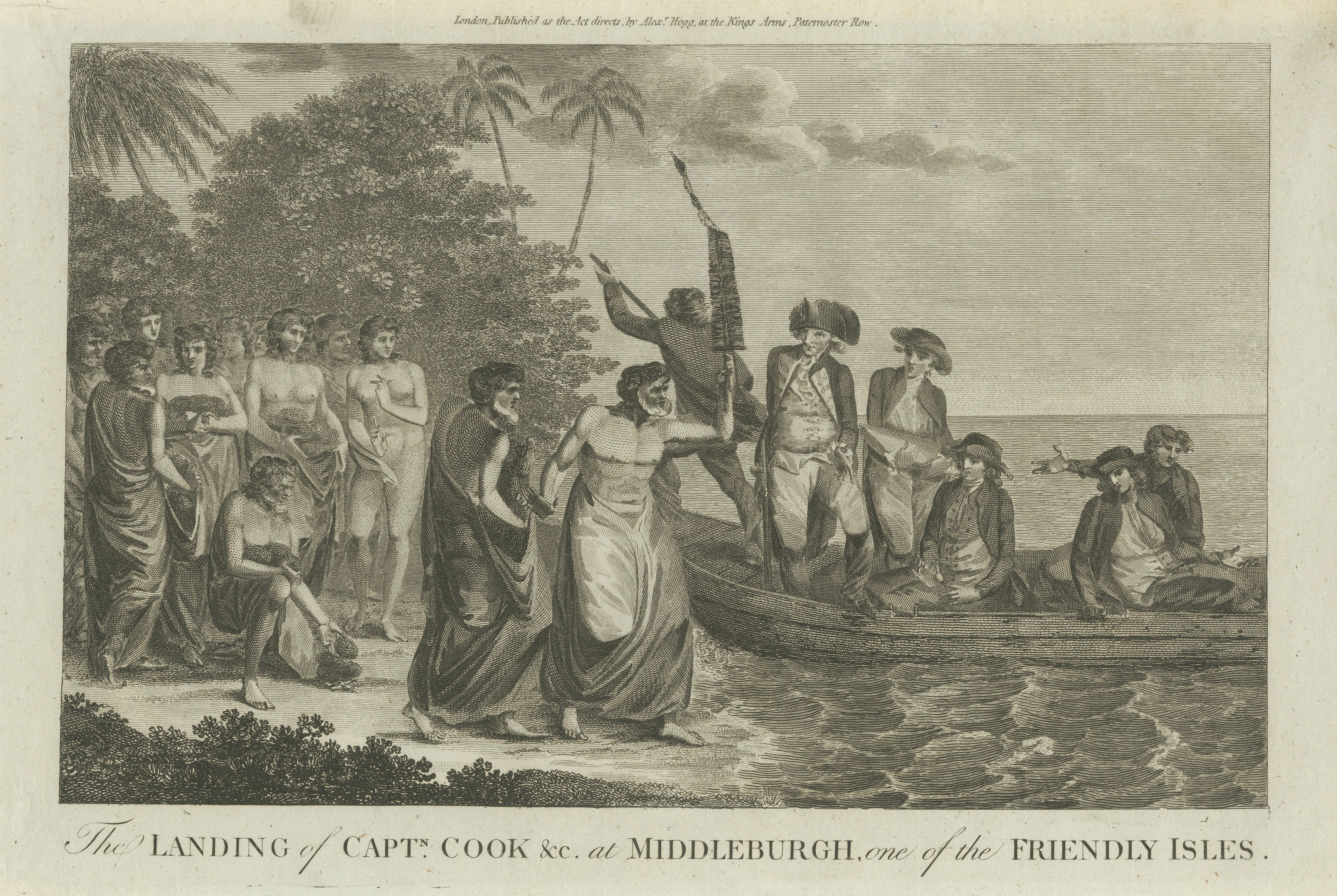
Captain Cook Landing Tonga Engraving, Friendly Isles, Pacific, 1777 This exceptional 18th-century copperplate engraving depicts the historic landing of Captain James Cook at Middleb...

Category

Antique Late 18th Century British Prints

Materials

Paper

Engraving of The Tragic Demise of Captain James Cook in 1779 in the South Seas

Engraving of The Tragic Demise of Captain James Cook in 1779 in the South Seas

Located in Langweer, NL

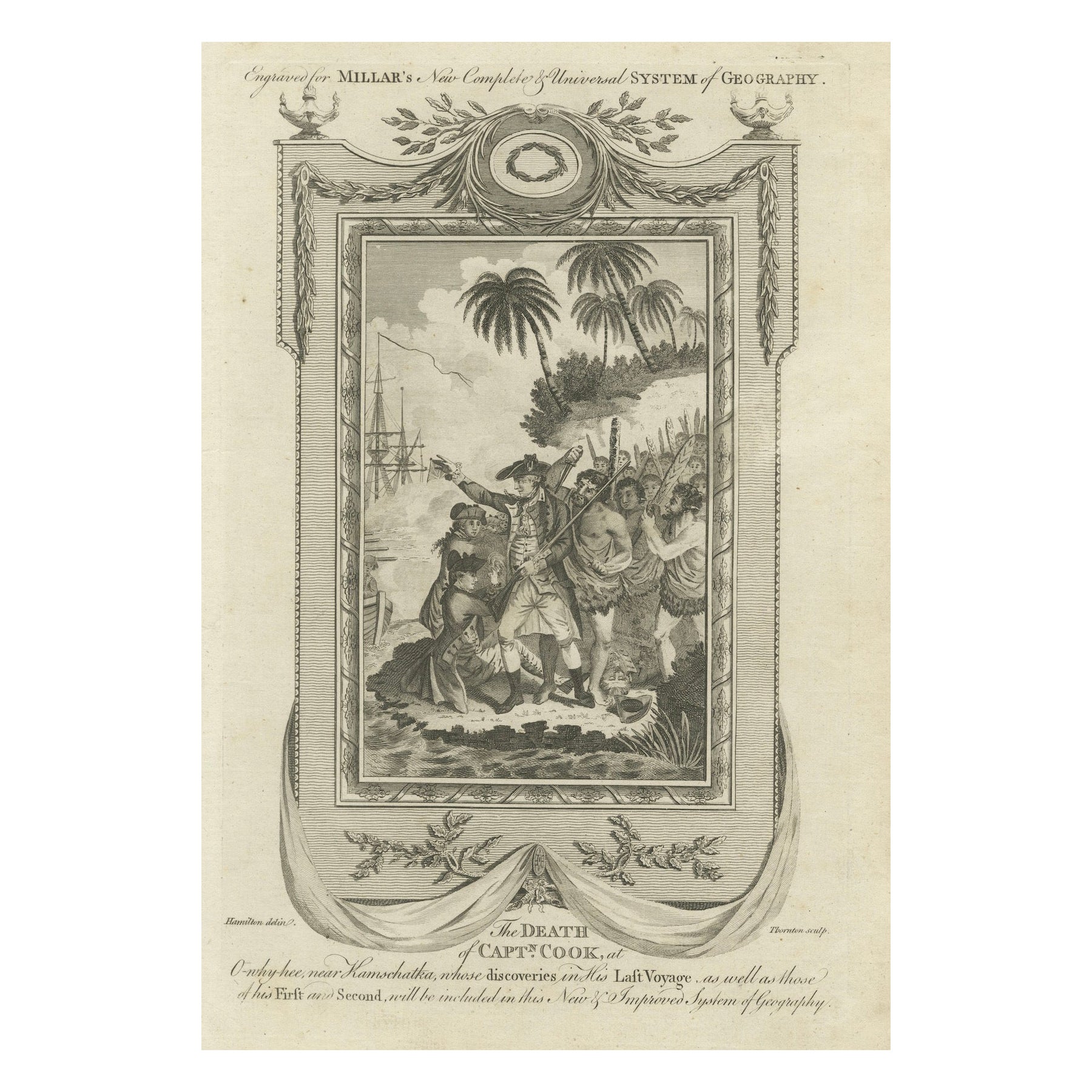
The engraving titled "The Death of Captn. Cook" depicts the dramatic and tragic event of Captain James Cook's death. This artwork is intricately framed with ornate borders and decora...

Category

Antique 1780s Prints

Materials

Paper

Encounters at Dawn: The Standoff at Tahiti with Captain Wallis Engraved, 1801

Encounters at Dawn: The Standoff at Tahiti with Captain Wallis Engraved, 1801

Located in Langweer, NL

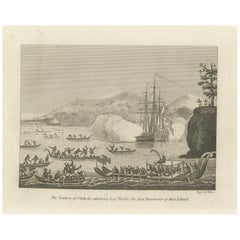
Title: "The Natives of Otaheite Attacking Capt. Wallis, The First Discoverer of that Island" This engraving depicts a significant historical encounter between the natives of Tahiti ...

Category

Antique Early 1800s Prints

Materials

Paper

You May Also Like

Surrender of Tahiti to Captain Wallis: An Original 18th C. Engraving

Surrender of Tahiti to Captain Wallis: An Original 18th C. Engraving

By John Webber

Located in Alamo, CA

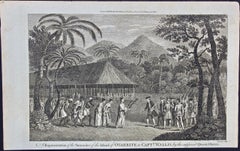
"A Representation of the Surrender of the Island of Otaheite to Capt.n Wallis, by the Supposed Queen of Oberea" is an original 18th century engraving created by Sparrow, from a drawi...

Category

1780s Landscape Prints

Materials

Engraving

Sandwich Islands Canoe (Hawaii): Framed 18th C. Engraving Captain Cook's Journal

Sandwich Islands Canoe (Hawaii): Framed 18th C. Engraving Captain Cook's Journal

By John Webber

Located in Alamo, CA

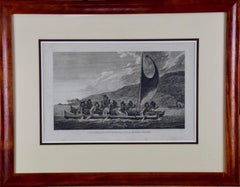
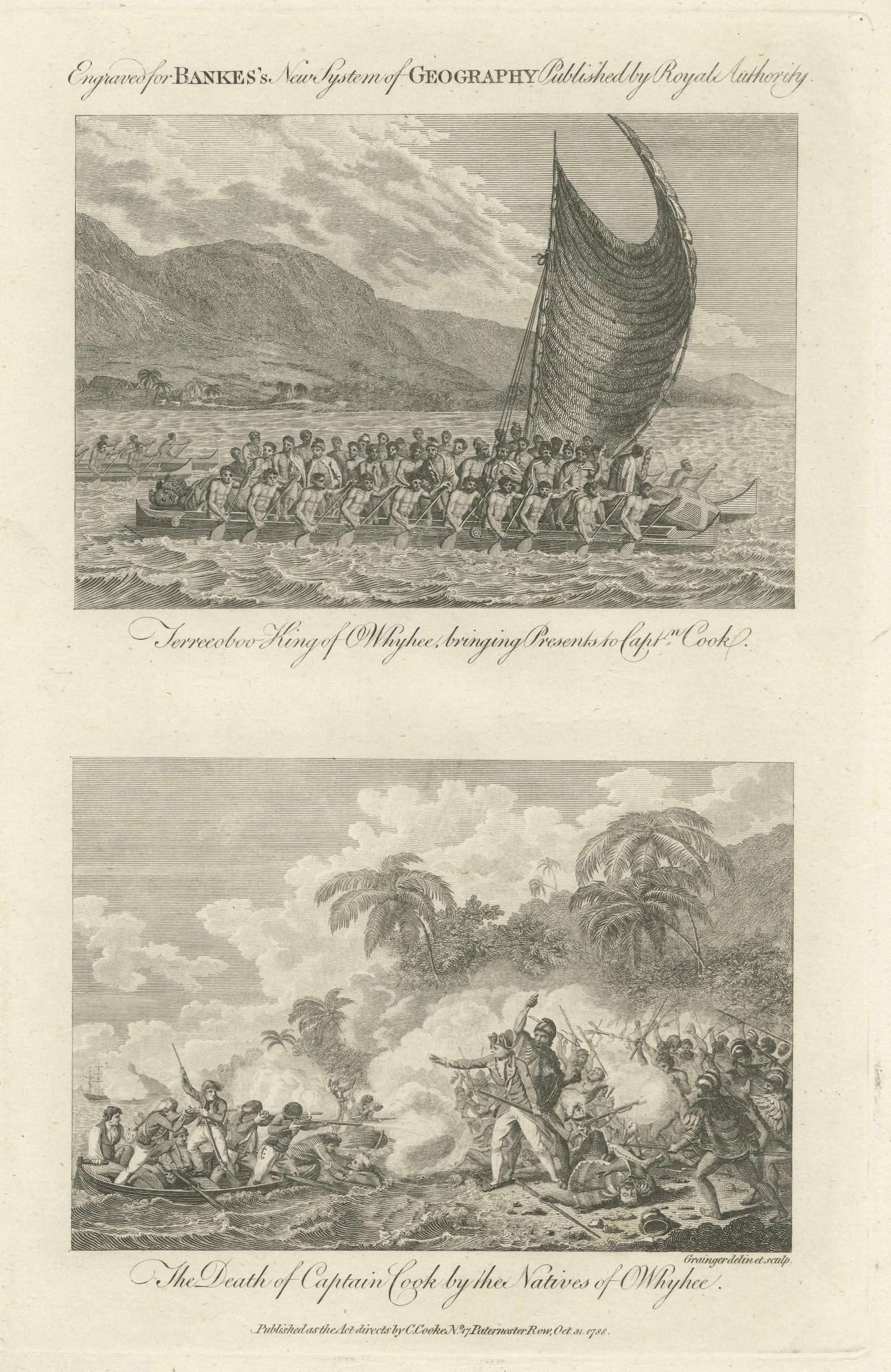
"A Canoe of the Sandwich Islands, the Rowers Masked" is an engraving created by Charles Grignion, from a drawing by John Webber (1752-1793), who was the artist on Captain James Cook's 3rd and final voyage of discovery. It is Plate 65 in the atlas of "A Voyage to the Pacific Ocean Undertaken by the Command of His Majesty, for Making Discoveries in the Northern Hemisphere", the official British Admiralty sanctioned journal published upon completion of the voyage in London in 1784 by Strahan & Cadell. This famous image of ten Hawaiian rowers transporting a priest who is carrying a feather-covered image of Kukailimoku, the Hawaiian god of war. The priests and paddlers are all wearing gourd masks in their double-hulled canoe with an upright lateen woven sail. Each hull was shaped from a single large Koa log harvested from island rainforests, where they were carved before being transported to the coast. This engraving is presented in a Koa wood frame and a white mat. There are occasional faint spots, but the print is otherwise in very good condition. Koa is the same wood as was used to make the canoe. Koa wood is legendary in Hawaii. Not only is this amazing wood native to Hawaii, but it is known for the deep rich colors and varied grain pattern. Koa has an honored heritage in Hawaii and is highly revered and sacred. The word “koa” means “warrior” in Hawaiian. The warriors of King Kamehameha the Great, created canoes and weapons from a wood plentiful on the Big Island of Hawaii. This wood became synonymous with the warriors themselves, and it became known as koa. The frame measures 20.75" high, 26.75" wide and 0.88" deep. There are three other engravings listed from the official journal of Captain Cook's 3rd voyage available that are presented in identical Koa wood frames and mat (LU117324682022, LU117324684052, LU117324684062). They would make a wonderful grouping for a display of 2, 3 or 4 prints. A discount is available for a grouping depending on the number of items included. Hawaii was discovered by Captain Cook (1728-1779) during this voyage. Hawaii was originally called The Sandwich Islands in honor of The Earl of Sandwich...

Category

1780s Landscape Prints
Materials

Engraving

Attack on Captain Wallis When He Discovered Tahiti: Original 18th C. Engraving

Attack on Captain Wallis When He Discovered Tahiti: Original 18th C. Engraving

Located in Alamo, CA

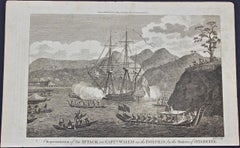
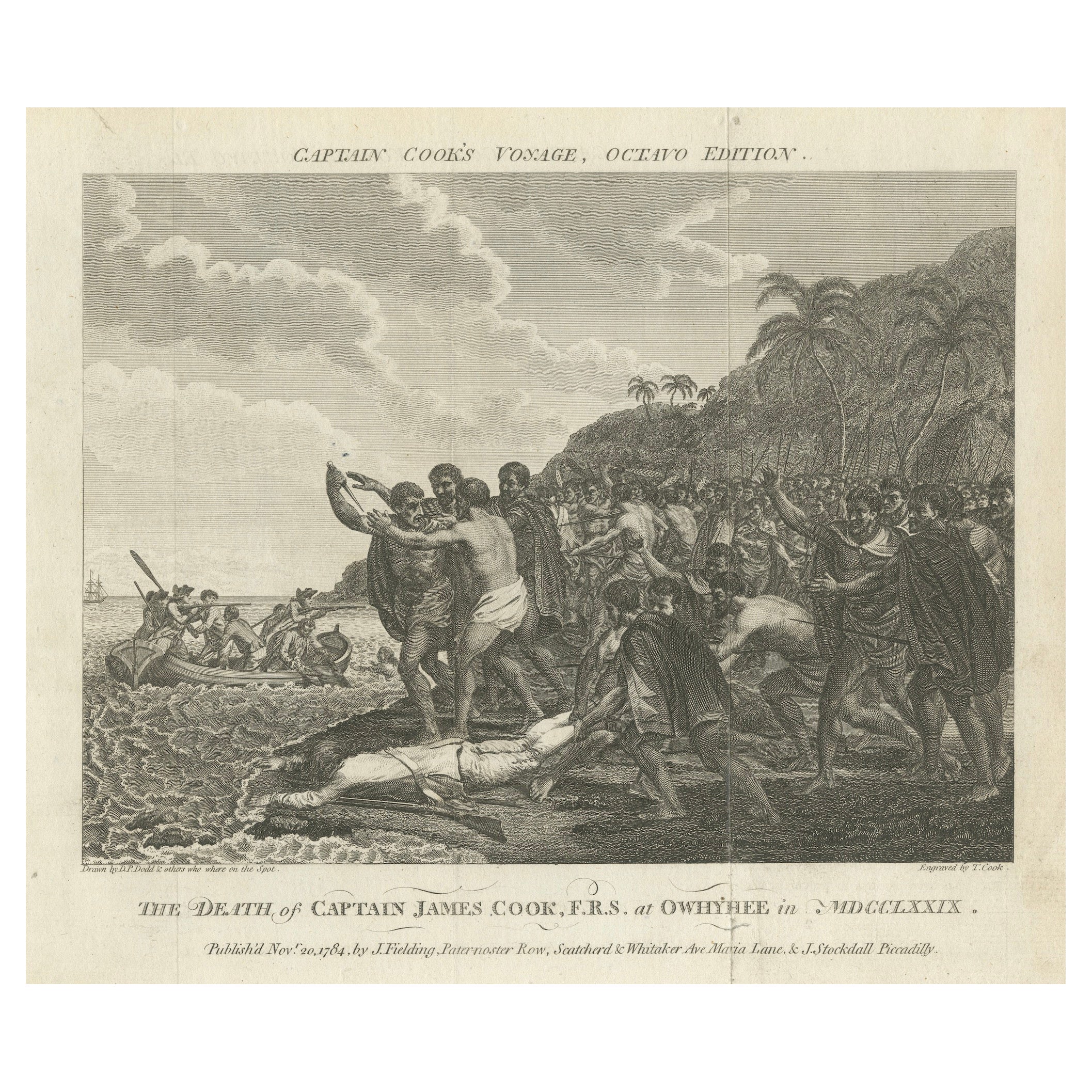
"A Representation of the Attack on Captain Wallis in the Dolphin by the Natives of Otaheite (Tahiti)" is an engraving created by the artist Sparrow based on an engraving in John Hawk...

Category

1780s Landscape Prints
Materials

Engraving

Coupang : Ile Timor. Vue d'un chantier de construction. Early C19th engraving

Coupang : Ile Timor. Vue d'un chantier de construction. Early C19th engraving

Located in Melbourne, Victoria

'Coupang : Ile Timor. Vue d'un chantier de construction' Depicts Timorese people and Europeans building a rowboat under a tree, with other boats in the distance. The work is being overseen by a senior naval man, possibly intended to be Captain Freycinet. Steel-engraving by Friedrich Schroeder (1768-1839) after F Garnier after Alphonse Pellion. Alphonse Pellion, artist and naval draughtsman, was a midshipman aboard l'Uranie on Louis de Freycinet's three-year scientific and ethnographic expedition around the world in 1817-1820. From Louis Freycinet's 'Voyage Autour du Monde, Entrepris par Ordre du Roi ... Execue sur les Corvettes de S. M. l'Uranie et la Physicienne Pendant les Annees 1817, 1818, 1819 et 1820', published in Paris in 1825. Louis Claude de Saulces de Freycinet (1779-1842) joined the French Navy in 1793 and was a veteran of the Baudin's voyage of discovery (1801-1803). He also completed the narrative of the expedition which appeared under the title of 'Voyage de Decouvertes aux Terres Australes'. In 1817 de Freycinet successfully lobbied the Government and King Louis XVIII agreed to support a new global campaign. Its mission was to finally determine the shape of the earth and return with detailed reports on geography, people, government, commerce and art of this new world. The 350-ton corvette Uranie had a complement of 120 men and 23 officers including the artist Jacques Arago and a priest. Over the next three years Uranie visited Australia, East Timor...

Category

Early 19th Century Victorian Landscape Prints

Materials

Engraving