Want more images or videos?
Request additional images or videos from the seller.

Jun Tomita, Ikat Kasuri Weaving, Made in Japan c1978

$4,795.50
£4,200VAT Included
€4,282.03
CA$6,733.29
A$6,950.33
CHF 3,917.54
MX$89,921.23
NOK 44,695.01
SEK 47,151.27
DKK 32,005.47

About the Item

Jun Tomita, born in Toyama Prefecture, Japan, in 1951, is a highly regarded contemporary Japanese weaver and a noted practitioner of the traditional kasuri method of ikat weaving. After studying and working in Australia and England, Tomita returned to Japan and, in 1982, established his home and studio in Koshihata, a mountainous rural area west of Kyoto. The surrounding forests and constantly changing landscape became an important source of inspiration for his work, resulting in textiles with a distinctive, atmospheric and almost painterly quality. Tomita dyes and weaves his own threads, creating textiles in which the irregularities and variations of the ikat process form an integral part of the design. His work includes traditional Japanese obi textiles as well as larger woven pieces intended for display on the wall or floor. Each work is individually made and possesses its own subtle variations and character. Tomita has exhibited internationally and has taught at both the West Surrey College of Art and Design in England and the Kyoto College of Art. His work is recognised for its quiet, layered compositions and strong connection with the natural world. Of particular interest is the history of this piece. It was acquired by the distinguished British weaver Mary Farmer, who selected it for inclusion in the 1982 Crafts Council exhibition The Maker’s Eye, held in London. Mary Farmer was a significant figure in the British contemporary craft movement and served as one of the selectors for this influential exhibition. Her selection of this work by Jun Tomita provides an interesting connection between Tomita’s developing reputation in Japan and the contemporary British craft scene of the early 1980s. The piece therefore carries not only the interest of Tomita’s distinctive kasuri weaving, but also a notable exhibition and collecting history associated with Mary Farmer and the Crafts Council. Viewing is welcomed at our West London showroom. High-resolution photography, detailed condition reports, and video inspections are available upon request. We offer local, national, and international shipping. Please contact us for further information or to arrange a private viewing.
  • Creator:
    Jun Tomita (Artist)
  • Dimensions:
    Height: 80.01 in (203.2 cm)Width: 12.01 in (30.5 cm)Depth: 0.4 in (1 cm)
  • Style:
    Mid-Century Modern (In the Style Of)
  • Materials and Techniques:
    Cotton,Ikat
  • Place of Origin:
  • Period:
  • Date of Manufacture:
    1978
  • Condition:
    At Gallery Kiy, all our pieces have been professionally restored using museum-grade restorers and are always presented in the best condition they can be in. If there are any flaws that stands out, they will be described and photographed.
  • Seller Location:
    Uxbridge, GB
  • Reference Number:
    1stDibs: LU9085251285042

More From This Seller

View All
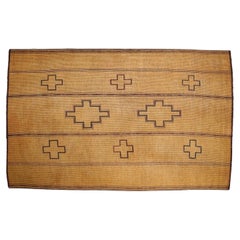
Large Vintage Tuareg Éseber Mat Rug Golden Brown Leather, Reed, Geometric Design

Large Vintage Tuareg Éseber Mat Rug Golden Brown Leather, Reed, Geometric Design

Located in Uxbridge, GB

A particularly large Tuareg éseber mat or rug, dating from the 1950s and constructed from woven palm reeds and naturally dyed leather. Measuring almost five metres in length, the rug has an impressive architectural presence. The surface is divided into broad longitudinal fields by narrow bands of dark leather, within which a series of simple cross-shaped geometric motifs are arranged. Two larger stepped motifs occupy the central field, surrounded by smaller crosses, creating a remarkably restrained and balanced composition. Éseber mats were traditionally made by Tuareg communities of the Sahara from locally available plant fibres and leather. Rather than being woven in the conventional manner of a woollen rug, closely arranged reeds are bound together with narrow strips of leather, while additional dyed leather is used to create the decoration and strengthen the structure. Historically, these large mats had a practical role within Tuareg tent...

Category

Mid-20th Century African Mid-Century Modern Moroccan and North African Rugs

Materials

Leather, Reed

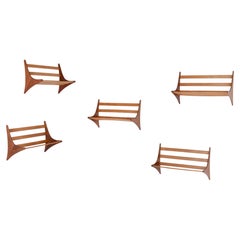
Vintage Set of Five Wall Shelves by Børge Mogensen for Erhard Rasmussen c1949

Vintage Set of Five Wall Shelves by Børge Mogensen for Erhard Rasmussen c1949

By Børge Mogensen, Erhard Rasmussen

Located in Uxbridge, GB

A rare and beautiful set of five shelves by Børge Mogensen for Erhard Rasmussen. This early collaboration brought together two highly regarded figures of Danish furniture making: the...

Category

Vintage 1940s Danish Mid-Century Modern Shelves and Wall Cabinets

Materials

Beech, Teak

Richard Young Highback Dining Chairs, Set of Six

Richard Young Highback Dining Chairs, Set of Six

By Merrow Associates, Richard Young

Located in Uxbridge, GB

A very handsome set of six Richard Young dining chairs, combining the polished chrome and strong geometric forms characteristic of British furniture design during the late 1960s and ...

Category

Mid-20th Century British Mid-Century Modern Dining Room Chairs

Materials

Chrome

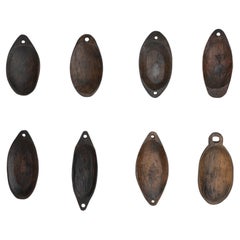
Tribal Naga Wooden Trays / Plates Wall Hanging Display from Nagaland, India

Tribal Naga Wooden Trays / Plates Wall Hanging Display from Nagaland, India

Located in Uxbridge, GB

A group of eight hand-carved hollock wood trays from Nagaland, north-east India, dating from the mid-20th century. Originally used for drying grain, each tray has been individually c...

Category

Vintage 1950s Indian Mid-Century Modern Tribal Art

Materials

Wood

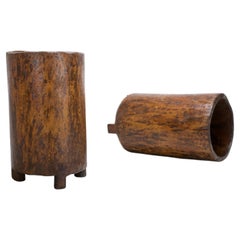
Tribal Naga Hand-Carved Grain Storage Vessel Bin 1930-60's from Nagaland India

Tribal Naga Hand-Carved Grain Storage Vessel Bin 1930-60's from Nagaland India

Located in Uxbridge, GB

Hand carved, hollock wood Width - 42.5cm - 16¾ inches Depth - 37cm - 14½ inches Height -68cm - 26¾ inches Internal Depth - 53cm - 20¾ inches Rim Thickness - 3cm - 1 inches A large h...

Category

Vintage 1930s Indian Planters, Cachepots and Jardinières

Materials

Wood

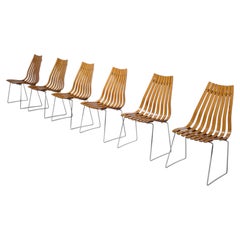
Hans Brattrud High Back Rosewood Scandia Prince Chairs by Hove Mobler 1957

Hans Brattrud High Back Rosewood Scandia Prince Chairs by Hove Mobler 1957

By Hans Brattrud

Located in Uxbridge, GB

A set of six rosewood Scandia Prince dining chairs, designed by Hans Brattrud for Hove Møbler in 1957. We have always liked these chairs and have bought and sold many sets over the ...

Category

Vintage 1950s Norwegian Mid-Century Modern Chairs

Materials

Steel, Chrome

You May Also Like

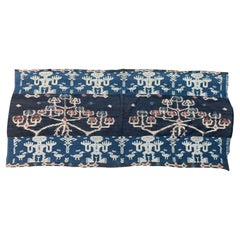
Ikat Textile from Timor Stunning Tribal Motifs & Colors, Indonesia, c. 1950

Ikat Textile from Timor Stunning Tribal Motifs & Colors, Indonesia, c. 1950

Located in Jimbaran, Bali

An wonderful example of a west timor ikat textile. It is hand-woven using naturally dyed yarns via a method passed on through generations. It features a stunning array of distinct tr...

Category

Vintage 1950s Indonesian Other Textiles

Materials

Yarn

Ikat Textile from Lembata Stunning Tribal Motifs, Indonesia c. 1920

Ikat Textile from Lembata Stunning Tribal Motifs, Indonesia c. 1920

Located in Jimbaran, Bali

This handwoven ikat textile comes from Lembata Island, Indonesia, where it was traditionally crafted as a tubular waist skirt (sarong) worn in both everyday life and ritual contexts....

Category

Vintage 1950s Indonesian Other Textiles

Materials

Yarn

Rare Ikat Textile from Timor Stunning Tribal Motifs & Colors, Indonesia c. 1950

Rare Ikat Textile from Timor Stunning Tribal Motifs & Colors, Indonesia c. 1950

Located in Jimbaran, Bali

This handwoven ikat textile originates from Timor, Indonesia, where it was traditionally made as a tubular waist skirt (sarong) and worn for daily life and ceremonial occasions. Wove...

Category

Vintage 1950s Indonesian Other Textiles

Materials

Yarn

Rare Ikat Textile from Sumba Stunning Tribal Motifs & Colors, Indonesia c. 1950

Rare Ikat Textile from Sumba Stunning Tribal Motifs & Colors, Indonesia c. 1950

Located in Jimbaran, Bali

This mid-20th century ikat textile from East Sumba, Indonesia is a powerful expression of Sumbanese textile tradition, renowned for its bold iconography and ceremonial significance. ...

Category

Vintage 1950s Indonesian Other Textiles

Materials

Yarn

Ikat Textile from Timor Stunning Tribal Motifs & Colors, Indonesia c. 1950

Ikat Textile from Timor Stunning Tribal Motifs & Colors, Indonesia c. 1950

Located in Jimbaran, Bali

An wonderful example of a west timor ikat textile. It is hand-woven using naturally dyed yarns via a method passed on through generations. It features a stunning array of distinct tr...

Category

Vintage 1950s Indonesian Other Textiles

Materials

Yarn