Want more images or videos?
Request additional images or videos from the seller.

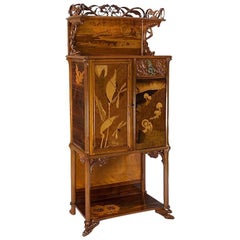
Rare sculptural cabinet Henry Ernest Anaclet Parayre (1879–1970)

$34,108.01
£25,535.68
€36,000VAT Included
CA$48,148.57
A$49,640.52
CHF 27,962.56
MX$635,211.86
NOK 322,658.35
SEK 337,481.69
DKK 228,813.58

About the Item

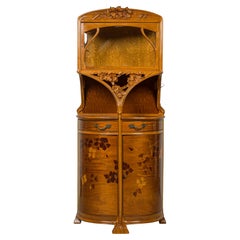
Henry Ernest Anaclet Parayre (1879–1970) Rare sculptural cabinet with an mechanism, carved and inlaid in walnut. Woman with a chignon and a house in the forest surrounded by two peacocks. The direct carving of the wood demonstrates his interest in local primitivism. Made in the wood workshop. Signed and dated 1903 H: 168 cm W: 58 cm D: 30 cm Henry Ernest Anaclet Parayre is renowned for his works in bronze, marble, and terracotta, distinguished by their great sensitivity and rigorous formal research. Parayre primarily explored the themes of the human figure, particularly the female nude, but also animal representations, which he approached with finesse and emotion. His style, influenced by Art Nouveau and the beginning of Art Deco, blends fluid lines with simple forms. Parayre's sculptures are sought after today for their elegance and their ability to capture the very essence of the subjects he depicts. He spent most of his childhood sculpting scrap wood. The death of his grandfather in March 1900, six years after that of his grandmother, left him without family ties when he finished his brilliant studies at the École des Beaux-Arts. He then decided to continue his training in Paris, an almost obligatory step for any young artist wishing to succeed in their field. His excellent results at the Toulouse school allowed him to enter the studio of Paul Dubois, a member of the Institut de France and director of the École Nationale des Beaux-Arts. This artist, along with sculptors Chapu and Falguière, belongs to the Florentine group, so named because they drew inspiration from the Tuscans of the Quattrocento, particularly Donatello, much more than from Greco-Roman antiquity. Paul Dubois achieved fame thanks, in particular, to his busts, such as those of Louis Pasteur and the painter Bonnat. Parayre attended his classes assiduously and learned a great deal from him, especially in portraiture technique and style, which he would retain throughout his career. His Florentine Head, exhibited in 1922, pays homage to Dubois's teaching and his elegant style inspired by the Italian Renaissance. Once in the capital, he had to earn a living. He worked for a time for furniture manufacturers and managed to get hired to participate in the sculpted decoration of the Grand Palais des Beaux-Arts, whose construction was nearing completion. As part of the 1900 Universal Exhibition, this vast building was preparing to house two exhibitions: the Centennial, a retrospective bringing together the principal French artists of the 19th century, from 1800 to 1889, and the Decennial, devoted more specifically to the artistic creation of those ten years. In its sculpture section, the Decennial included no fewer than 640 works, distributed among 336 artists. Very few of them, in truth, were destined to leave their mark on posterity. But for the budding sculptor Parayre, the exhibition was a unique opportunity: to have before his eyes a nearly complete panorama of French "fin de siècle" sculpture, with its trends and diversity. In the halls of the Grand Palais, he first encountered his mentor Paul Dubois, the leading figure of the Florentine school. But at that time, public preferences leaned more towards the Neo-Baroque. Certainly, the contortions of the female body or the billowing draperies characteristic of the Prix de Rome winners Denys Puech, Louis-Ernest Barrias, or de Saint-Marceaux hardly influenced the young Parayre, any more than the patriotic or historical emphasis of an Antonin Mercié, from the Toulouse group. On the other hand, when later sculpting statuettes like Fisherman's Wife, he undoubtedly kept in mind the works of Alexandre Charpentier or Dalou, proponents of the social realism introduced by the Belgian Constantin Meunier, who wished to follow in sculpture the naturalism of a Courbet. But the young provincial adapted poorly to the capital and rarely frequented artistic and intellectual circles. His preferred visits were to Parisian museums and, in particular, the Louvre. Homesickness drove him to return to his region of origin in 1904 just after the creation of this sculptural piece of furniture.
  • Creator:
    Henry Parayre (Artist)
  • Dimensions:
    Height: 66.15 in (168 cm)Width: 22.84 in (58 cm)Depth: 11.82 in (30 cm)
  • Style:
    Art Nouveau (Of the Period)
  • Materials and Techniques:
  • Place of Origin:
  • Period:
    1900-1909
  • Date of Manufacture:
    1903
  • Condition:
    Wear consistent with age and use.
  • Seller Location:
    NEUILLY-SUR-SEINE, FR
  • Reference Number:
    1stDibs: LU9892249920372

More From This Seller

View All
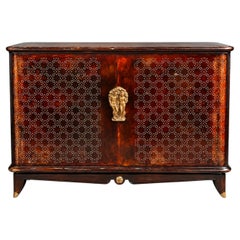
Cabinet, Buffet of Maurice Dufrêne

Cabinet, Buffet of Maurice Dufrêne

By Maurice Dufrêne

Located in NEUILLY-SUR-SEINE, FR

Maurice Dufrêne (1876-1955) Important 3-door cabinet in pommelé mahogany with wood marquetry and mother-of-pearl decoration French designer, Circa 1925, H: 181 cm D: 50 cm W: 174 cm ...

Category

Vintage 1920s French Art Deco Cabinets

Materials

Wood

Vitrine exceptionnelle par Léon Jallot – 1910

Vitrine exceptionnelle par Léon Jallot – 1910

By Léon Jallot

Located in NEUILLY-SUR-SEINE, FR

Vitrine exceptionnelle par Léon Jallot – 1910 Magnifique vitrine en bois de hêtre signée Léon Jallot, datant de 1910. Modèle "Fleurs et feuilles de cerisier stylisées", présenté au ...

Category

Vintage 1910s French Mid-Century Modern Vitrines

Materials

Wood

Art Deco Cabinet by MAURICE JALLOT & LEON DRIVIER 1940

Art Deco Cabinet by MAURICE JALLOT & LEON DRIVIER 1940

By Maurice Jallot

Located in NEUILLY-SUR-SEINE, FR

MAURICE JALLOT (1900-1971) and LÉON DRIVIER (1878-1951) Art Deco cabinet, circa 1948 An elegant storage cabinet created by Maurice Jallot, featuring sculptural gilt-bronze decorati...

Category

Vintage 1940s European Mid-Century Modern Buffets

Materials

Nutwood

Louis Süe - Rare Vitrine en Fer Forgé et Placage de Merisier (vers 1948)

Louis Süe - Rare Vitrine en Fer Forgé et Placage de Merisier (vers 1948)

By Louis Sue

Located in NEUILLY-SUR-SEINE, FR

Rare Vitrine en Fer Forgé et Placage de Merisier (vers 1948) Type : Vitrine en fer forgé et placage de merisier Date de création : Vers 1948 Dimensions : H : 169 cm L : 104 cm P :...

Category

Vintage 1940s European Vitrines

Materials

Metal

Paire Exceptionnelle de Colonnes "Cubisantes" Bois de Palmier - 1930

Paire Exceptionnelle de Colonnes "Cubisantes" Bois de Palmier - 1930

By Pierre-Emile Legrain

Located in NEUILLY-SUR-SEINE, FR

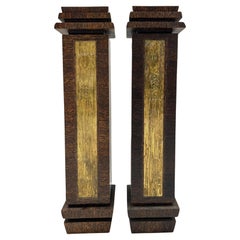
Travail Français, 1930 - Paire Exceptionnelle de Colonnes "Cubisantes" en Placage de Bois de Palmier Date de création : 1930 Matériaux : Placage de bois de palmier, plaque de verre gravé et doré Dimensions : H : 126,5 cm Condition : Usure et légers éclats de placage Exceptionnelle paire de colonnes "cubisantes" en placage de bois de palmier, ornées sur une face d'une plaque de verre gravée représentant des personnages stylisés sculptés et rehaussés d'or. Attribution : Cette paire de colonnes pourrait être attribuée à Gustave Miklos ou Pierre Legrain, deux figures emblématiques de l'époque. On y retrouve : L'utilisation de placages épais en bois de palmier, récurrente dans l'œuvre de Pierre Legrain, inspirée par un esprit africaniste propre à son travail. Des figures stylisées gravées sur verre, typiques du langage cubiste de Gustave Miklos. Contexte et importance historique : Le design de ces colonnes rappelle le bureau cubisant de Pierre Legrain, livré en 1927 à Maurice Martin...

Category

Vintage 1930s French Art Deco Pedestals

Materials

Glass, Palmwood

Spectacular dining table by Eugène Gaillard ca.1900

Spectacular dining table by Eugène Gaillard ca.1900

By Eugène Gaillard

Located in NEUILLY-SUR-SEINE, FR

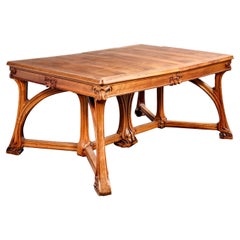
Eugène Gaillard (1862–1933) Rectangular dining table in molded and carved walnut, decorated with vegetal motifs around the apron. It rests on four cabriole legs, molded, ribbed, an...

Category

Antique Early 1900s French Art Deco Dining Room Tables

Materials

Walnut

You May Also Like

Art Nouveau Cabinet attributed to Gustave Serrurier-Bovy, Belgium, circa 1900

Art Nouveau Cabinet attributed to Gustave Serrurier-Bovy, Belgium, circa 1900

Located in Antwerp, Antwerp

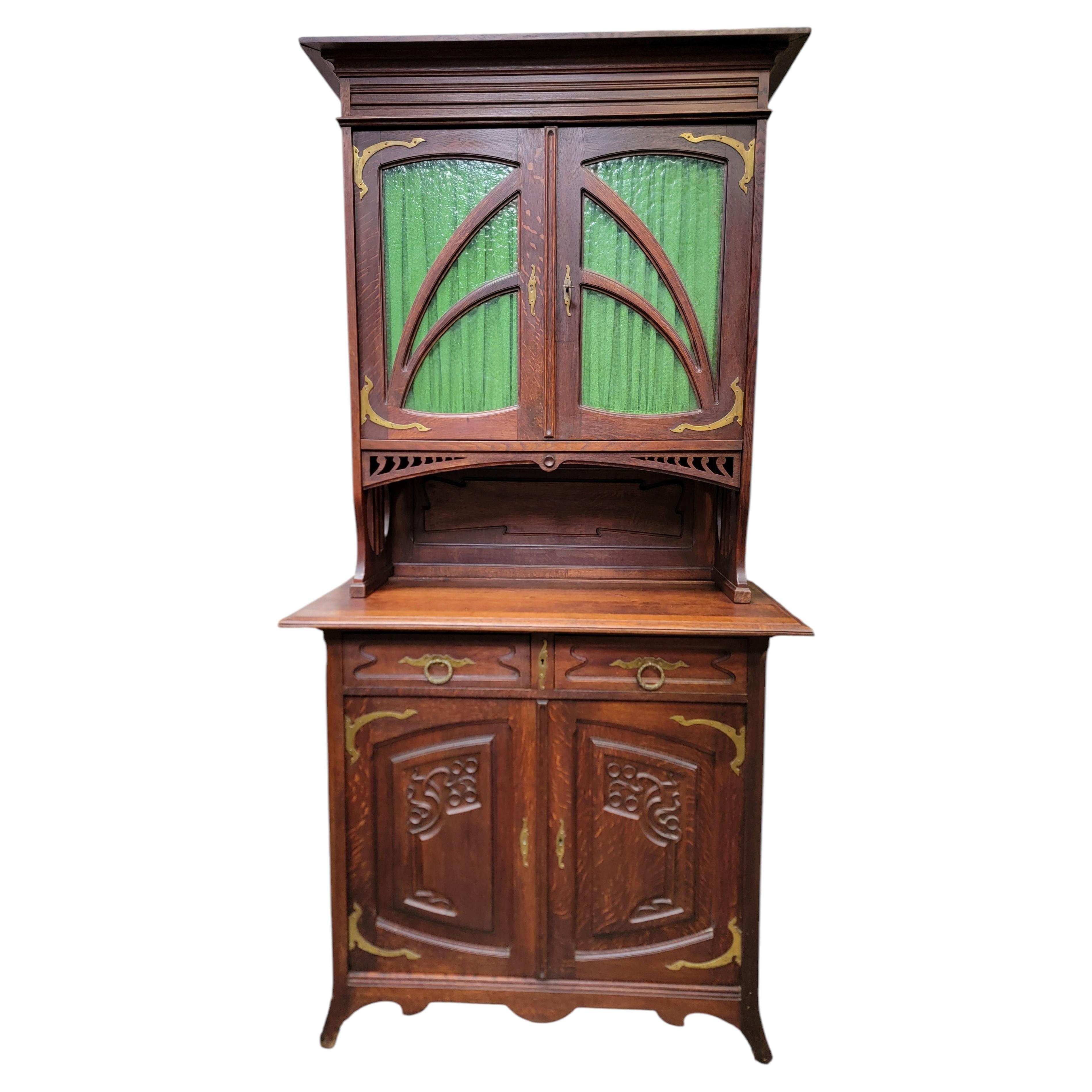
An exeptional Art Nouveau cabinet attributed to Gustave Serrurier-Bovy, produced in Belgium around 1900. Executed in oak, the piece combines leaded stained glass, green and yellow fa...

Category

Antique Early 1900s Belgian Art Nouveau Cabinets

Materials

Brass

Art Nouveau Cupboard by Pander Hollandia, 1900s

Art Nouveau Cupboard by Pander Hollandia, 1900s

By Pander

Located in Amsterdam, NL

Stunning and elegant Art Nouveau cupboard. Design by Pander Hollandia Den Haag. Striking Dutch design from the 1900s. Solid walnut base with original patinated brass handles on drawe...

Category

Antique Early 1900s Dutch Art Nouveau Cupboards

Materials

Brass

Émile Gallé "Grenouilles" Fruitwood Cabinet

Émile Gallé "Grenouilles" Fruitwood Cabinet

By Émile Gallé

Located in New York, NY

This French Art Nouveau "Grenouilles" carved fruitwood cabinet by Émile Gallé features detailed and masterful marquetry depicting dragonflies and mushrooms in a lush, leafy landscape...

Category

Antique Early 1900s French Art Nouveau Cabinets

Materials

Beech, Fruitwood

ITALIAN  ART NOVEAU FURNITURE  Late 19th Century

ITALIAN ART NOVEAU FURNITURE Late 19th Century

Located in Madrid, ES

ITALIAN ART NOVEAU FURNITURE Late 19th century, rosewood with carvings, trimmed finish. Three glass doors and glass sides with two mirrors. Dimensions: 210 x 116 x 36 cm Good condi...

Category

Antique 19th Century Italian Art Nouveau Cabinets

Materials

Rosewood

Antique Art Nouveau Cabinet or Cupboard Early 1900's

Antique Art Nouveau Cabinet or Cupboard Early 1900's

Located in Fulton, CA

Early 20th century, graceful and organic Art Nouveau 2 piece cabinet. Crafted in oak, circa. 1890-1915. The Art Nouveau period is defined by flowing lines, organic shapes, and nature...

Category

Early 20th Century Art Nouveau Cabinets

Materials

Brass