Want more images or videos?
Request additional images or videos from the seller.

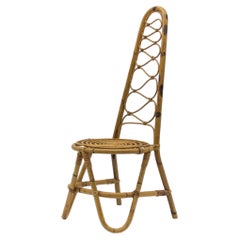
Rare Vintage Rattan Chair signed by Audoux-Minet, 1950s

$1,297.60
£980.60
€1,207.50VAT Included
CA$1,850.06
A$1,907.27
CHF 1,083.70
MX$24,142.57
NOK 12,409.83
SEK 13,000.84
DKK 8,768.88

About the Item

A beautiful and rare vintage rattan chair signed by Adrien Audoux & Frida Minet, the renowned French design duo associated with modernist furniture from the French Riviera. The design features a high, rounded fan-shaped backrest and a bent-rattan structure—crafted entirely from slender, bound rattan rods – resting on four legs reinforced by an elegant X-shaped stretcher. The numerous hand-tied bindings give these chairs their distinctive character and showcase the craftsmanship typical of Audoux-Minet productions. While little is known about the audacious modernist designers Adrien Audoux and Frida Minnet, the Franco-Swiss husband-and-wife duo created playful and unique decorative objects, dining chairs, wall sconces, and other furniture during the mid-20th century. Rejecting the opulence of Art Deco and the concept that seats, tables, and other furniture should be made from luxurious and exotic materials, Minnet and Audoux embraced a rustic style in their work, incorporating abaca, hemp rope, and other organic materials such as rattan, beech, and bamboo into their provocative designs. This model is highly representative of the furniture created by Adrien Audoux and Frida Minet on the French Riviera during the 1950s, blending French modernism, natural materials, and Mediterranean influences. It would fit perfectly into a Mid-Century Modern, Mediterranean, boho-chic, or Riviera-style interior, as well as a holiday home, architect-designed residence, or a setting featuring vintage decor or 1950s French design. In excellent condition for a vintage chair. One small defect (see photo) where one of the rattan is bent. A detailed certificate will be issued to the buyer.
  • Creator:
  • Dimensions:
    Height: 35.44 in (90 cm)Width: 17.33 in (44 cm)Depth: 18.12 in (46 cm)Seat Height: 17.33 in (44 cm)
  • Style:
    Mid-Century Modern (Of the Period)
  • Materials and Techniques:
  • Place of Origin:
  • Period:
  • Date of Manufacture:
    1950
  • Condition:
    Wear consistent with age and use. One small defect (see photo) where one of the rattan is bent. Otherwise excellent.
  • Seller Location:
    MOUGINS, FR
  • Reference Number:
    1stDibs: LU10660252285452

More From This Seller

View All
Low Rattan Settee Armchair by Audoux-Minnet - Golfe-Juan, 1950s-1960s

Low Rattan Settee Armchair by Audoux-Minnet - Golfe-Juan, 1950s-1960s

By Adrien Audoux and Frida Minnet

Located in MOUGINS, FR

A rare low rattan settee / armchair by Audoux Minnet in Golfe-Juan, dating from the 1950s-1960s, with a very modern shape and designed to be fitted with cushions. While little is kn...

Category

Vintage 1950s French Mid-Century Modern Lounge Chairs

Materials

Rattan

Blackened Wood Boudoir Chair - Napoleon III

Blackened Wood Boudoir Chair - Napoleon III

Located in MOUGINS, FR

Beautiful boudoir chair from the Napoleon III period / late 19th century in blackened and gilded wood. Beautiful tapestry and trimmings in perfect condition. Very sturdy and suit...

Category

Antique Late 19th Century French Aesthetic Movement Chairs

Materials

Wood

Magnificent Anglo-Indian / Burmese Carved Teak Armchair - 1880s

Magnificent Anglo-Indian / Burmese Carved Teak Armchair - 1880s

Located in MOUGINS, FR

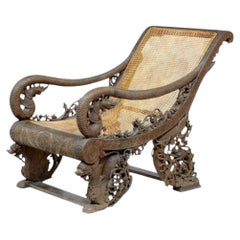
A magnificent and exceptionally elaborate Burmese carved teak reclining armchair, probably dating from the 1880s, of highly sculptural form and extraordinary quality of carving. Carved throughout from Burmese teak, the armchair is distinguished by its unusually elaborate pierced and relief-carved decoration, combining luxuriant scrolling foliage with mythical creatures, serpentine dragons or nāgas, floral motifs and anthropomorphic or divine figures. The sweeping arms are particularly spectacular, each terminating in an imposing serpentine dragon/nāga head, while the sides of the chair are formed as an intricate openwork composition of intertwined mythical creatures and scrolling vegetation. The elaborate carving continues throughout the seat rail, apron, legs and supports, with numerous deeply undercut elements producing an almost three-dimensional, sculptural effect. The front supports are noteworthy, being conceived as mythical beasts and guardian figures, with the feet terminating in powerful animal forms. The extensive use of pierced carving allows the light to pass through the decoration, creating the characteristic "lacework" effect associated with the finest Burmese carved furniture of the nineteenth century. The armchair has a woven cane seat and reclining back, providing a striking contrast to the dense, sculptural carving of the teak frame. The design combines indigenous Burmese decorative vocabulary with the form of a substantial European-style reclining armchair. Such furniture belongs to the fascinating tradition of Anglo-Burmese furniture, in which highly skilled Burmese craftsmen adapted local carving traditions to furniture forms produced for wealthy Burmese patrons, European residents and the colonial market. The extraordinary richness of the carving suggests that this was not an ordinary domestic chair but a prestige or ceremonial piece, intended to demonstrate both the status of its owner and the exceptional skill of its maker. The form, cane work, construction and style of carving are consistent with the flourishing production of elaborate Burmese furniture during the latter part of the nineteenth century and the early British colonial period. Another late-19th-century Burmese carved teak chair in the National Trust collection, dated approximately 1870–1910, demonstrates the exceptional level of Burmese woodcarving during this period. It is described as deeply and intricately carved with foliage, mythical animals and other figural motifs. The British Museum likewise illustrates the extraordinary importance of Burmese teak and carving in the nineteenth century, noting that teak was prized for its strength and resistance to insects and moisture and that Burmese craftsmen were renowned for highly sophisticated wood carving. A detailed certificate will be issued to the buyer. Condition: Recently replaced cane work, minor losses to carving. Provenance: by tradition from Ulriksdals Slott Palace. Formerly in the collections of King Gustav VI Adolf of Sweden (1882-1973). Historical context During the nineteenth century Burma became one of the most important sources of highly carved teak furniture in Southeast Asia. Burmese teak was particularly suited to furniture because of its exceptional durability and resistance to the tropical climate. Following the British annexation of Upper Burma in 1885, Burmese craftsmen increasingly produced furniture incorporating European forms while retaining highly sophisticated indigenous carving traditions. The resulting furniture is frequently referred to as Anglo-Burmese or Anglo-Indian/Burmese furniture. The phenomenon is part of a much broader history of exchange between European and Asian furniture traditions. Amin Jaffer's important reference work Furniture from British India and Ceylon examines precisely this interaction between European furniture forms and local craftsmanship and discusses the considerable difficulties involved in attributing colonial furniture correctly. The book, published by V&A Publications in 2001, contains a catalogue of approximately 200 pieces from the Victoria and Albert Museum and Peabody Essex Museum collections. Interestingly, Christie's specifically cites Amin Jaffer's Furniture from British India and Ceylon, p. 392, in connection with another late-19th-century Anglo-Indian teak chair with carved dragons and foliage. Related Literature Amin Jaffer, Furniture from British India and Ceylon, V&A Publications / Peabody Essex Museum, 2001, 416 pp. Christie's, "A Burmese Carved Teak Reclining Armchair," late 19th/early 20th century. National Trust Collections, Kedleston Hall, "Steering Chair...

Category

Antique 1880s French Armchairs

Materials

Wood

Pair of Horseshoe Armchairs in Catalpa Wood (梓木), China, Qing Dynasty

Pair of Horseshoe Armchairs in Catalpa Wood (梓木), China, Qing Dynasty

Located in MOUGINS, FR

Rare Chinese fine wood horseshoe armchair. The curved upper border of circular section continuing in a broad sweep to the arms, sloping down and extending to the hook handles with r...

Category

Antique Late 19th Century Chinese Qing Armchairs

Materials

Wood

Coffee Table / Magazine Rack “java”, Mathieu Mategot, 1955

Coffee Table / Magazine Rack “java”, Mathieu Mategot, 1955

By Mathieu Matégot

Located in MOUGINS, FR

Coffee table / magazine rack, "Java" model, circa 1955, top in "rigitulle" lacquered in light yellow-green, bordered by a square section gallery, lacquered tubular base, copper sabot...

Category

Vintage 1950s French Mid-Century Modern Side Tables

Materials

Metal, Sheet Metal

Pair of Napoleon III Chairs / Aesthetic Movement - Blue Velvet & Gilt Bronze

Pair of Napoleon III Chairs / Aesthetic Movement - Blue Velvet & Gilt Bronze

Located in MOUGINS, FR

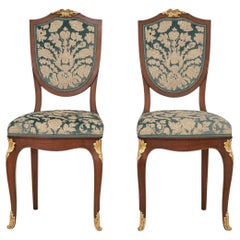
A pair of Napoleon III / late 19th century varnished wood and gilt bronze chairs. Gilding in excellent condition. Some markings in the wood (numbers), showing signs it belonged to a...

Category

Antique Late 19th Century French Chairs

Materials

Bronze

You May Also Like

Signed Compact Rattan Side Chair by Hudon - France 1960's

Signed Compact Rattan Side Chair by Hudon - France 1960's

By Adrien Audoux and Frida Minnet

Located in New York, NY

Stylish petite rattan side chair in the style of Audoux Minnet. "Hudon" SIgnature underneath seat. In good vintage condition. This chair will ship from France and can be returned to...

Category

Vintage 1960s French Side Chairs

Materials

Rattan

Mid Century Modern Rattan Chair by Janine Abraham & Dirk Jan Rol, France, 1960s

Mid Century Modern Rattan Chair by Janine Abraham & Dirk Jan Rol, France, 1960s

By Janine Abraham

Located in Vienna, AT

Mid Century Modern Riviera Style armchair by Janine Abraham & Dirk Jan Rol attributed, France, 1960s. A wonderful organic lounge chair or side chair from rattan with beautiful wicker...

Category

Vintage 1960s Mid-Century Modern Armchairs

Materials

Rattan

Mid-century French Vintage Rattan Chair, 1960s

Mid-century French Vintage Rattan Chair, 1960s

Located in LEGNY, FR

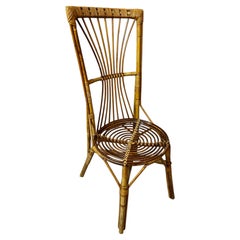
Charming rattan chair dating from the 1960s, featuring a tall, openwork backrest with slender rods drawn together at the centre to create an elegant fan-shaped design. Its round seat...

Category

Vintage 1960s French Chairs

Materials

Rattan

Duran Rattan Chair, Handmade in Europe, Mid-Century Modern Design, New

Duran Rattan Chair, Handmade in Europe, Mid-Century Modern Design, New

Located in West Palm Beach, FL

A more contemporary design for an indoor or undercover seating. This dining chair is handmade made in rattan and has a light natural color. The backrest is beautifully shaped in a de...

Category

21st Century and Contemporary European Mid-Century Modern Side Chairs

Materials

Rattan

Riviera Chair Made in Rattan and Bamboo, 1960s Italy

Riviera Chair Made in Rattan and Bamboo, 1960s Italy

By Abraham and Rol

Located in Nürnberg, Bayern

Very rare chair made of bamboo and wicker, designed in 1956 by French-Dutch couple Janine Abraham and Dirk Jan Rol. The famous couple won several awards, including the gold medal at...

Category

Vintage 1950s French Mid-Century Modern Armchairs

Materials

Bamboo, Rattan