Want more images or videos?
Request additional images or videos from the seller.

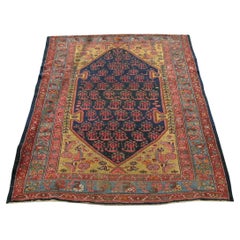
Mid-19th Century Persian Tribal Bidjar Rug

$6,300
£4,810.96
€5,765.09
CA$9,071.26
A$9,352.35
CHF 5,268.19
MX$119,674.87
NOK 60,789.32
SEK 63,582.06
DKK 43,108.82

About the Item

Antique Bidjar Rugs Bidjar is a town in Persian Kurdistan located in north-west Persia. The Bidjar name is also used to describe the antique rugs that were produced in the many villages in the surrounding vicinity. The Bidjar is noted as being the stiffest carpet made; they are very heavy in relation to their size, and very thick and durable. All of the knots are symmetrical and the rows are beaten down during the weaving process producing a dense compact fabric. Given their thickness and construction Bidjar rugs can be difficult to fold. The many designs depict the Kurdish influence of the area and often floral and classical geometric motifs are employed as well as the use of large, whimsical medallion designs. The color palate is rich and jewel toned making the Bidjar a highly desirable rug sought after by designers. Bidjar rugs, produced in Northwest Iran are among the finest of Persian rugs by virtue of their design and technique. They cannot be identified readily by their patterns, for their repertoire is quite rich and varied. They are distinguished by primarily by their weave, which is perhaps the densest and most durable of all oriental rugs. Bidjar carpets were produced in a classical medallion format as well as in allover designs and pictorial or garden patterns. The quality of their wool is lustrous and soft, the drawing at times classically precise or wildly tribal. Some are attributable to Kurdish weavers living in the Bijar region. Known for producing some of the most important Persian rugs, rug weavers in Bidjar have perfected a style of rug weaving that results in what are called “Iron Rugs.” Bidder weavers are also responsible for the so-called “Man’s Rug.” The city of Bidjar is located in the province of Kurdistan in the heart of Northwest Iran. Bidjar lies between the city of Senneh or Sanandaj to the south and the legendary weaving center of Tabriz to the north. Kurdish tribes have traditionally been the region’s endemic people. However, the Afshari tribe also produced many Bidjar’s workshop rugs using patterns borrowed from Heriz, Tabriz and other great weaving centers of Northwest Persia. Geography plays a tremendous role in the history of the production of antique rugs from Bidjar. Although the Kurdish tribes have always been a dominant group in the region, they are one of the few cultures in the world who have never had their own country. Bidjar’s carpet weaving traditions were formed through a combination of cultural isolation and assimilation that is evidenced in the diverse range of designs used in the region as well as the continued use of natural dyes throughout the 1920s when many other regions adopted modern methods. The rugs of Bidjar encompass a broad range of styles and patterns that makes them difficult to define or distinguish from other regions. Although Bidjar was first mentioned in the 1500’s when the region was annexed with Armenia by Safavid forces, archaeological evidence of domestic technology and weaving implements dating back approximately 10,000 years has been found throughout Kurdistan. Situated in a corridor between the border of Persia, Anatolia and the Caucasus, Bidjar has been at the mercy of invading cultures for thousands of years. Military invasions from Russia and Europe have influenced Kurdish culture as early as 500 BC when Cyrus the Great launched a large-scale incursion into the region. The turmoil across Northwest Persia and neighboring countries continued through the 1800s with ongoing fighting related to the Russo-Turkish War. Over the centuries, Kurdish influence has waxed and waned as neighboring empires were distracted with their own wars. At the height of Kurdish power, the group claimed parts of neighboring Turkey and Azerbaijan. However, the Kurdish people had almost always been a subordinate tribal group that was part of a larger empire. The city’s untimely establishment on the world’s maps coincided with the re-establishment of shipping ports and the gradual decline of the Silk Road. This shift changed the course of events in Bidjar and allowed the city to maintain its weaving traditions into the early 20th century. Influences from Persia, Russia and the Caucasus can be seen in Bidjar’s diverse rugs, which include European roses, curvilinear arabesques, inset-lozenges featuring intricate Herati and Mina-Khani patterns, and Serapi-style medallions set on a stark background. The designs used on Bidjar rugs often include sophisticated patterns with small details that highlight their origin in the village workshops of tribal weavers. Examples of weavings from Bidjar include small-format rugs as well as long corridor carpets. However, large-format pieces are relatively rare. Rugs from Bidjar are known for their durable construction and strong, raised pile. Weavers in Bidjar used double weft or double knot construction along with a number of implements to create an extremely firm pile using the symmetric Turkish or Ghiordes knot. A small number of Bidjar rugs were also produced using the asymmetric Persian knot along with traditional curvilinear patterns from Persia. Goat hair is another fiber that is occasionally seen in rugs from the region. Weavers in Bidjar used a unique combination of yarns for the weft to create the signature look and feel of the firm pile. First, a dampened shoot of thick weft is inserted and tamped down with tools to secure the knots. The weaver follows this with a second shoot of finer yarn to secure the entire row in place. Wool is the most common foundation found in antique Bidjar rugs. However, cotton was also used. Many of the oldest Bidjar rugs are extremely coarse and incapable of being folded while later pieces and rugs produced in the neighboring village of Halvai tend to be thinner and finer. Rugs signed by the legendary master weaver Tajhavi (Taghavi) are among the finest and most prized carpets from the Kurdistan province displaying impeccable workmanship. Bidjar is a small city in a sparsely populated province with a rich carpet weaving tradition. The resulting pieces are as
  • Dimensions:
    Width: 50 in (127 cm)Length: 78 in (198.12 cm)
  • Style:
    Tribal (In the Style Of)
  • Materials and Techniques:
  • Period:
  • Date of Manufacture:
    1900
  • Condition:
    Good Condition.
  • Seller Location:
    Los Angeles, US
  • Reference Number:
    Seller: 5911y1stDibs: LU9020235635932

More From This Seller

View All
19th Century Tribal Persian Shirvan Rug

19th Century Tribal Persian Shirvan Rug

Located in Los Angeles, US

Shirvan rugs – The historic Khanate or administrative district of Shirvan produced many highly decorative antique rugs that have a formality and stylistic complexity that is found in...

Category

Antique Early 1900s Tribal Russian and Scandinavian Rugs

Materials

Wool
19th Century Persian Tribal Gabbeh Rug

19th Century Persian Tribal Gabbeh Rug

Located in Los Angeles, US

Persian Gabbeh Rugs – Persian rugs made with extra high pile and very simple, graphic designs focused on the use of color, which can be vibrant or soft and earthy. As pieces made for...

Category

Antique Early 1900s Tribal Russian and Scandinavian Rugs

Materials

Wool
1920s Antique Fine Turkish Oushak Rug

1920s Antique Fine Turkish Oushak Rug

Located in Los Angeles, US

Antique Turkish Oushak rugs have been woven in Western Turkey since the beginning of the Ottoman period. Historians attributed to them many of the great masterpieces of early Turkish...

Category

Antique Early 1900s Asian Tribal Russian and Scandinavian Rugs

Materials

Wool
Antique Malayer Rug 4.9 X 3.5

Antique Malayer Rug 4.9 X 3.5

Located in Los Angeles, US

Antique Malayer Rug 4.9 X 3.5 , handmade and hand-knotted, tribal rug , Wool on cotton foundation, authentic Persian Carpet

Category

Antique Early 1900s Tribal Russian and Scandinavian Rugs

Materials

Wool, Cotton

1900s Fine Antique Caucasian Karabagh Rug

1900s Fine Antique Caucasian Karabagh Rug

Located in Los Angeles, US

Antique Karabagh rugs Eagerly sought after by collectors as well as designers, have one of the oldest and most varied design traditions of any antique Caucasian rugs. Many are descen...

Category

Antique Early 1900s Asian Tribal Russian and Scandinavian Rugs

Materials

Wool, Cotton

Mid-19th Century Persian Zanjan Rug 5.6x4.1

Mid-19th Century Persian Zanjan Rug 5.6x4.1

Located in Los Angeles, US

Antique Zanjan Rug 5.6x4.1, handmade and hand-knotted, wool on cotton foundation, tribal carpet, authentic Persian carpet, vegetable dyes, tribal carpet from mid-19th Century

Category

Antique Early 1900s Other Russian and Scandinavian Rugs

Materials

Wool, Cotton

You May Also Like

Late 19th Century Antique Russian Caucasian Kazak Rug

Late 19th Century Antique Russian Caucasian Kazak Rug

Located in Dallas, TX

73080 Antique Caucasian Kazak Rug, 04’00 x 08’00. Bold and rustic, this hand-knotted wool antique Caucasian Kazak rug features a robust composition. Two jagged edge lozenge medallion...

Category

Antique Late 19th Century Caucasian Kazak Caucasian Rugs

Materials

Wool

Vintage hand-knotted Afghan Baluch Rug, 100% natural dyed wool, 1934

Vintage hand-knotted Afghan Baluch Rug, 100% natural dyed wool, 1934

Located in Beograd, RS

In this listing you will find an extra fine and soft Vintage (almost Antique) hand-woven Afghan Baluch rug. The geometric designs and angular shapes are typical of rugs woven by noma...

Category

Vintage 1930s Afghan Tribal Persian Style Rugs

Materials

Wool

Antique Caucasian Karabagh Rug, hand-knotted 100% wool, late 19th Century

Antique Caucasian Karabagh Rug, hand-knotted 100% wool, late 19th Century

Located in Beograd, RS

In this listing you will find a stunning antique hand-knotted Karabagh rug. Done in Caucasus region, the rug features geometric and floral patterns in red, blue and cream tones. The ...

Category

Antique Late 19th Century Caucasian Tribal Caucasian Rugs

Materials

Wool

Vintage Persian Luri Rug, natural dyed wool, Turkey 1950s

Vintage Persian Luri Rug, natural dyed wool, Turkey 1950s

Located in Beograd, RS

In this listing you will find a gorgeous vintage hand-woven Luri rug. The designs suggest an origin in the Anatolian (Turkish) or neighboring Caucasian/Persian regions, particularly ...

Category

Vintage 1950s Turkish Tribal Persian Style Rugs

Materials

Wool

Handmade Antique Persian Bakhtiari Rug 4.8' x 6.9, 1920s - 2B91

Handmade Antique Persian Bakhtiari Rug 4.8' x 6.9, 1920s - 2B91

Located in Bordeaux, FR

This magnificent antique Persian Bakhtiari rug (c. 1920s) is a genuine piece of textile history, renowned for its collectible Khesti or 'Garden Panel' design . Hand-knotted from dura...

Category

Vintage 1920s French Western European Rugs

Materials

Wool

Early 20th Century Persian Shrivan Rug

Early 20th Century Persian Shrivan Rug

Located in Chicago, IL

A wonderful early 20th century Persian Azerbaijani Shrivan rug with three large octagonal medallions, each with a large stylized floral pattern, living amidst a field of more stylize...

Category

Antique Early 1900s Azerbaijani Tribal Persian Style Rugs

Materials

Wool