Video Loading
Want more images or videos?
Request additional images or videos from the seller.

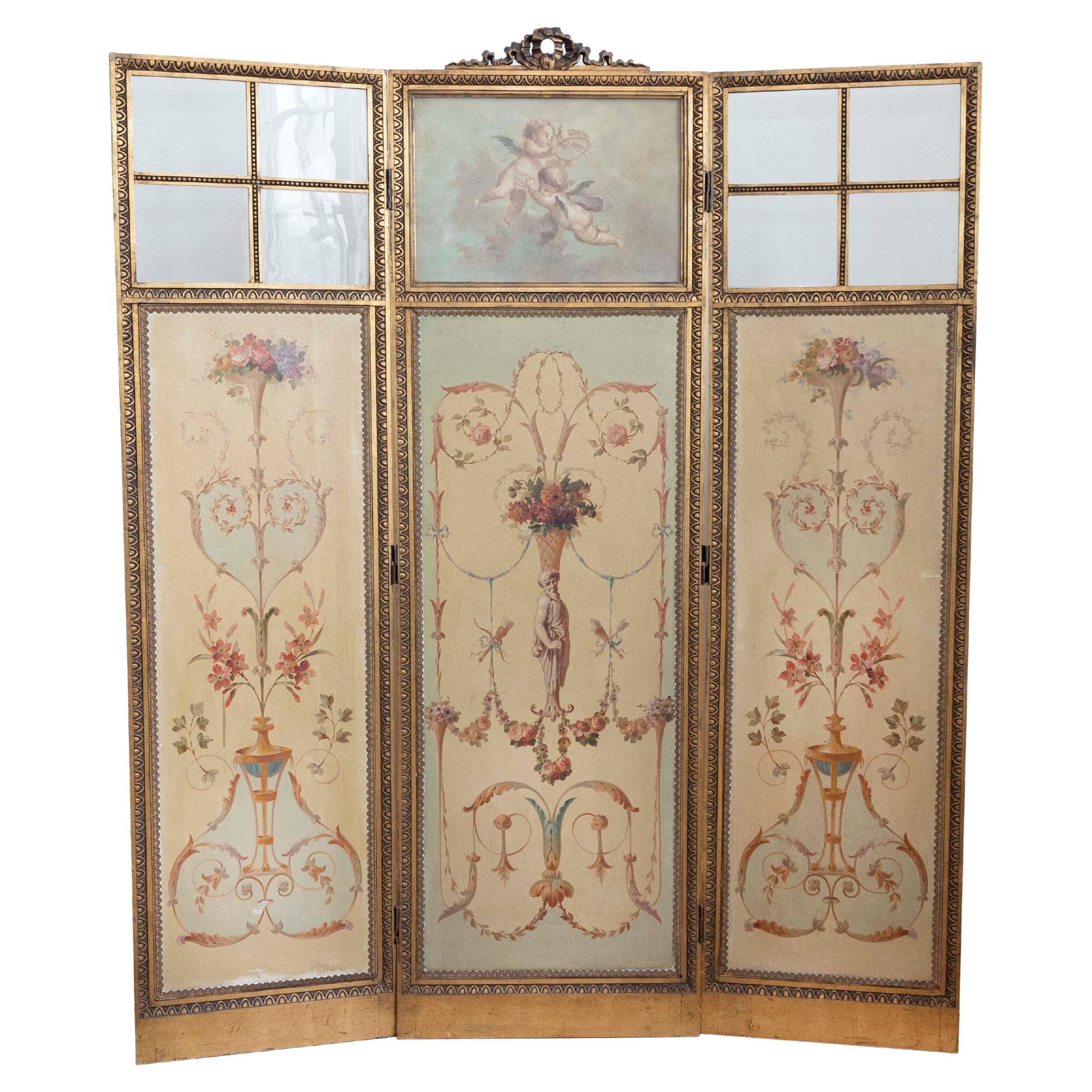
Palatial and Opulent Belle Epoque Giltwood & Oil on Canvas Three-Panel Screen

$88,500
$124,90029% Off
£68,217.13
£96,274.8029% Off
€81,601.91
€115,164.7329% Off
CA$128,702.90
CA$181,638.3429% Off
A$132,682.82
A$187,255.1929% Off
CHF 75,389.26
CHF 106,396.8229% Off
MX$1,679,522.55
MX$2,370,309.2229% Off
NOK 863,312.94
NOK 1,218,393.0729% Off
SEK 904,427.23
SEK 1,276,417.6329% Off
DKK 610,023.54
DKK 860,925.8729% Off

About the Item

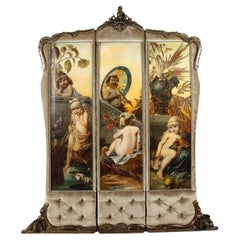
A Palatial and Opulent Belle epoque giltwood & oil on canvas three-panel screen, circa 1890. "Allegory of Youth" Comprising of three exquisite hand-painted triptych oil on canvas panels of cherubs and putti amongst a peacock, all by Ferdinand Wagner II (German, 1847-1927). Each panel depicting different playful and joyous scenes of putti and cherubs. All three-in-one panels within individually carved giltwood and upholstered frames. One panel signed at the lower left: Ferd.Wagner. A truly magnificent and one of a kind piece, perfect for any room in the home. Overall: 101" high 85" wide x 5" deep Very good condition. Ready to place. Ferdinand Wagner II (German, 1847-1927) was the son of Passau Ferdinand Wagner Senior, a teacher at a vocational art school who began training him professionally at a young age. After traveling to Italy in 1867-1868, he continued with his art studies at The Munich Academy of Arts led by Peter Von Cornelius and Julius Schnorr Von Carolsfeld. Wagner II was influenced by the Munich School of master painters and by his art teacher, Karl von Piloty, who had been teaching at the Munich Art Academy since 1856. Piloty’s approach to historical paintings was influenced by the French art academic Paul Delaroche and by the fine artworks by Rubens and the Venetians. After his return to Germany he was commissioned to decorate the former the Tenormayer Wine Tavern in Munich, subsequently he received numerous other commissions as a decorator. Ferdinand Wagner II wall paintings and ceiling frescos attracted the attention from the Munich City Hall and he was commissioned to decorate the cellar and at the German Theatre. He also decorated the dining room at The Drachenburg in the Ko¨nigswinter on the Rhine, the Cafe´ of Roth and Luitpold in Munich and The Tivoli Restaurant in London. Between 1890 and 1891 he was comissioned numerous art works for the "Prince Bismarck" Steamboat. In Passau he created works at the town's City Hall. Between 1892 and 1916 he worked continuously decorating the Castle Ratibor by Roth where in 1894 he painted it's main artwork "The Triumph of Aphrodite". Amongst other works, in 1891 he decorated the facade at The Schwyz City Hall, in 1895 the Grand Hall ceiling fresco at the Castle Bueckeburg's, in 1897 the decoration of the large dining hall at the Famous Munich Hofbra¨uhaus and in 1899 he was commissioned to decorate the tower hall of the newly built Hamburg City Hall. In Passau, Ferdinand Wagner II was awarded numerous honors where, in 1887, he was named an Honorary Citizen, the Ferdinand-Wagner-Straße Street was named after him and the "Ferdinand Wagner Hall" at the Town's City Hall was named after him as well.
  • Creator:
  • Dimensions:
    Height: 101 in (256.54 cm)Width: 85 in (215.9 cm)Depth: 5 in (12.7 cm)
  • Style:
    Belle Époque (Of the Period)
  • Materials and Techniques:
  • Place of Origin:
  • Period:
  • Date of Manufacture:
    circa 1880
  • Condition:
    Wear consistent with age and use.
  • Seller Location:
    Long Island City, NY, NY
  • Reference Number:
    1stDibs: LU1798227737212

More From This Seller

View All
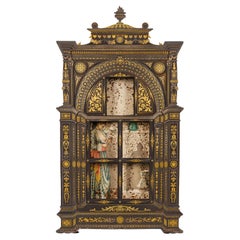
Placido Zuloaga, an Extremely Rare Spanish Gold and Silver Damascened Frame

Placido Zuloaga, an Extremely Rare Spanish Gold and Silver Damascened Frame

By Plácido Zuloaga 1

Located in Long Island City, NY, NY

Placido Zuloaga, An extremely rare Spanish gold and silver damascened window frame, in the Alhambra / Islamic taste, circa 1880. The interior is lined and fitted with an orientalist artwork throughout. Signed PZ on the reverse. Placido Zuloaga was a renowned Spanish metalworker and damascene artist known for his exceptional skills in working with gold and silver and for creating intricate and ornate designs on metal surfaces using a technique called damascening. One of Zuloaga's works is this rare gold and silver damascened frame that he created in the late 19th century. The frame is decorated with intricate designs in silver and gold, creating a stunning contrast that is characteristic of Zuloaga's work. The frame is a remarkable example of Zuloaga's artistry and skill, as well as his mastery of the damascening technique. The technique involves inlaying silver or gold wire into the surface of the metal, creating intricate and detailed designs that are both beautiful and durable. Zuloaga's work was highly sought after during his lifetime and is still highly valued today. His pieces are considered to be some of the finest examples of damascene artistry in the world, and his legacy continues to inspire and influence metalworkers and artists today. His works are in private collections and in museums worldwide. Comparative Literature: James D. Lavin, The Art and Tradition of the Zuloagas, Spanish Damascene...

Category

Antique 19th Century Spanish Islamic Picture Frames

Materials

Steel, Iron

An Exceptional French Ormolu and Vernis Martin Kingwood Commode, Attr. to Dasson

An Exceptional French Ormolu and Vernis Martin Kingwood Commode, Attr. to Dasson

By Henry Dasson

Located in Long Island City, NY, NY

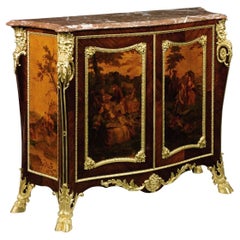
An Exceptional French Ormolu and Vernis Martin Kingwood Commode, Attributed to Henry Dasson, C. 1870 This remarkable commode cabinet epitomizes the elegance and craftsmanship of the...

Category

Antique 19th Century French Napoleon III Commodes and Chests of Drawers

Materials

Marble, Ormolu

Exquisite French Ormolu-Mounted Mahogany and Glass Vitrine Cabinet

Exquisite French Ormolu-Mounted Mahogany and Glass Vitrine Cabinet

By François Linke

Located in Long Island City, NY, NY

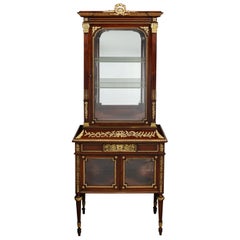
An exquisite French Ormolu-mounted mahogany and glass vitrine cabinet, attributed to Francois Linke, circa 1880. Although unsigned, the jewel-like quality ormolu bronze mounts throughout, especially the corinthian columns, and the best mahogany and craftsmanship of the period, confirms our attribution to Francois Linke, who was almost certainly one of best furniture makers of the Belle Epoque period alongside Paul Sormani, Henry Dasson, Alexandre Chevrie...

Category

Antique 19th Century French Napoleon III Vitrines

Materials

Bronze, Ormolu

Palatial & Rare Napoleon III French Ormolu and Patinated Bronze Clock, Detouche

Palatial & Rare Napoleon III French Ormolu and Patinated Bronze Clock, Detouche

By C. Detouche

Located in Long Island City, NY, NY

A Palatial and Extremely Rare Napoleon III French Ormolu and Patinated Bronze Regulateur de Parquet Clock by Louis-Constantin Detouche, Paris, Circa 1850 An exceptional testament to the grandeur and technical mastery of 19th-century French horology, this palatial and extraordinarily rare Napoleon III ormolu and patinated bronze Regulateur de Parquet clock stands as a crowning achievement of the renowned Parisian horologist Louis-Constantin Detouche. Created circa 1850, this monumental timepiece exemplifies the perfect synthesis of artistic opulence and mechanical precision, distinguishing itself as one of the most impressive works from Detouche’s illustrious oeuvre. At over six feet tall, this clock’s imposing scale and decorative grandeur make it an object of immense historical and aesthetic significance. The case, crafted from the finest French ormolu, features two majestic patinated bronze seated putti, serving as allegorical figures and underscoring the artistic sophistication characteristic of the Second Empire style. The white enamel dial, elegantly signed "C. Detouche/Paris," affirms its prestigious maker, while the movement, meticulously numbered 7064 and bearing the stamps "C. Detouche RUE St. MARTIN" and "C. DETOUCHE 158 R. St MARTIN 160," speaks to the highest standards of 19th-century horological craftsmanship. Further distinguishing this piece is the medaille d’argent stamp, a testament to the numerous accolades and awards bestowed upon Detouche for his innovations in timekeeping. A Masterpiece of Horological Artistry: Louis-Constantin Detouche was not merely a clockmaker; he was a visionary whose contributions to horology redefined precision and complexity. This particular regulator clock...

Category

Antique 19th Century French Napoleon III Grandfather Clocks and Longcase...

Materials

Bronze, Ormolu

Exceptional Quality French Ormolu-Mounted Mahogany Center Table, Attrib F. Linke

Exceptional Quality French Ormolu-Mounted Mahogany Center Table, Attrib F. Linke

By François Linke

Located in Long Island City, NY, NY

An exceptional quality Louis XVI style French ormolu-mounted mahogany and leather coffee center table, attributed to Francois Linke, Paris, circa 1880. With exceptional quality or...

Category

Antique 19th Century French Napoleon III Center Tables

Materials

Bronze, Ormolu

You May Also Like

Palatial and Opulent Belle Epoque Giltwood & Oil on Canvas Three-Panel Screen

Palatial and Opulent Belle Epoque Giltwood & Oil on Canvas Three-Panel Screen

Located in Queens, NY

A Palatial and Opulent Belle epoque giltwood & oil on canvas three-panel screen, circa 1890. "Allegory of Youth" Comprising of three exquisite hand-painted triptych oil on canvas panels of cherubs and putti amongst a peacock, all by Ferdinand Wagner II (German, 1847-1927). Each panel depicting different playful and joyous scenes of putti and cherubs. All three-in-one panels within individually carved giltwood and upholstered frames. One panel signed at the lower left: Ferd.Wagner. A truly magnificent and one of a kind piece, perfect for any room in the home. Overall: 101" high 85" wide x 5" deep Very good condition. Ready to place. Ferdinand Wagner II (German, 1847-1927) was the son of Passau Ferdinand Wagner Senior, a teacher at a vocational art school who began training him professionally at a young age. After traveling to Italy in 1867-1868, he continued with his art studies at The Munich Academy of Arts led by Peter Von Cornelius and Julius Schnorr Von Carolsfeld. Wagner II was influenced by the Munich School of master painters and by his art teacher, Karl von Piloty, who had been teaching at the Munich Art Academy since 1856. Piloty’s approach to historical paintings was influenced by the French art academic Paul Delaroche and by the fine artworks by Rubens and the Venetians. After his return to Germany he was commissioned to decorate the former the Tenormayer Wine Tavern in Munich, subsequently he received numerous other commissions as a decorator. Ferdinand Wagner II wall paintings and ceiling frescos...

Category

19th Century Romantic Figurative Paintings

Materials

Oil

A Beautiful Early 20th Century Gilt and Painted Wood Three Panel Floor Screen

A Beautiful Early 20th Century Gilt and Painted Wood Three Panel Floor Screen

Located in Long Island City, NY

A Beautiful Early 20th Century Gilt and Painted Wood Three Panel Floor Screen Rectangular shaped hand painted panel screen, the center panel depicting a courting couple strolling, the two side paintings with musical instruments...

Category

Early 20th Century French Belle Époque Screens and Room Dividers

Materials

Fabric, Wood, Giltwood

French Louis XV Screen Three Fold Tapestry Dressing Circa 1880

French Louis XV Screen Three Fold Tapestry Dressing Circa 1880

Located in Potters Bar, GB

Elegant French three panel folding screen with carved giltwood and painted frames In the Louis XV style and circa 1880 Each panel inset with decorative tapestry depicting elegant cla...

Category

Antique 1880s Louis XV Tapestries

Materials

Giltwood

19th Century Execptional three leave panel screens giltwoo and tapestry

19th Century Execptional three leave panel screens giltwoo and tapestry

Located in Los Angeles, CA

Napoleon III screens in gilded wood and tapestry , the carved of this sreens is magnificent .all leaves depicting a scene in garden show a couples dancing representing love ,joy and ...

Category

Antique 1880s French Napoleon III Screens and Room Dividers

Materials

Tapestry, Giltwood

Rare Late 19th Century Louis XVI Style Giltwood and Aubusson Tapestry Screen

Rare Late 19th Century Louis XVI Style Giltwood and Aubusson Tapestry Screen

Located in Long Island City, NY

A Rare and Very Special Late 19th Century Louis XVI Style Giltwood and Aubusson Tapestry Three Panel Floor Screen The rectangular shaped wonderful quality woven panel screen still h...

Category

Antique Late 19th Century French Belle Époque Screens and Room Dividers

Materials

Tapestry, Wood, Giltwood

19th Century 3-Fold Screen with Vernis Martin Panels in the Louis XV Style

19th Century 3-Fold Screen with Vernis Martin Panels in the Louis XV Style

By William-Adolphe Bouguereau

Located in London, GB

A three-fold Vernis Martin screen In the Louis XV Manner The frame constructed from carved and gilded wood in the Rococo manner, the triptych Vernis Martin panels depicting idyll...

Category

Antique 19th Century French Louis XV Screens and Room Dividers

Materials

Giltwood, Paint