Video Loading
Want more images or videos?
Request additional images or videos from the seller.

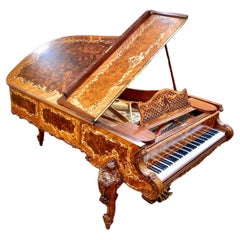
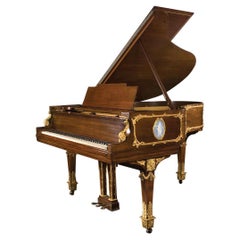
Important Ormolu-Mounted Amaranth, Kingwood and Satine Parquetry Grand Piano

$260,000
£200,411.91
€239,734.44
CA$378,110.23
A$389,802.63
CHF 221,482.58
MX$4,934,190.53
NOK 2,536,286.61
SEK 2,657,074.34
DKK 1,792,159.54

About the Item

Attributed to Henry Dasson (d. 1896) Origin: French Date: circa 1885-q890 Dimension: (H) 35 1/4 in x (W) 54 in x (W) 78 in. Provenance: Acquired by Dr. J. T Nieto-Gomez from first owner March 21, 1926 Acquired by current owner from the above February 1, 1957 An Extremely Fine Quality Ormolu-Mounted Amaranth, Kingwood and Satine Trellis-Parquetry Grand Piano circa 1885-90 Movement by Erard, serial number 68250 the lid inlaid with a trellis pattern parquetry and set with an acanthus-cast molded border lifting to reveal a burr maple veneered interior and movement inscribed Par Brevet d'invention, Seb & Pre Erard 13 & 21, rue du Mail, Paris and stenciled 68250 and with a further stamp PINEL, with ebony keyboard beneath a brass cursive inscription Erard, the case embellished with mounts allegorical of the Triumph of Peace. The lyre shaped pedal stamped 68250, on tapering legs with floral garlands and castors. Catalog Notes: With a serial number corresponding with the Parisian workshop's records between 1876 and 1895, the case of the present piano could strongly be attributed to the celebrated ébéniste and bronzier Henry Dasson (d. 1896). The quality and design of the cabinetry and, moreover, the exquisitely rendered fine gilt-bronze mounts decorating the case of this piano, strongly suggest his work. The attribution is strengthened further by the existence of other Erard pianos with cases signed by Dasson and with similar mounts allegorical of the Triumph of Peace. Sébastien Erard was born in Strasburg in 1752, and established his workshop at 45-47 rue la Boétie in 1777. Following Sebastien's death in 1831, the workshops were taken over by his nephew Pierre Erard who supplied pianos for the most renowned musicians.
  • Attributed to:
    Henry Dasson (Cabinetmaker)
  • Dimensions:
    Height: 35.25 in (89.54 cm)Width: 78 in (198.12 cm)Depth: 54 in (137.16 cm)
  • Style:
    Louis XVI (In the Style Of)
  • Materials and Techniques:
  • Place of Origin:
  • Period:
  • Date of Manufacture:
    1885
  • Condition:
  • Seller Location:
    New York, NY
  • Reference Number:
    Seller: F061316-21stDibs: LU4745220110412

More From This Seller

View All
19th Century Louis XV Style Ormolu-Mounted Tulipwood and Kingwood Bureau Plat

19th Century Louis XV Style Ormolu-Mounted Tulipwood and Kingwood Bureau Plat

By Joseph-Emmanuel Zwiener

Located in New York, NY

An exquisite quality French Louis XV style gilt bronze mounted tulipwood and kingwood bureau plat attributed to Joseph-Emmanuel Zwiener Attributed to Joseph-Emmanuel Zwiener (1848...

Category

Antique Late 19th Century French Louis XV Desks and Writing Tables

Materials

Tulipwood, Kingwood

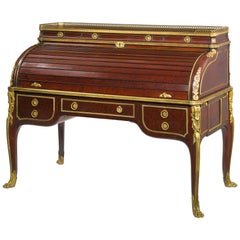
A François Linke Louis XVI Style Gilt-Bronze Mounted Mahogany Bureau à Cylindre

A François Linke Louis XVI Style Gilt-Bronze Mounted Mahogany Bureau à Cylindre

Located in New York, NY

A fine quality Louis XVI style gilt bronze mounted plum pudding mahogany bureau à cylindre after the model by Jean-Henri Riesener. The cylinder opening to six filing compartments an...

Category

Antique Late 19th Century French Desks and Writing Tables

Materials

Bronze

Exceptional Singerie-Themed Rosewood Commode Att , Joseph-Emmanuel Zwiener

Exceptional Singerie-Themed Rosewood Commode Att , Joseph-Emmanuel Zwiener

By Joseph-Emmanuel Zwiener

Located in New York, NY

Maker: Attributed to Joseph-Emmanuel Zwiener Date: Late 19th Century Dimension: 39(H) x 62(W) x 24(D) inches Inspired by Charles Cressent, this darling rosewood commode showcases the increasingly favored theme of hilarious monkey antics. Named "commode aux enfants balançant un singe," the style is beloved by many. One is showcased in the Rothschild Collection at Waddesdon Manor, and another located within the Linsky Collection at the Metropolitan Museum of Art; two reside in the Gulbenkian Museum in Lisbon, and another is part of the collection at the Louvre. Singerie — from the French for "Monkey Trick" — is a genre of art in which monkeys are depicted apeing human behaviour. Adorned with cast gilt bronze, the commode features a delightful scene on its front and sides where two children playfully swing a monkey on a rope amidst a lavish display of cast acanthus leaves. The central monkey ornament...

Category

Antique Late 19th Century French Rococo Commodes and Chests of Drawers

Materials

Bronze

19th Century French Ormolu Mounted Marquetry Center Table Att. Alfred Beurdeley

19th Century French Ormolu Mounted Marquetry Center Table Att. Alfred Beurdeley

By Louis August Alfred Beurdeley 1

Located in New York, NY

A Very Important "Table De Salon" or "Table des Muses", after the design by Alfred Beurdeley An amarante, satine, burr, stained and fruitwood marquetry on sycamore veneers with one...

Category

Antique Late 19th Century French Louis XVI Desks and Writing Tables

Materials

Ormolu

A Fine Quality Louis XVI style Ormolu Mounted Mahogany Bureau Plat by Alexandre

A Fine Quality Louis XVI style Ormolu Mounted Mahogany Bureau Plat by Alexandre

By Alexandre Chevrié, Paris 1

Located in New York, NY

Contains gilt ornaments and a frieze of putti in heaven on either side. Topped with blind-tooled leather, an inset writing surface. Contains one large drawer that runs the width of ...

Category

Antique Mid-19th Century Rococo Revival Desks and Writing Tables

Materials

Bronze, Gold Leaf

19th Century François Linke Ormolu Mounted Tulipwood and Ambonya Commode

19th Century François Linke Ormolu Mounted Tulipwood and Ambonya Commode

By François Linke

Located in New York, NY

An Important 19th Century French Ormolu-Mounted Mahogany, Tulipwood and Amboyna Commode by François Linke The villefranche de conflet marble top above a frieze set with three drawer...

Category

Antique Late 19th Century French Commodes and Chests of Drawers

Materials

Ormolu

You May Also Like

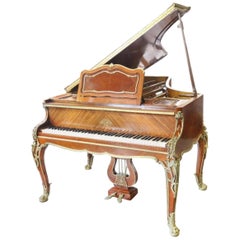
Very Fine Louis XV Style Piano by Francois Linke, Signed., Stamped by Zwiener

Very Fine Louis XV Style Piano by Francois Linke, Signed., Stamped by Zwiener

By François Linke

Located in West Palm Beach, FL

Francois Linke (1855-1946) A very fine Louis XV style gilt bronze mounted kingwood piano,late 19th century , signed Francois Linke, stamped Joseph-Emmanuel Zwiener, movement by E...

Category

Antique Late 19th Century Musical Instruments

Materials

Wood

A German 19th Century Louis XVI Style Burr Walnut Bechstein Concert Grand Piano

A German 19th Century Louis XVI Style Burr Walnut Bechstein Concert Grand Piano

By Bechstein Piano Company

Located in Los Angeles, CA

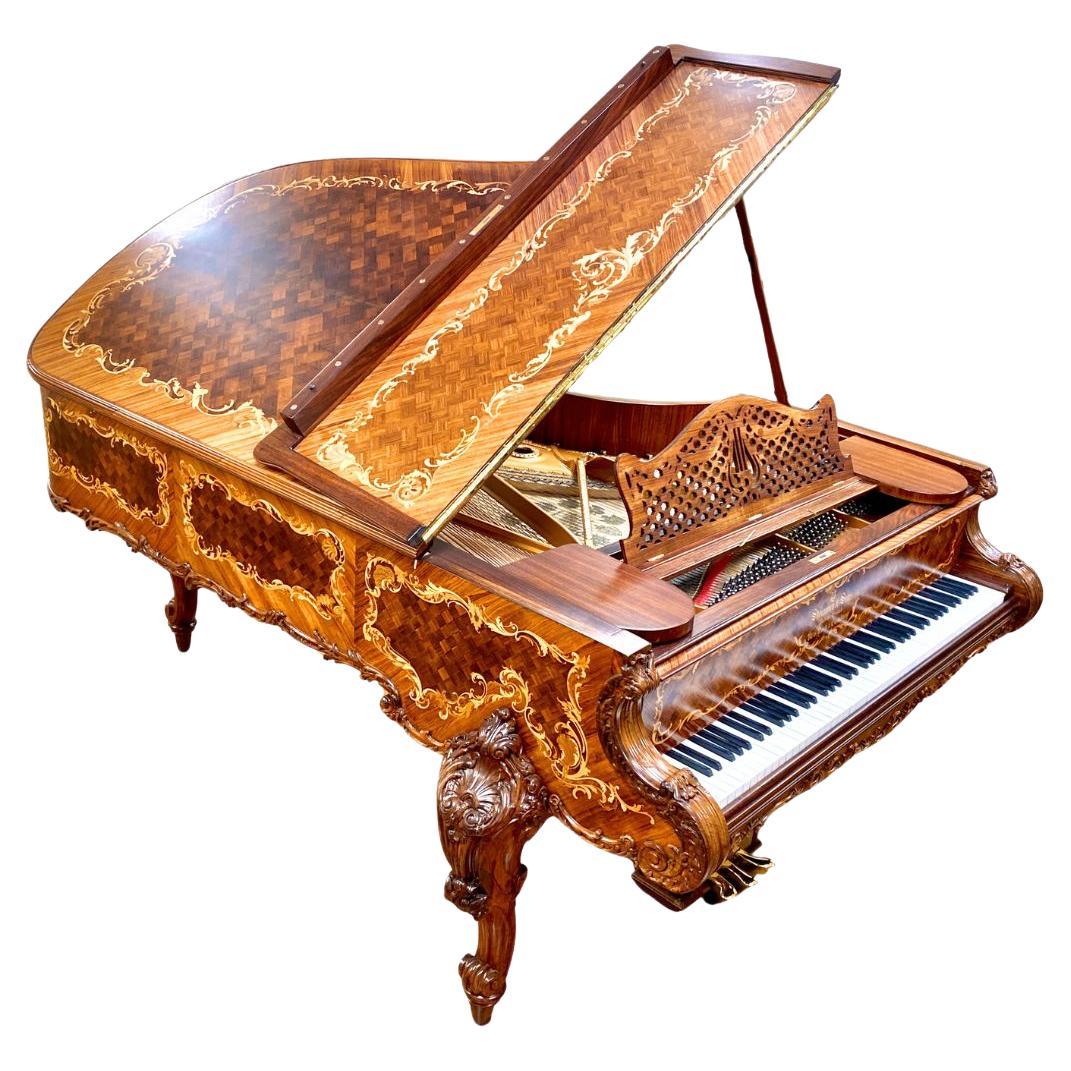
A Very Fine German 19th Century Louis XVI Style Burr Walnut Bechstein Concert Grand Piano, Serial No. 5655. The beautifully crafted Grand piano, raised on three tapered barrel shaped legs, with an intricately carved ornate music desk and original keys. Circa: 1872. Length: 80 inches (203.2 cm) Width: 59 inches: (149.9 cm) Height (top closed): 38 5/8 inches (98.1 cm) C. Bechstein Pianofortefabrik C. Bechstein Pianofortefabrik AG (also known as Bechstein) is a German manufacturer of pianos, established in 1853 by Carl Bechstein. Before Bechstein Young Carl Bechstein studied and worked in France and England as a piano craftsman, before he became an independent piano maker. His first pianos were made for other companies. C. Bechstein C. Bechstein piano factory was founded on 1 October 1853 by Carl Bechstein in Berlin, Germany. Carl Bechstein set out to manufacture a piano able to withstand the great demands imposed on the instrument by the virtuosi of the time, such as Franz Liszt. In 1857, Hans von Bülow (Liszt's son-in-law) gave the first public performance on a Bechstein grand piano by performing Liszt's Piano Sonata in B minor in Berlin By 1870, with endorsements from Franz Liszt and Hans von Bülow, Bechstein pianos had become a staple in many concert halls and private mansions. By that time three piano makers, all of which were founded in 1853, became established as the industry leaders across the world: Bechstein, Blüthner and Steinway & Sons. In 1881 Bechstein began supplying pianos to Queen Victoria. A gilded art-case piano was delivered to Buckingham Palace, followed by several more Bechstein pianos to Windsor Castle and other royal residences. By January 1886 they were among the piano manufacturers holding a Royal Warrant as a supplier to the Queen. Several British embassies across the world acquired Bechstein pianos. In 1885, Bechstein opened a branch in London, that eventually grew to become the largest showroom and dealership in Europe. By 1890 showrooms had been opened in Paris, Vienna, and Saint Petersburg. On 31 May 1901, Bechstein Hall, built at a cost of £100,000, was opened next to the company's London showroom at 36-40 Wigmore Street. Between 1901 and 1914, C. Bechstein was the largest piano dealership in London. At that time, Bechstein was patronized by the tsars of Russia, the royal families of Spain, Belgium, the Netherlands, Italy, Sweden, Norway, Austria and Denmark, and other royalty and aristocracy. The list of royal clients of Bechstein may be found on the soundboard of vintage Bechstein pianos made before the Second World War. The list is part of the original Bechstein trademark logo; it can be seen under the strings in the center of a piano's soundboard. The signature of Carl Bechstein The years from the 1870s through 1914 brought Bechstein their most dramatic increase in sales. In 1880 a second Bechstein factory was opened in Berlin, and the third factory was opened in 1897 in Berlin-Kreuzberg. Production reached 3,700 pianos annually in 1900, and 4,600 in 1910, making Bechstein the largest German manufacturer of high-end pianos. At that time, about three quarters of production went to international markets, especially Britain and the Commonwealth, and Russia. Carl Bechstein died in 1900, and the Bechstein company continued to operate under the management of his sons. Between 1900 and 1914 C. Bechstein was one of the leading piano makers in the world, employing 1,200 craftsmen and workers by 1913 and making five thousand pianos per year. First World War C. Bechstein suffered huge property losses in London, Paris, and St. Petersburg during World War I. The largest loss was in London. Although the company's position in the United Kingdom was initially unaffected, with the company still listed as holding a Royal Warrant in January 1915, Warrants to both King George V, and his wife Queen Mary were cancelled on 13 April 1915. Bechstein was not the only musical concern to be affected by growing anti-German sentiment: there were earlier attempts, led by William Boosey, to boycott German music altogether. In 1915, despite being a Baronet and Privy Counsellor, Sir Edgar Speyer, who was then funding the Proms, was forced to leave the country. Following the passing of the Trading with the Enemy Amendment Act 1916 the British arm of the company was wound-up on 5 June 1916, all Bechstein property, including the concert hall and showrooms full of pianos, were seized as "enemy property" and closed. In 1916 the hall was sold as alien property at auction to Debenhams for £56,500. It was renamed Wigmore Hall, and then re-opened under the new name in 1917. All 137 Bechstein pianos at the Bechstein showrooms were confiscated too, and became property of the new owner of the Hall. After a dispute with his brother, Edwin Bechstein left the company and was paid off. Eventually the Bechstein factory resumed full-scale production during the 1920s. At that time, technical innovations and inventions of new materials and tools, as well as improvements in piano design and construction, had allowed Bechstein to become one of the leading piano makers again. The most successful models were the updated "A"-185 and "B"-208 grand pianos. The upright pianos became more popular after the war, and C. Bechstein were successful with its upright pianos Model-8 and Model-9, both of which have been considered the finest upright pianos. As the company was changed into a joint-stock company 1923, Edwin Bechstein and his wife Helene, bought themselves back into the company as shareholders. In 1930 the company collaborated with German electrical goods manufacturer Siemens under Nobel laureate Walther Nernst to produce one of the first electric pianos...

Category

Antique 19th Century German Louis XVI Musical Instruments
Materials

Bronze

Louis XV Grand Piano by Carl Bechstein, France, 1888

Louis XV Grand Piano by Carl Bechstein, France, 1888

By Carl Bechstein

Located in Queens, NY

French Louis XV-style ormolu mounted kingwood, tulipwood & parquetry grand piano (sgnd C.BECHSTEIN, numbered 20475 for the date 1888)

Category

Antique 19th Century French Musical Instruments

Materials

Ormolu, Brass

Empire Style Ibach Model 2 Grand Piano Mahogany Case Ormolu Mounts

Empire Style Ibach Model 2 Grand Piano Mahogany Case Ormolu Mounts

Located in Leeds, GB

Empire style, 1901, Ibach model 2 grand piano with a mahogany case and gate legs. Entire cabinet decorated with ormolu mounts depicting classical scenes of gods, goddesses and wreaths. This piano is one of 12 unique instruments made as exhibition models...

Category

Early 20th Century German Empire Musical Instruments

Materials

Mahogany