Want more images or videos?
Request additional images or videos from the seller.

Antique Print of a Wedding Ceremony in Japan, ca.1824

$225.67
£170.54
€200VAT Included
CA$321.75
A$331.70
CHF 188.47
MX$4,198.71
NOK 2,158.23
SEK 2,261.02
DKK 1,525.02

About the Item

Isaac Titsingh, Bijzonderheden van Japan. Het huwelijksprotocol uitgebeeld. This print is from a work of Titsingh, who had a long and successful career in Asia. It shows the ceremonies for a wedding, how gifts are exchanged and seating positions. Titel of the book: Bijzonderheden over Japan: behelzende een verslag van de huwelijks plegtigheden, begrafenissen en feesten der Japanezen, de gedenkschriften der laatste Japansche Keizers en andere merkwaardigheden nepens dat Ryk. Uit het Engelsch, met gekleurde platen naar Japansche originelen Auteur Isaac Titsingh Uitgever De Wed. J. Allart, 1824 Isaac Titsingh (c. January 1745 – 2 February 1812) was a Dutch scholar, merchant-trader and ambassador. During a long career in East Asia, Titsingh was a senior official of the Dutch East India Company (VOC). He represented the European trading company in exclusive official contact with Tokugawa Japan, traveling to Edo twice for audiences with the shogun and other high bakufu officials. He was the Dutch and VOC governor general in Chinsura, Bengal. Titsingh worked with his counterpart, Charles Cornwallis, who was governor general of the British East India Company. In 1795, Titsingh represented Dutch and VOC interests in China, where his reception at the court of the Qing Qianlong Emperor stood in contrast to the rebuff suffered by British diplomat George Macartney's mission in 1793, just prior to celebrations of Qianlong's sixty-year reign. In China, Titsingh effectively functioned as ambassador for his country at the same time as he represented the Dutch East India Company as a trade representative. Titel Bijzonderheden over Japan: behelzende een verslag van de huwelijks plegtigheden, begrafenissen en feesten der Japanezen, de gedenkschriften der laatste Japansche Keizers en andere merkwaardigheden nepens dat Ryk. Uit het Engelsch, met gekleurde platen naar Japansche originelen Volumes 1-2 van Bijzonderheden over Japan: behelzende een verslag van de huwelijks plegtigheden, begrafenissen en feesten der Japanezen, de gedenkschriften der laatste Japansche Keizers en andere merkwaardigheden nepens dat Ryk, Isaac Titsingh Auteur Isaac Titsingh Uitgever De Wed. J. Allart, 1824 The condition of the print is good. The paper is equally light brownish and there is one very small hole in the top left corner outside the image, hardly visible. The hand made paper has an interesting watermark : 'Cool & C 'with a small heart.
  • Dimensions:
    Height: 9.65 in (24.5 cm)Width: 11.82 in (30 cm)Depth: 0 in (0.02 mm)
  • Materials and Techniques:
  • Period:
  • Date of Manufacture:
    1824
  • Condition:
    Wear consistent with age and use.
  • Seller Location:
    Langweer, NL
  • Reference Number:
    Seller: BG-13133-131stDibs: LU3054326333522

More From This Seller

View All
Antique Print of a Japanese Wedding Ceremony

Antique Print of a Japanese Wedding Ceremony

Located in Langweer, NL

Antique print titled 'Iapanische traugeprauge - Ceremonie van haer Trouwen'. View of a Japanese wedding ceremony. This print originates from 'Denckwürdig...

Category

Antique Mid-17th Century Prints

Materials

Paper

Pl. 60 Antique Print of Japanese Scenes by Racinet, 'circa 1880'

Pl. 60 Antique Print of Japanese Scenes by Racinet, 'circa 1880'

Located in Langweer, NL

Antique print titled 'Japan - Japon - Japan'. Chromolithograph of Japanese scenes. This print originates from 'Le Costume Historique' by M.A. Racinet. Published, circa 1880.

Category

Antique Late 19th Century Prints

Materials

Paper

Antique Print of Japanese People and Their Costumes

Antique Print of Japanese People and Their Costumes

Located in Langweer, NL

Antique print titled 'Japanneezen in verschillende Kleeding'. This prints shows Japanese people and their costumes. Engraved by D. Veelwaard, circa 1820.

Category

Antique Early 19th Century Prints

Materials

Paper

Original Antique Japanese Wedding Ceremony, Hand-Colored Ferrario Print, 1815

Original Antique Japanese Wedding Ceremony, Hand-Colored Ferrario Print, 1815

Located in Langweer, NL

This is an original hand colored copper engraving, dated 1815, from Giulio Ferrario's Le Costume Ancien et Moderne (ancient and modern costume), showing a Japanese wedding ceremony. ...

Category

Antique Early 19th Century Italian Prints

Materials

Paper

Antique Print of a Japanese Ceremonial Costume by Wahlen, 1843

Antique Print of a Japanese Ceremonial Costume by Wahlen, 1843

Located in Langweer, NL

Antique costume print titled 'Japonais en Costume de Cérémonie'. Original antique print of a Japanese ceremonial costume. This print originates from 'Moeurs, usages et costumes de to...

Category

Antique Mid-19th Century Prints

Materials

Paper

You May Also Like

"Various Himochi" Wagashi Festival Japanese Woodblock Print by Utagawa Toyokuni

"Various Himochi" Wagashi Festival Japanese Woodblock Print by Utagawa Toyokuni

By Utagawa Toyokuni

Located in Soquel, CA

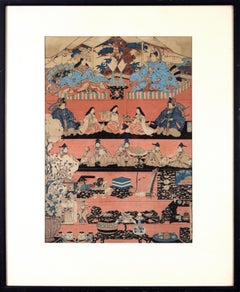
"Various Himochi" Wagashi Festival Japanese Woodblock Print by Utagawa Toyokuni Rare oversized early 19th century 5-tiered woodblock by Utagawa Ichiyosai Toyokuni, (Japan, 1769-1825), a Japanese lord and wife oversee a sekku festival of food, music, and dolls or toys. '"oshi" is the first day of “Mi (Snake)” in the third month of the lunar calendar. This day, known in modern Japan as the Girls' Festival, originated in China as a form of purification ceremony in which water and drinking peach blossom wine were used to drive away evil. Many kinds of hishi-mochi appear in this picture of hina ningyo (dolls associated with Hinamatsuri, or the Girl’s Day) from Omochae. The custom of eating special dishes at events throughout the year and at milestones in people's lives has existed since ancient times. This paragraph specifically focuses on the annual event called sekku, and life events that involve eating sweets. Joshi is the first day of “Mi (Snake)” in the third month of the lunar calendar. This day, known in modern Japan as the Girls' Festival, originated in China as a form of purification ceremony in which water and drinking peach blossom wine were used to drive away evil. According to the Keiso saijiki, in ancient China, on the third day of the third lunar month, people ate “ryuzetsuhan,” which is the juice of gogyo (Jersey cudweed) mixed with rice flour and nectar. In Japan, there is a record in the Heian period history book Nihon Montoku tenno jitsuroku [839-5] that it was an annual event to make kusamochi using gogyo on the third day of the third month of the lunar calendar, which may have been influenced by Chinese customs. The tradition of eating kusamochi on the third day of the third month of the lunar calendar continued after that. By the Edo period, however, hishimochi had come to be used as a sweet to serve on the third day of the third month. A picture of a hishimochi is included in the Morisada manko , which we mentioned in Part 1. According to it, hishimochi in the Edo period were often three layers of green-white-green instead of the now common red-white-green. However, it is possible to see from our collection that not all hishimochi were made in this way. Omochae published in 1857, is a good example. Omochae is a type of ukiyoe print...

Category

1820s Edo Figurative Prints

Materials

Ink, Rice Paper, Woodcut
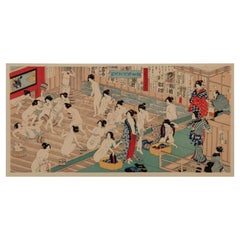
Japanese Woodblock Print by Utagawa Yoshiika 落合芳幾  '1833-1904'

Japanese Woodblock Print by Utagawa Yoshiika 落合芳幾 '1833-1904'

Located in Norton, MA

Japanese woodblock print by Utagawa Yoshiika 落合芳幾 (1833-1904), unframed. About the artist Yoshiiku was a popular ukiyo-e printmaker during the Meiji period. It is thought that he was the son of a tea house proprietor, hence his particular skill success in the portrayal of various beauties from teahouses and restaurants. Yet, he was an artist comfortable across subject matter and is recognized for his fierce portrayal of famous historical warriors. Yoshiiku was a student of Kuniyoshi and a contemporary rival of the famed Yoshitoshi. He signed his name Utagawa Yoshiiku...

Category

Antique Mid-19th Century Japanese Prints

Materials

Paper

Lovely Japanese Blockprint Made by Kogyo Antique Meiji, 19th century

Lovely Japanese Blockprint Made by Kogyo Antique Meiji, 19th century

Located in Amsterdam, Noord Holland

Interesting and finely painted Japanese painting. Marked Kogyo. Additional information: Material: Paper Type: Paintings, Scrolls & Prints Region of Origin: Japan Period: ca 1900 Age...

Category

Antique 19th Century Japanese Prints

Materials

Paper

Antique Japanese Wood Block Print Of Scene From Sumidagawa Play, Tsukioka

Antique Japanese Wood Block Print Of Scene From Sumidagawa Play, Tsukioka

Located in Big Flats, NY

Antique Japanese Wood Block Print Of Scene From Sumidagawa Play Signed By Kogyo Tsukioka 19thC Measures - 13 3/8" x 18" x 1 1/4" This antique Japanese woodblock print, signed by Ko...

Category

Antique 19th Century Prints

Materials

Paper

Japanese Woodblock Gakutei by Harunobu Sugawara-2

Japanese Woodblock Gakutei by Harunobu Sugawara-2

Located in Norton, MA

Japanese Woodblock Gakutei (1786-1868) by Harunobu Sugawara, original and unframed. About the artist Born in Edo as Harunobu Sugawara, Gakutei Yashima studied printmaking under Shuei and Hokkei. He moved to Osaka in the 1830s, where he designed landscape studies of his new home with a delicate and decorative style likely influenced by Hokusai. In addition to printmaking, he wrote Kyoka (comic poems), often illustrating these verses in his prints. While a talented woodblock artist, Gakutei was also known throughout Japan as a writer. He translated and illustrated the 16th-century Chinese novel Journey to the West...

Category

Antique Early 19th Century Japanese Prints

Materials

Paper