Want more images or videos?
Request additional images or videos from the seller.

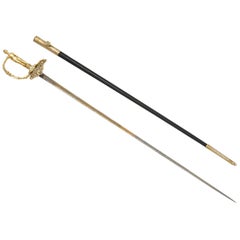
Midshipman Proctor’s Sword for Valour at the Battle of Copenhagen

$253,076.28
£187,500
€228,774.89
CA$360,824.78
A$371,982.66
CHF 211,357.42
MX$4,708,622.16
NOK 2,420,339.32
SEK 2,535,605.19
DKK 1,710,230.30

About the Item

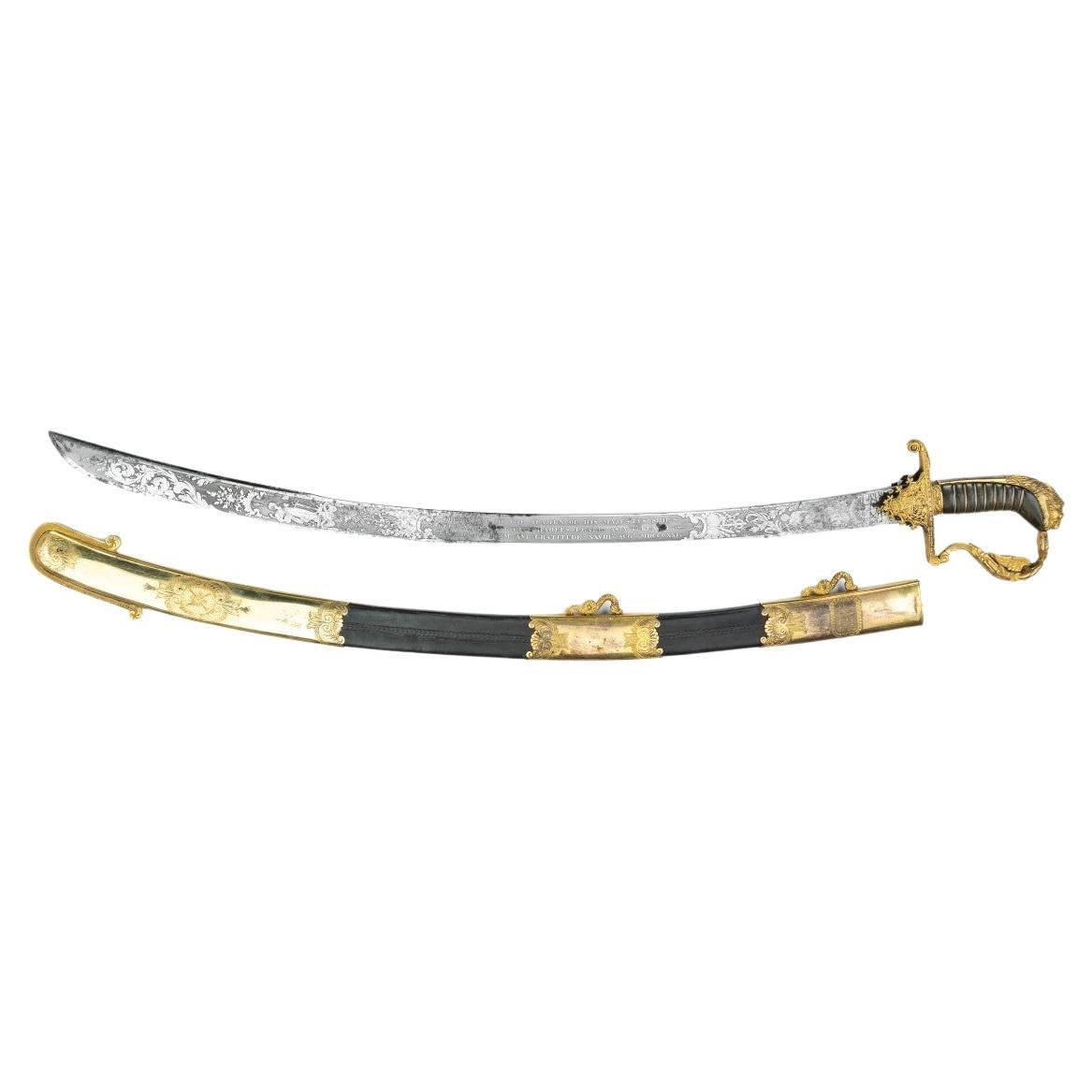
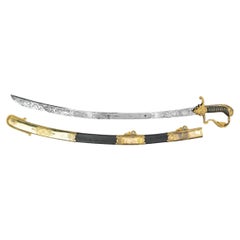
This curved sword has a blued steel German blade with an ivory cross-hatched grip bearing silver and gilt mounts in the form of a lion’s head and mane. The grip is mounted with an oval silver plaque engraved with the coat of arms (1801-1816 pattern) of King George III supporting a medal decorated with a fouled anchor; and the has reverse a similar plaque engraved with the monogram JP, probably for Midshipman James Proctor, surmounted by a naval coronet, within a garter inscribed ‘Battle of Copenhagen’ above the ship’s name ‘EDGAR’. The top of the blade signed in gilt ‘J.J. Runkel Solingen’. With belt and slings in a fitted mahogany box lined in green velvet. English, c 1800. James Proctor (died before 1814), the likely recipient of this presentation sword, was midshipman in HMS Edgar, 74 guns, which led Nelson’s division at the Battle of Copenhagen in April 1801. As the first ship to engage the enemy, Edgar sustained extensive damage and suffered 142 casualties including one lieutenant killed, another whose arm was shot away, and five midshipmen wounded. Among the wounded was Proctor who, given the officer losses, may have demonstrated outstanding leadership for which he received this sword, possibly from his grateful commanding officer Captain James Murray. Proctor recovered from his wound, was promoted lieutenant and by March 1805 was serving in Spencer, 74 guns, attached to Nelson’s fleet in the Mediterranean. However, with many of the crew suffering from scurvy and fever, Spencer was sent away to re-victual just days before Trafalgar. The ship subsequently joined Admiral Duckworth’s squadron for the Battle of San Domingo in February 1806 Presented before the institution in 1803 of Lloyd’s Patriotic Fund, this sword is an example of an unofficial presentation made on an ad hoc basis by a senior officer following an action. To Nelson’s dismay, the Battle of Copenhagen was not recognised with a gold medal and, unlike the Nile, it was not widely commemorated making relics connected to the action rare. Johann Justus Runkel (1751-1808) was born in Germany. He emigrated to Britain as an importer of swords and sword blades from Solingen and set up shop at 8 Tookes Court, Castle Street, Holborn where he sold swords to military officers and unmounted blades to other English cutlers including Thomas Gill. Despite fines, court cases and confiscation of blades for undervaluing imports, he was one of the most important merchants involved in the trade of Solingen blades in London and became a freeman of the Cutlers Company in 1796. Ivory License Ref: 27PA12UF
  • Dimensions:
    Height: 37 in (93.98 cm)Width: 0.1 in (2.54 mm)Depth: 0.1 in (2.54 mm)
  • Materials and Techniques:
  • Place of Origin:
  • Period:
  • Date of Manufacture:
    1800
  • Condition:
    Wear consistent with age and use.
  • Seller Location:
    Lymington, GB
  • Reference Number:
    1stDibs: LU973036542782

More From This Seller

View All
Fine Presentation Sword Given to Lieutenant Charles Peake

Fine Presentation Sword Given to Lieutenant Charles Peake

Located in Lymington, Hampshire

A fine presentation sword given to Lieutenant Charles Peake as a token of gratitude by the Men of His Ship when recommissioned for Foreign Service i...

Category

Antique 1820s English Arms, Armor and Weapons

Materials

Metal

A Historically Important Sword Given to Midshipman Finucane by Sir Peter Parker

A Historically Important Sword Given to Midshipman Finucane by Sir Peter Parker

Located in Lymington, Hampshire

Provenance Vice-Admiral Sir Charles Paget (1778-1839) Given to Sir Peter Parker (1775-1814) Given to Midshipman Henry Augustus Finucane (1798-1850) Given back by Finucane to the ...

Category

Antique Early 19th Century English Nautical Objects

Materials

Brass

Large Elm Tiller from the Brixam Fishing Trawler 'Provident'

Large Elm Tiller from the Brixam Fishing Trawler 'Provident'

Located in Lymington, Hampshire

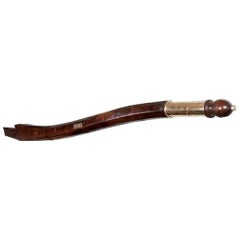
A large elm tiller with a bronze helm and turned finial from the Brixham fishing trawler 'Provident', 1924 Provident details: Builder: J Sander...

Category

Vintage 1920s English Sports Equipment and Memorabilia

Materials

Elm

Mid-Victorian Model of a Field Cannon

Mid-Victorian Model of a Field Cannon

Located in Lymington, Hampshire

A mid-Victorian model of a field cannon, the bronze barrel set on an oak carriage with large iron-bound wheels, with traces of the original black, red an...

Category

Antique 1870s English Arms, Armor and Weapons

Materials

Bronze

Pair of Antique English Naval Cannon

Pair of Antique English Naval Cannon

Located in Lymington, Hampshire

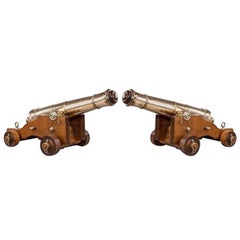
Pair of antique English naval cannon each with a tapering three stage barrel flanked by plain trunnions, with a knob shaped cascabel button before a shaped rectangular raised vent and ending in a 3 1/2” bore muzzle, enclosing a removable conforming wood plug, circa 1800. Stood upon a naval type bronze-mounted four wheeled wooden carriage, including its wedge shaped quoin with knob handle. The Earls of Lonsdale, Lowther Castle, Cumbria, presumably by descent to Hugh Cecil Lowther, 5th Earl of Lonsdale (1857-1944), until sold by his heir and brother, Lancelot, 6th Earl, as part of the contents of Lowther Castle, Maple & Co. Ltd./Thomas Wyatt, Tuesday 14 April 1947 and two following days, lot 558: ‘A pair of Old Gun Metal Cannons on teakwood carriages, 3ft. 6in. long’. Mrs. P.M. Adie-Shepherd, sold Christie’s, London, 29 May 1970, lot 96. Lowther Castle is a castellated mansion built by Robert Smirke between 1806 and 1814 for William Lowther, 1st Earl of Lonsdale (1757-1844). It was constructed on the foundations of the former 17th century family seat, Lowther Hall, but it was only in the early 19th century that it was afforded the name ‘castle’ in keeping with the Europe-wide fashion for romanticism and which was promoted by influential characters such as William Beckford at Fonthill Abbey, Wiltshire in England and by the writer Sir Walter Scott at Abbotsford, Roxburghshire, Scotland. While it’s not known when these naval cannon were acquired for Lowther they would have been entirely fitting in the castle or its approaches and it’s likely that they were in place soon after the castle was completed, or perhaps acquired later by the 5th Earl. A tantalising possibility is that the cannon were originally aboard the East Indiaman Lowther Castle which was active in the early 19th century. HUGH CECIL LONSDALE, 5TH EARL OF LONSDALE (1857-1944) AND THE DEMISE OF LOWTHER CASTLE In 1882 at the age of 25 Hugh Lonsdale (1857-1944) unexpectedly inherited the earldom and with it the extensive Lonsdale estate, including tens of thousands of acres of Cumberland and Westmorland and coalfields at Whitehaven. However, despite his spectacular inherited wealth – he was suddenly one of the wealthiest men in England, over the course of his lifetime he managed to decimate the family fortune. He led a full and colourful life, one of adventure and luxury. An early intrepid escapade took place in July 1888 when, as part of an expedition called the Scotch Naturalist Society, he set embarked on horse sleigh...

Category

Antique Early 1800s English Arms, Armor and Weapons

Materials

Bronze

Model of a cannon made from bronze recovered from the the former flagship

Model of a cannon made from bronze recovered from the the former flagship

Located in Lymington, Hampshire

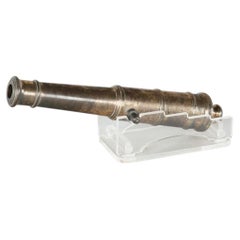
Model of a cannon made from bronze recovered from the the former flagship of the Royal Navy’s Western Squadron, HMS Royal George, a veteran of the Battles of Quiberon Bay (1759) and ...

Category

Antique 19th Century English Models and Miniatures

Materials

Bronze

You May Also Like

19th Century British Cavalry Officer's Sword and Sheath

19th Century British Cavalry Officer's Sword and Sheath

Located in Dublin 8, IE

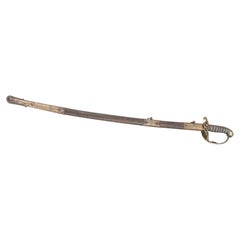
19th Century British cavalry officer’s sword and sheath stamped Hawks & Co. Piccadilly. The sword features an etched, original blade and three-bar hilt with a metal scabbard.

Category

Antique 19th Century English Georgian Arms, Armor and Weapons
Materials

Metal, Steel

Officer's Sword – France Or Austrian Netherlands – Circa 1770–1790

Officer's Sword – France Or Austrian Netherlands – Circa 1770–1790

Located in Bilzen, BE

"Officer's Sword – France Or Austrian Netherlands – Circa 1770–1790 – Length 99 Cm" An elegant officer's sword, late 18th century (circa 1770–1790), probably French or Austrian Nethe...

Category

Antique Late 18th Century French Louis XVI Arms, Armor and Weapons
Materials

Brass, Steel

Civil War M1840 AMES Artillery Sword With Scabbard 1862

Civil War M1840 AMES Artillery Sword With Scabbard 1862

Located in Dallas, TX

CIVIL WAR M1840 AMES ARTILLERY SWORD SCABBARD 1862 Length: 37 Inches overall with a 32" blade that is 1 1/4" wide. The blade is excellent and shiny Marked: Ames Mfg. Co. Chicopee Ma...

Category

Antique 1860s American American Classical Mounted Objects

Materials

Cast Iron, Steel, Brass

19th Century British Officer's Sword and Sheath Stamped 'Buckmaster'

19th Century British Officer's Sword and Sheath Stamped 'Buckmaster'

Located in Dublin 8, IE

19th Century British officer's sword and sheath stamped 'Buckmaster'. The saber features an original, etched blade and a leather sheath, fitted with brass mounts on the ends and middle.

Category

Antique 19th Century English Georgian Arms, Armor and Weapons

Materials

Steel

Jean-Gabriel Domergue's French Academician Sword

Jean-Gabriel Domergue's French Academician Sword

By Odette Domergue

Located in New Orleans, LA

This important and unique sword was presented to the famed French painter Jean-Gabriel Domergue to commemorate the painter's election to the illustrious Académie des Beaux-Arts in 1950. One of the highest honors bestowed on a French artist, the ceremonial induction into the French Academy has been accompanied by the presentation of a sword since the age of Napoléon. Rather than a weapon, the sword became part of the Academician's uniform, and, over time, its design came to represent the interests and aspirations of its recipient. This example was designed entirely by Domergue's wife Odette, a great sculptor in her own right, and thus it represents both a highly personal gift and an important art historical relic. The design of the sword is simply magnificent. Odette Domergue found her inspiration in antiquity, a theme that is also seen in the neoclassical sculptures that occupy the gardens of the couple's famous home, Villa Fiesole - also known as Villa Domergue - in Cannes. The impressive weapon boasts a solid gold handle that takes the form of a sinuous caryatid, who is nude save for a single swath of drapery. While the female figure recalls the sculpted supports prevalent in ancient Greek architecture, she also calls to mind the subjects for which Domergue was renowned - languorous, slightly risqué women with a seductive air. Other decorative elements such as fauna, cypresses, and grotesque heads enhance the whimsy and imagination of the incredible neoclassical design. Furthermore, the scabbard that contains the finely etched blade is also an impeccable work of art. Crafted of black Moroccan leather in imitation of the snake skin, it displays intricately engraved foliage patterns with a lion's head and Domergue's coat of arms. Though imagined by his wife, the sword was expertly chiseled by the celebrated goldsmith R. Delsinne and assembled by the atelier of the famed sculptor and medalist Raymond Delamarre...

Category

20th Century Neoclassical Arms, Armor and Weapons

Materials

Steel