Want more images or videos?
Request additional images or videos from the seller.

Eisenhower's 1952 Portrait Style Presidential Campaign Kerchief

$1,950
£1,503.09
€1,798.01
CA$2,835.83
A$2,923.52
CHF 1,661.12
MX$37,006.43
NOK 19,022.15
SEK 19,928.06
DKK 13,441.20

About the Item

PORTRAIT STYLE KERCHIEF FROM THE 1952 PRESIDENTIAL CAMPAIGN OF REPUBLICAN IKE EISENHOWER, FORMER SUPREME COMMANDER OF ALLIED FORCES IN EUROPE DURING WWII (NATO) Printed cotton kerchief, made for the 1952 presidential campaign of General Dwight David "Ike" Eisenhower and Richard M. Nixon. A portrait of the man who would become the 34th President of the United States appears above his famous slogan, "I Like Ike", within a flag-draped, oval frame, decorated with scrollwork and crowned with a star. Above this, in large lettering, the following text appears: "Win With Ike For President." The turkey red background has a white calico print in the center, surrounded by a swag border of red and blue stripes. "Ike" appears below the gathering of each valence and a patriotic shield anchors each corner. A maker's mark appears along the edge, and though it does not reveal the maker's name, the words "Fast Color" surround an image of an elephant, the Republican Party mascot. A Brief History of Dwight D. "Ike" Eisenhower: A U.S Army general, Eisenhower served as Supreme Commander of the Allied forces in Europe during WWII. He was immensely popular and produced landslide wins in both 1952 and 1956, losing only in the Democratic, deep South to his opponent, Adlai Ewing Stevenson II, Governor of Illinois. Stevenson's grandfather, Adlai Ewing Stevenson I, served as Vice President under Grover Cleveland following his second campaign win (1892), made an unsuccessful bid for the 1896 presidential nomination, then ran again on the 1900 ticket for Vice President under William Jennings Bryan in 1900, in a campaign lost to William McKinley & Teddy Roosevelt. Born on October 14th, 1890, in Denison, Texas, Eisenhower grew up in Abilene, Kansas, where he "absorbed the virtues of small town America that distinguished him the rest of his life-scrupulous honesty, self-reliance, determination, and hard work as President" (U.S. Army Center of Military History, publication 71-40). Graduating from West Point in 1915, Eisenhower served as Captain during WWI (U.S. involvement 1917-18), but never left the States, which immensely disappointed him. During the signing of the Armistice of November 11th, 1918, that ended the war, he was in command of Camp Colt, the Army's tank corps training center on the Civil War battlefield at Gettysburg. In 1930, he became special assistant to General Douglas MacArthur, then Chief of Staff, which vaulted him up the Army food chain. Eisenhower followed McArthur to the Philippines, but after the bombing of Pearl harbor, he was summoned to Washington to serve under Franklin Roosevelt's U.S. Army Chief of Staff, General George C. Marshall, who would oversee the building of the largest military force in U.S. history. Marshall appointed Eisenhower chief of the War Plans Division (subsequently Operations Division), the office widely regarded as the brains of the Army. After the German surrender, Eisenhower, now Chief of Staff, presided over the postwar demobilization. During this time he became the Army's first Chief of Staff to participate in the newly created, unified, Joint Chiefs of Staff. In 1948, Eisenhower retired from the Army to become president of Columbia University, but the Korean War followed shortly thereafter and, in 1951, he became the first supreme commander of Allied Forces in Europe (NATO). Eisenhower would eventually end the war as president and he maintained a stern eye on the Cold War during his tenure in the Whitehouse. He was the first president to be "constitutionally forced" from office, in 1961, having served the maximum two terms. Term limitations had come about via the 22nd Amendment to the U.S. Constitution, ratified in 1951, just prior to Eisenhower’s 1952 election. Following the presidency he retired to Gettysburg. He passed in 1969 at Walter Reed Hospital and was buried in his hometown of Abilene, Kansas. His funeral was presided over by then-president Richard Nixon, who had served as Eisenhower's vice president for both terms. Mounting: The textile was mounted and framed within our own conservation department, which is led by expert trained staff. We take great care in the mounting and preservation of flags and have framed thousands of examples. The mount was then placed in a black-painted, hand-gilded and distressed Italian molding. Spacers keep the textile away from the glass, which is U.V. protective. Fell free to contact us for more details. Condition: Minor fading.
  • Dimensions:
    Height: 46 in (116.84 cm)Width: 46 in (116.84 cm)Depth: 25 in (63.5 cm)
  • Materials and Techniques:
  • Place of Origin:
  • Period:
  • Date of Manufacture:
    1952
  • Condition:
    See Item Description.
  • Seller Location:
    York County, PA
  • Reference Number:
    Seller: ker-0011stDibs: LU849740262472

More From This Seller

View All
Teddy Roosevelt Silk Kerchief Made for His 1912 Presidential Run

Teddy Roosevelt Silk Kerchief Made for His 1912 Presidential Run

Located in York County, PA

SILK CAMPAIGN KERCHIEF FEATURING A PROMINENT BULL MOOSE, MADE FOR THE 1912 PRESIDENTIAL RUN OF TEDDY ROOSEVELT, WHEN HE RAN ON THE NATIONAL PROGRESSIVE PARTY TICKET Printed silk ker...

Category

Vintage 1910s American Political and Patriotic Memorabilia

Materials

Silk

Commission Pennant with 13 Stars, like for Private Vessel, Ca 1892-1910

Commission Pennant with 13 Stars, like for Private Vessel, Ca 1892-1910

Located in York County, PA

Commission pennants are the distinguishing mark of a commissioned U.S. Navy ship. Flown at the topmast, the typical American format is a long blue field, usually with a single row of white stars, although sometimes with their total divided into two rows, followed by two long stripes, red-over-white. A ship became commissioned when this pennant was hoisted. Flown during both times of peace and war, the only time the pennant is not flown is if a flag officer or civilian official was aboard and replaced it with their own flag. Sometimes the owners of private ships mimicked the use of Navy signals. Some seafaring men would have served in the Navy and become privy to various practices in that capacity. Others flew them purely for stylistic reasons, either on a regular basis or while the boat was dressed for special occasion. Hudson River steamers regularly flew pennants of this nature, as evidenced by period photography as well as the paintings of artists such as John and James Bard...

Category

Antique Late 19th Century American Political and Patriotic Memorabilia

Materials

Wool

Hand-Painted 19th Century Banner with the 1867 Proposed Seal of Illinois

Hand-Painted 19th Century Banner with the 1867 Proposed Seal of Illinois

Located in York County, PA

HAND-PAINTED 19TH CENTURY BANNER WITH AN 1867 VERSION OF THE SEAL OF THE STATE OF ILLINOIS, PROPOSED IN THAT YEAR BY THE SECRETARY OF STATE, BUT IN A VARIATION NEVER FORMALLY ADOPTED Banner with the Illinois State Seal, in a rare variation of the design, never adopted. In 1867 Illinois Secretary of State Sharon Tyndale proposed that the phrases in the state motto be reversed. In the wake of the Civil War, (which ended in 1865,) Tyndale suggested that the verbiage be changed from "State Sovereignty--National Union" to "National Union--State Sovereignty,” which made sense given the recent secession of the Southern States, which placed their own interests first. Illinois' own Abraham Lincoln had worked hard to preserve national interests, echoed here in the altering of the language. Though Tyndale’s suggestion was rejected, he was nonetheless charged with creating a new design, which he did and was soon adopted. This displayed the dates of "1818," when Illinois became a state, and "1868," when the seal was officially changed. Interestingly enough, Tyndale did manage to send a message in the new version by turning the word “sovereignty” upside-down , with the surmised explanation that this fit accordingly with the orientation / position of the streamer. The banner is beautifully hand-painted on muslin and retains its original staff. The shape is beautifully scalloped at the bottom edge, which is painted to look as if there is an applied fringe. Most of the elements are congruent with the 1868 version, but there are various differences. Set within a shield-shaped medallion—usually circular—is the expected eagle in a side view, spread wing pose with beak uplifted. The eagle is supposed to be perched upon a rock with one talon, while gripping a Federal shield in the other. Here there is no rock and both talons grip the shield, which displays 13 stars. Note the date of "1867" and Tyndale's preferred order of the wording on the billowing ribbon in the eagle's beak. The foreground of the official design is all grass. Here there are olive branches—a peacetime reference appropriate for a country recovering from war—on a grassy area, set upon a sandy shore before Lake Michigan, with a rising sun on the horizon. Mounting: The banner was mounted and framed within our own conservation department, which is led by masters degree trained staff. We take great care in the mounting and presentation of flags and have preserved thousands of examples; more than anyone worldwide. The background is 100% cotton twill, black in color. The mount was placed in a black-painted, hand-gilded and distressed Italian molding. A shadowbox was created to accommodate the staff. The glazing is U.V. protective plexiglass. Feel free to contact us for more details. Banner - 49" x 56.5" Frame - 67.75" x 59.25" About Jeff R. Bridgman Antiques, Inc.: As an advisor to top museums and collectors alike, Jeff Bridgman is the world's leading expert and source for antique American flags and political textiles...

Category

Antique 1860s American Political and Patriotic Memorabilia

Materials

Cotton

Teddy Roosevelt and His Great White Fleet American Flag, circa 1907-1909

Teddy Roosevelt and His Great White Fleet American Flag, circa 1907-1909

Located in York County, PA

Rare & Beautiful American Parade Flag With Images Of Teddy Roosevelt And His Great White Fleet, 1907-1909, Ex-richard Pierce Collection: 46 star parade ...

Category

Antique Early 1900s American Political and Patriotic Memorabilia

Materials

Silk

13 Star American Parade Flag with Rare Design, circa 1888 Ex Richard Pierce

13 Star American Parade Flag with Rare Design, circa 1888 Ex Richard Pierce

Located in York County, PA

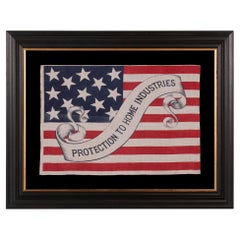
13 Star American parade flag in an extremely rare design, with “protection to home industries” slogan on a fanciful, scrolling streamer, made for the 1888 presidential campaign of Benjamin Harrison; formerly in the collection of Richard pierce. 1888 Benjamin Harrison campaign flag, printed on cotton, with 13 large stars in a 3-2-3-2-3 pattern, upon which a whimsical, scrolling streamer is superimposed that features the slogan: “Protection to Home Industries.” There are numerous styles of both documented and undocumented, red, white, and blue bandanas and handkerchiefs, made for Harrison’s campaign in this year, as well as from the subsequent one, in 1892. Most bear variations of text to support the “Protection for American Industries” platform of the Republican Party. America was in the midst of the industrial age and there was a great deal of public interest, both in protecting growth and discouraging both imported goods and immigration. The constant stream of immigrants posed great challenges for a working families, competing for scarce jobs, in work environments that were already often far from ideal. In post-Civil War America, many of the working men were Civil War veterans. Bandanas abound from Harrison’s Campaigns, but flags do not. This example, along with three others, were once part of an 1888 patriotic quilt that was disassembled by a dealer and sold piecemeal to collectors. I eventually acquired all four. Fifteen to twenty years ago, these were the only four known copies. A couple of others have since surfaced, but the total count known still stands closer to 5 than 10. The use of 13 stars is seen in the flags of various candidates in the 19th century. Among these are Abraham Lincoln (1860 campaign), Henry Clay (1844 campaign), John Fremont (1856), and Benjamin Harrison’s grandfather, William Henry Harrison...

Category

Antique 1880s American Political and Patriotic Memorabilia

Materials

Cotton

13 Star Antique Parade Flag, Hand Inscribed by the Owner in Salem, MA 1896

13 Star Antique Parade Flag, Hand Inscribed by the Owner in Salem, MA 1896

Located in York County, PA

ANTIQUE AMERICAN FLAG WITH 13 STARS ARRANGED IN 6-POINTED GREAT STAR / STAR OF DAVID PATTERN, OF A TYPE MADE FOR THE 1876 CENTENNIAL OF AMERICAN INDEPENDENCE, WORN AND HAND-INSCRIBED...

Category

Antique 1870s American Political and Patriotic Memorabilia

Materials

Cotton

You May Also Like

Thomas Dewey & Harry Truman 1948 Presidential Election Campaign Collage

Thomas Dewey & Harry Truman 1948 Presidential Election Campaign Collage

Located in Colorado Springs, CO

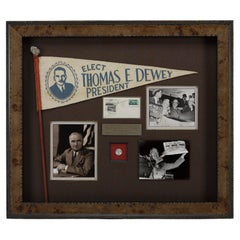
Presented is a unique commemorative collage, celebrating the 1948 U.S. presidential election between Harry Truman and Thomas Dewey. This one-of-a-kind collage features a Harry Truman signed...

Category

Vintage 1940s American Mid-Century Modern Political and Patriotic Memora...

Materials

Metal

"The Old Flag and Protection" Benjamin Harrison Campaign Handkerchief, 1888

"The Old Flag and Protection" Benjamin Harrison Campaign Handkerchief, 1888

Located in Colorado Springs, CO

Presented is an original Benjamin Harrison campaign handkerchief, from the 1888 presidential election. Printed on white silk, this design features a waving 39-star American flag and ...

Category

Antique 1880s American Political and Patriotic Memorabilia

Materials

Silk

Large Framed American Flag Folk Art Quilt

Large Framed American Flag Folk Art Quilt

Located in Santa Monica, CA

Nicely faded American flag quilt. Excellent hand stitched dancing Folk Art stars. Skilled quilting, a nice graphic large-scale wall hanging. White ...

Category

Early 20th Century North American Folk Art Political and Patriotic Memor...

Materials

Cotton

46-Star Printed American Flag, "Baltimore 1903 Saengerfest Inaugural Concert"

46-Star Printed American Flag, "Baltimore 1903 Saengerfest Inaugural Concert"

Located in Colorado Springs, CO

Presented is an original 46-star American parade flag, created to celebrate the Saengerfest Inaugural Concert of June 14, 1903, held in Baltimore, Maryland. Printed on silk, the dark...

Category

Antique Early 1900s American Political and Patriotic Memorabilia

Materials

Silk

36-Star American Printed Parade Flag, Circa 1865-1867

36-Star American Printed Parade Flag, Circa 1865-1867

Located in Colorado Springs, CO

This is an antique 36-star American flag, as striking as it is scarce. The flag has a glazed cotton construction, with a blue canton printed with 36 white stars. The stars are arrang...

Category

Antique 1860s American Political and Patriotic Memorabilia

Materials

Cotton

Framed Hand Sewn Patriotic Sham Made from a Flag and Ship Ribbons

Framed Hand Sewn Patriotic Sham Made from a Flag and Ship Ribbons

Located in Los Angeles, CA

This Great framed Folk Art sham with 48star flag and ship ribbons is a great patriotic item. The top left corner as well as the bottom right corner are scraps of a 48 star linen flag and in between them are ribbons of ships names that are sewn together in a collage. The American ships span three centuries of ships ribbons, from late 19th century to present day ships. As well as the "USS Utah" which was sunk during the attack on Pearl Harbor. This great and proud sham is not only a great American item but is a Symbol of hope and unity throughout the ages. Serves better as a hanging Folk Art...

Category

20th Century American Folk Art Political and Patriotic Memorabilia

Materials

Plexiglass