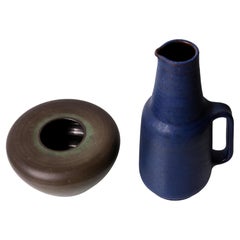
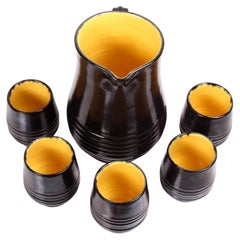
Rare Tea Set (as produced in this colour):
The set comprises a teapot and a milk jug.
St. Clément
The faience factory of Saint-Clément, located 12 km from Lunéville, was established in 1758 by Jacques Chambrette, who already owned another such factory in Lunéville. The intention behind the establishment of this second factory was to target the higher echelons of the market with the production of prestigious objects. This strategic decision led to the factory being awarded the prestigious title of Royal Supplier for Marie-Antoinette's Trianon.
Following the death of Jacques in 1758, ownership of the factory passed to his son Gabriel. From 1759 to 1763, the factory was managed by Charles Loyal, the son-in-law of Jacques Chambrette, and by Paul Louis Cyfflé, an architect who owned half of the factory in 1786.
The factory was owned by several shareholders. Notably, the Thomas family strategically acquired all the shares, becoming the sole proprietors in 1863. In 1892, the factory was sold to Keller and Guérin, who already owned the earthenware factory of Lunéville. Under their administration, the company underwent significant expansion during the latter years of the 19th century. In 1907, the workshop where the ovens were located underwent partial reconstruction by the company Masson from Lunéville.
The Saint-Clément dish is a notable product of this period.
Saint-Clément dish.
In 1922, Edouard Fenal, who was already the proprietor of the earthenware factory in Badonviller, acquired the Saint-Clément and Lunéville factories. Fenal proceeded to establish the "Atelier d'Art de Lunéville", a studio that attracted notable artists such as Lachenal, Bussière and Majorelle. The sculptors Charles Lemanceau and Geo Condé joined the ceramists Joseph and Pierre Mougin, and together they created Art Nouveau and Art Déco earthenware.
Concurrently, traditional production methods persisted. Presently, Saint-Clément remains the sole operational earthenware factory. Despite the demise of the hand-painted decoration technique, the successful designs continue to be utilised.The factory is now part of the Sarreguemines group and has a workforce of 130. Since 1968, the factory has specialised in the production of Lunéville earthenware under the name "K.G. Lunéville".
In the 18th century, Saint-Clément specialised in the production of domestic objects of ordinary earthenware, as well as luxurious objects and decorative objects of fine earthenware (terre de pipe). The period between the first quarter of the 19th century and 1892 saw the production of both everyday and fine earthenware utensils, as well as decorative objects of grand and petit feu (Emile Gallé).
In the latter half of the 19th century, the factory reproduced Louis XIV objects, including those with highly unnatural forms, in which they sought to emulate the multicoloured decorations of Strasbourg faience.
Following 1920, the production primarily comprised dinnerware crafted from fine earthenware, frequently adorned with historical motifs, and decorative objects featuring animals, primarily produced in craquelé earthenware, a technique that emerged around 1925 and persisted until around 1930. The production of barbotine continued until 1930.