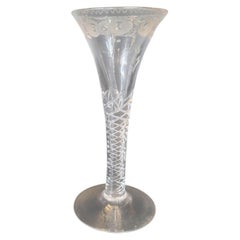
Large Dutch Georgian Flint Glass Rummer Engraved Windmill & Farmhouse ca. 1750
Located in Nottingham, GB
A truly rare and exceptional 18th-century drinking glass and a wonderful estate find. This substantial Georgian rummer is an impressive example of early hand-blown flint glass, beautifully decorated with finely engraved rural and agricultural imagery.
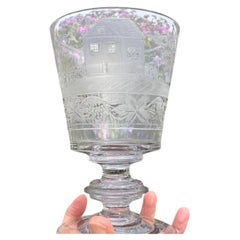
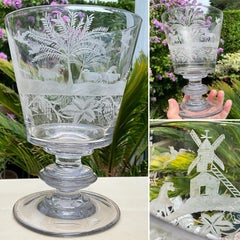
The large bucket-shaped bowl is decorated with a highly detailed engraved scene incorporating a Dutch-style windmill and farmhouse, horses, sheep, birds, trees and a flowing river, together with an elaborate grapevine and foliate design around the lower portion of the bowl. The combination of the countryside scene and grapevine decoration gives the glass an extraordinary amount of character and visual interest.
The substantial form, measuring almost 8 inches in height with a 5¼-inch rim, makes this an unusually large and imposing rummer. The thick stem incorporates a distinctive triple medial bladed knop, above a broad, sturdy terraced foot. The form is particularly suggestive of the robust firing or toasting glasses associated with the 18th century.
The glass is believed to have been made in Holland, possibly around the mid-18th century, although precise country of manufacture can be difficult to establish with certainty for early European flint glass. The engraved Dutch rural imagery certainly provides a strong connection with the Netherlands.
The bowl is beautifully hand engraved using fine wheel-cut decoration, with exceptional detail throughout. The grapevine leaves and tendrils are particularly attractive, while the landscape scene provides a fascinating glimpse into the decorative taste of the period. It would make an extraordinary marriage or wedding toast glass, although it is equally appealing as a museum-quality decorative object for a serious glass collection.
The glass itself has the characteristic slightly greyish tone and occasional striations, bubbles and inclusions associated with early hand-blown glass. These features are part of its historic character rather than imperfections in a modern piece. The base retains an original rough pontil scar, further supporting its early hand-made construction.
When gently tapped on the rim, the glass produces a remarkably prolonged and resonant ring. Please see the accompanying video.
This is an unusually substantial survivor. An 18th-century glass of this size, with such extensive engraving, a substantial stem and an intact bowl, is exceptionally difficult to find.
MEASUREMENTS:
Height: 7⅞"
Rim diameter: 5¼"
Base diameter: 4½"
Stem thickness: approximately 1"
Weight: approximately 1.1kg
CONDITION:
Excellent antique condition for its age. No chips, cracks or significant scratches to the bowl. There is some light shelf wear around the lowest edge of the foot and the original pontil scar remains visible on the underside. The glass contains natural striations, bubbles and minor inclusions consistent with 18th-century hand-blown manufacture. The overall condition is exceptionally good considering its age. Please see all photographs carefully.
RESEARCH NOTES:
Pontil marks are an important feature when examining early hand-blown glass. A pontil scar is formed when the finished vessel is detached from the iron pontil rod, leaving a rough or broken mark at the centre of the base. Over the course of the 18th century, polished and ground bases became increasingly common, although pontil scars can still be encountered on later examples.
The substantial terraced foot is another particularly interesting feature. Corrugated and terraced feet are associated with robust drinking and firing glasses designed to withstand the impact of being placed firmly onto a table during a toast.
The exceptionally thick stem and substantial proportions are also characteristic of early Georgian drinking glasses...
Category
Antique Mid-18th Century Glass