Located in Nottingham, GB
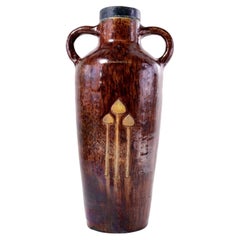
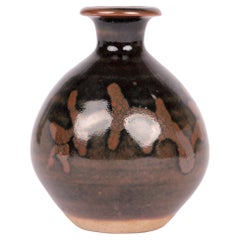
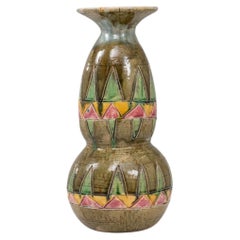
Three stylised toadstool motifs rise in shallow relief across the front of this earthenware vase, each slender stalk terminating in a pointed, spade-like cap. The motifs are defined by crisp incised outlines and filled with a pale honey-ochre glaze bearing fine craquelure, contrasting distinctly against the surrounding dark ground.
Flanking the high shoulder are two sturdy loop handles that rise from the curve to meet the waisted neck. The vessel stands 35 cm tall on a slightly tapered cylindrical body, finishing at the top with a defined collar rim picked out in a deep mottled slate-green tone.
The main body is covered in a lustrous treacle-brown glaze, applied in vertical streaks that evoke mottled horn or tortoiseshell. Subtle iridescent flashes with purplish reflections shimmer across the lower third of the vase under direct light. Popular during the late Victorian era around 1880, this distinctive combination of fluid lead glazing and naturalistic botanical motifs was widely produced by regional Flemish art potteries in and around Bruges.
The underside reveals a flat, unglazed buff-red ceramic foot with pooled brown glaze around the bevelled margin. There are no maker's stamps or signatures present on the base. The vessel displays general age-appropriate surface wear, including faint contact marks and minor glaze irregularities inherent to handmade studio earthenware...
Category
Antique Late 19th Century Vases