Video Loading
Want more images or videos?
Request additional images or videos from the seller.

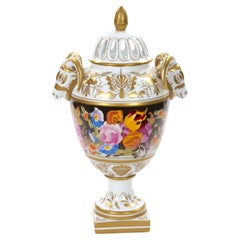
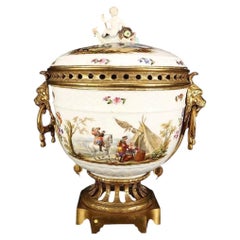
Fine German 19th Century Porcelain and Gilt-Bronze Mounted Potpourri Urn Vase

$12,950
$18,95031% Off
£9,895.14
£14,479.7631% Off
€11,830.13
€17,311.2731% Off
CA$18,756.42
CA$27,446.6631% Off
A$19,204.05
A$28,101.6831% Off
CHF 10,907.37
CHF 15,960.9831% Off
MX$245,594.30
MX$359,383.1731% Off
NOK 125,470.82
NOK 183,604.0331% Off
SEK 130,380.81
SEK 190,788.9031% Off
DKK 88,431.48
DKK 129,403.6031% Off

About the Item

A very fine German 19th century porcelain and gilt-bronze mounted Potpourri Urn-Vase with Lid, attributed to Meissen. The ovoid white porcelain urn, decorated on all sides and lid with outdoor Country scenes of the hunting life, with peasants, horses, falcons, dogs, preys and flowers, all surmounted on an Imperial gilt-bronze plinth with lion-paw-feet and centered with a burning flame. The lid supported with an intricate pierced ormolu apron with a laurels and shield motif and twin branches, the top with an ormolu acorn with acanthus leaves. circa: 1880 Height: 26 1/4 inches (66.7 cm) Diameter: 14 1/8 inches (35.9 cm) Meissen Porcelain or Meissen china was the first European hard-paste porcelain. Early experiments were done in 1708 by Ehrenfried Walther von Tschirnhaus. After his death that October, Johann Friedrich Böttger continued von Tschirnhaus's work and brought this type of porcelain to the market, financed by Augustus the Strong, King of Poland and Elector of Saxony. The production of porcelain in the royal factory at Meissen, near Dresden, started in 1710 and attracted artists and artisans to establish, arguably, the most famous porcelain manufacturer known throughout the world. Its signature logo, the crossed swords, was introduced in 1720 to protect its production; the mark of the swords is reportedly one of the oldest trademarks in existence. Dresden Porcelain (or "china") was once the usual term for these wares, until in 1975 the Oberlandesgericht (Higher Munich State Court) decided in favour of the Saxon Porcelain Manufactory Dresden, which alone was then allowed to use the name Dresden Porcelain (it ceased producing in 2020). Meissen remained the dominant European porcelain factory, and the leader of stylistic innovation, until somewhat overtaken by the new styles introduced by the French Sèvres factory in the 1760s, but has remained a leading factory to the present day. Among the developments pioneered by Meissen are the porcelain figurines, and the introduction of European decorative styles to replace the imitation of Asian decoration of its earliest wares. Since 1991, the manufactory has been operating as the Staatliche Porzellan-Manufaktur Meissen GmbH, whose owner is the Free State of Saxony. The company is one of the world's leading porcelain manufacturers and one of the oldest and most internationally known German luxury brands. Beginning: Chinese porcelain had gradually developed over centuries, and by the seventeenth century both Chinese and Japanese export porcelain were imported to Europe on a large scale by the Dutch East India Company and its equivalents in other countries. It was a very expensive product by the time it reached European customers, and represented wealth, importance and refined taste in Europe. European attempts to produce porcelain, such as the brief experiment that produced Medici porcelain in Florence, had met with failure. At the beginning of the eighteenth century Johann Friedrich Böttger pretended he had solved the dream of the alchemists, to produce gold from worthless materials. When King Augustus II of Poland heard of it, he kept him in protective custody and requested him to produce gold. For years Johann Friedrich Böttger was unsuccessful in this effort. At the same time, Ehrenfried Walther von Tschirnhaus, a mathematician and scientist, experimented with the manufacture of glass, trying to make porcelain as well. Crucially, his ingredients included kaolin, the vital ingredient of true porcelain, though he was unable to use it successfully. Tschirnhaus supervised Böttger and by 1707 Böttger reluctantly started to help in the experiments by Tschirnhaus. When Tschirnhaus suddenly died, the recipe apparently was handed over to Böttger, who within one week announced to the King that he could make porcelain. Böttger refined the formula and with some Dutch co-workers, experienced in firing and painting tiles, the stage was set for the manufacturing of porcelain. In 1709, the King established the Royal-Polish and Electoral-Saxon Porcelain Manufactory (Königlich-Polnische und Kurfürstlich-Sächsische Porzellan-Manufaktur), placed Böttger's laboratory at Albrechtsburg castle in Meissen and production started officially in 1710. Early Work: The first type of ware produced by Böttger was a refined and extremely hard red stoneware known as "Böttger ware" in English (in German: Böttgersteinzeug). This copied Chinese Yixing ware, and like that was especially used for teapots, and now coffee pots. Similar wares had been made by the Dutch and the Elers brothers in England. Böttger's version was harder than any of these, and retained very crisp definition in its cast or applied ("sprigged") details, on bodies that could be polished to a gloss before firing. Models were derived from Baroque silver shapes and Chinese ceramic examples. There was also a softer stoneware, which was glazed and decorated. Meissen's production of a hard paste white porcelain that could be glazed and painted soon followed, and wares were put on the market in 1713. Dish with Chinese scene and laub- und bandelwerk surrounds, 1720s Böttger's experimental wares rapidly gained quality but never achieved successful painted and fired decor. The first successful ornaments were gold decorations applied upon the fired body and finely engraved before they received a second firing at a lower temperature. The lacy frameworks outside painted scenes known in German as Laub- und bandelwerk in red, gold or puce, were often used. Augustus II charged first Johann Jakob Irminger with the design of new vessels. In 1720 Johann Gregor Herold became the director and in 1723 introduced brilliant overglaze colours that made Meissen Porcelain famous, with an increasingly broad palette of colors that marked the beginning of the Classic phase of Meissen Porcelain. His enamel paints are still the basis for ceramic paints today. Initially painting mostly imitated the oriental designs known from Chinese and Japanese export porcelain, but some European landscape scenes were painted from early on. The signature underglaze "Meissen Blue" was introduced by Friedrich August Köttig. Soon minutely detailed landscapes and port scenes, animals, flowers, galante courtly scenes and chinoiseries, fanciful Chinese-inspired decorations, were to be found on Meissen Porcelain. The Kakiemon floral decoration of vases and tea wares in Japanese export porcelain were combined with Chinese famille verte to create a style known as Indianische Blume ("Indian Flowers"); Augustus had large collections of both Chinese and Japanese porcelain. Coloured grounds with decoration painted on white in panels appear in the 1730s. Paintings by Watteau were copied. Wares were also sold with plain glazed colors, usually white, to be enamelled in private workshops (Hausmalerei), many in Augsburg and Bayreuth, and independently retailed. The support of Augustus' patronage attracted to Meissen some of the finest painters and modellers of Europe as staff artists.
  • Attributed to:
    Meissen Porcelain (Manufacturer)
  • Dimensions:
    Height: 26.25 in (66.68 cm)Diameter: 14.13 in (35.9 cm)
  • Style:
    Regency Revival (In the Style Of)
  • Materials and Techniques:
  • Place of Origin:
  • Period:
  • Date of Manufacture:
    circa: 1880
  • Condition:
    Wear consistent with age and use. Minor fading. A truly stunning porcelain and ormolu mounted vase. Overall condition is very good with almost no wear on the porcelain. The ormolu with its original mercury gilt with some gilt age wear from rubbing, mainly on the base plinth. Please view all images.
  • Seller Location:
    Los Angeles, CA
  • Reference Number:
    Seller: Ref.: A2680 - Lot 114591stDibs: LU1796233453852

More From This Seller

View All
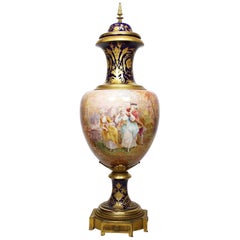
Fine French 19th Century Napoleon III Sèvres Style Porcelain Urn Signed Ch Fuchs

Fine French 19th Century Napoleon III Sèvres Style Porcelain Urn Signed Ch Fuchs

By Manufacture Nationale de Sèvres

Located in Los Angeles, CA

A fine French 19th century Napoleon III Sèvres style porcelain and ormolu-mounted covered urn, the 360 degree painted urn centered with an 18th century romantic scene of two ladies a...

Category

Antique 19th Century French Louis XV Porcelain

Materials

Ormolu

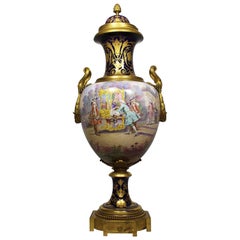
A French 19th Century Napoleon III Sévres Style Porcelain and Ormolu Mounted Urn

A French 19th Century Napoleon III Sévres Style Porcelain and Ormolu Mounted Urn

By Manufacture Nationale de Sèvres

Located in Los Angeles, CA

A very fine French 19th Century Napoleon III Sévres Style Porcelain and Ormolu Mounted Covered Urn, the 360 degree painted urn centered with an 18th century scene of a young Princess...

Category

Antique 19th Century French Louis XV Porcelain

Materials

Ormolu

Large 19th Century Chinese Porcelain and French Figural Ormolu Centerpiece

Large 19th Century Chinese Porcelain and French Figural Ormolu Centerpiece

Located in Los Angeles, CA

A very fine and large 19th century Chinese porcelain and French figural ormolu-mounted Chinoiserie style centerpiece. The circular ovoid bowl, maybe 18th century Jiaqing period (unve...

Category

Antique 19th Century French Chinoiserie Planters, Cachepots and Jardinières

Materials

Ormolu

A Fine French 19th-20th C.Louis XV Style Ormolu-Mounted Marble Urn with Cover

A Fine French 19th-20th C.Louis XV Style Ormolu-Mounted Marble Urn with Cover

By François Linke

Located in Los Angeles, CA

A Fine French 19th-20th century Louis XV style ormolu-mounted Fleur de Pêcher marble vase or urn with a gadrooned cover surmounted by a pomegranate gilt-bronze finial, above a taperi...

Category

Antique Early 1900s French Louis XV Urns

Materials

Marble, Bronze

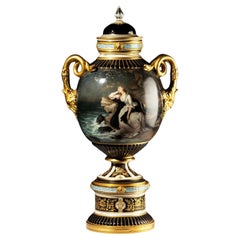
Fine 19th Century Vienna-Style Porcelain Vase 'Search for Love' by Pirkenhammer

Fine 19th Century Vienna-Style Porcelain Vase 'Search for Love' by Pirkenhammer

By Pirkenhammer

Located in Los Angeles, CA

A Very Fine and Impressive Bohemian 19th Century Vienna-Style Neoclassical Revival Style Pirkenhammer Porcelain Vase - Urn. The ovoid shaped finely painted all around body with allegorical scenes representing 'The Search for Love', with one side depicting a pensive maiden seated on a rock form by the seashore, the opposite side depicting a maiden, also seated by the seashore, being visited by a love-cupid (cherub or angel), flanked by a pair of finely detailed double-headed snake-form 24 carat gilt handles centered with mask terminals, raised on an attached circular gilt, cream and blue Celeste decorated plinth. Stamped with an underglaze black printed crossed hammers mark and further mark "O.P.C.N. / RAD" to the underside. The associated and later domed cobalt-blue, cream and gilt decorated porcelain cover-lid with a cream and gilt bud finial, not original to the vase. Signed "Al Eckardt". Circa: Bohemia, 1890-1894. The porcelain painter A. Louis Eckardt is mentioned by Waltraud Neuwirth, Porzellanmaler-Lexicon (1977), Vol. I, p.251 as working from the Prager Strasse in Dresden in 1894. The Bohemian Pirkenhammer factory was founded in 1803, and in the second half of the 19th century the factory was exporting to Vienna and London. The Prikenhammer marks on these vases show they were made after 1887, and it is therefore likely this vase can be dated between the time of the introduction of the mark for this Bohemian factory, and the time Eckhardt returned to Dresden in 1894. Eckhardt is also recorded as a painter of Berlin plaques. The Pirkenhammer porcelain factory was established in 1802 in Karlovy Vary using...

Category

Antique Late 19th Century Czech Neoclassical Revival Vases

Materials

Porcelain

You May Also Like

Antique German Meissen Porcelain Painted & Gilt Decorative Covered Urn

Antique German Meissen Porcelain Painted & Gilt Decorative Covered Urn

By Meissen Porcelain

Located in Tarry Town, NY

A magnificent antique German Meissen porcelain covered urn dating to the early to mid-19th century, showcasing the exceptional craftsmanship and refined decorative artistry for which...

Category

Antique Mid-19th Century German Rococo Urns

Materials

Gold

Large Samson Porcelain and Ormolu Covered Urn in the Meissen Style, Late 19th C

Large Samson Porcelain and Ormolu Covered Urn in the Meissen Style, Late 19th C

By Edmé Samson, Samson & Cie, Meissen Porcelain

Located in Atlanta, GA

An exceptionally detailed Samson porcelain and gilt bronze covered urn or potpourri vase , Paris, late 19th century, executed in the Meissen manner. The baluster-form vessel is richl...

Category

Antique Late 19th Century French Rococo Urns

Materials

Bronze

Samson Gilt Bronze Mounted Porcelain Potpourri Urn, after Meissen

Samson Gilt Bronze Mounted Porcelain Potpourri Urn, after Meissen

Located in Nottingham, GB

Surmounting the domed cover of this substantial urn is a finely modelled porcelain putto grasping an oar while astride a mythical sea fish. The cover and matching baluster body are d...

Category

Antique Late 19th Century Urns

Materials

Bronze

Continental Gilt-Bronze Mounted Porcelain Potpourri, Late 19th Century

Continental Gilt-Bronze Mounted Porcelain Potpourri, Late 19th Century

Located in West Palm Beach, FL

A continental gilt-bronze mounted porcelain potpourri Late 19th century, The large round-form body topped by a domed lid and dolphin finial, the whole painted with satiric dinner scenes...

Category

Antique 19th Century Urns

Materials

Porcelain

19th Century Samson Porcelain Covered Vase or Potpourri Jar

19th Century Samson Porcelain Covered Vase or Potpourri Jar

Located in Atlanta, GA

19th Century Samson Porcelain Covered Vase or Potpourri Jar. Ormolu mounted. France, circa 1880. Dimensions: Height 18 1/2" Diameter 13" CW5706

Category

Antique 1880s French Louis XV Vases

Materials

Bronze

19th C. Sevres Style Porcelain Painted Mounted Chateau des Tuileries Style Urn

19th C. Sevres Style Porcelain Painted Mounted Chateau des Tuileries Style Urn

Located in Germantown, MD

A 19th Century Antique French Sevres Style Hand Painted and Mounted Chateau des Tuileries Style covered urn with Gilt Highlights and Front & Back Panels of variegated flowers Scenes....

Category

Antique 19th Century American Louis XV Urns

Materials

Bronze