Want more images or videos?
Request additional images or videos from the seller.

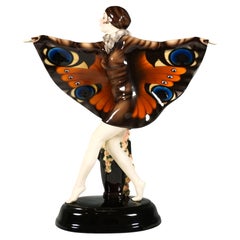
Goldscheider "The Captured Bird" ceramic statuette by Josef Lorenzl

$15,000
£11,420.47
€13,655.23
CA$21,384.05
A$21,766.97
CHF 12,604.77
MX$287,436.51
NOK 140,890.05
SEK 150,340.86
DKK 102,470.22

About the Item

Goldscheider Ceramic statuette "The Captured Bird" design by Josef Lorenzl (1892-1950) and it was registered as "Model 5230".The woman depicted here is the German dancer Niddy Impekoven (1904-2002). This specific statuette has a butterflies design. Ora Pinhas (2006) "Goldscheider" p. 118-119. Austria, CIRCA 1930.
  • Creator:
    Goldsheider (Designer)
  • Dimensions:
    Height: 18.9 in (48 cm)Width: 16.54 in (42 cm)Depth: 6.3 in (16 cm)
  • Style:
    Art Deco (Of the Period)
  • Materials and Techniques:
    Ceramic,Enameled
  • Place of Origin:
  • Period:
  • Date of Manufacture:
    1930
  • Condition:
    Wear consistent with age and use.
  • Seller Location:
    Ciudad Autónoma Buenos Aires, AR
  • Reference Number:
    1stDibs: LU7045246474312

More From This Seller

View All
Goldscheider "the Captured Bird" Ceramic Statuette by Josef Lorenzl

Goldscheider "the Captured Bird" Ceramic Statuette by Josef Lorenzl

By Goldscheider Manufactory of Vienna

Located in Ciudad Autónoma Buenos Aires, C

Goldscheider Ceramic statuette "The Captured Bird" design by Josef Lorenzl (1892-1950) and it was registered as the "Model 5230".The woman depicted h...

Category

Vintage 1930s Austrian Art Deco Figurative Sculptures

Materials

Ceramic

Goldscheider "The Egyptian Dancer" ceramic statuette by Josef Lorenzl

Goldscheider "The Egyptian Dancer" ceramic statuette by Josef Lorenzl

By Josef Lorenzl, Friedrich Goldscheider

Located in Ciudad Autónoma Buenos Aires, C

Goldscheider Ceramic statuette "The Egyptian Dancer" design by Josef Lorenzl (1892-1950) and it was registered as "Model 5281". This ceramic can be found in many different painted sh...

Category

Vintage 1930s French Art Deco Figurative Sculptures

Materials

Ceramic

Goldscheider "Indian Dancer" Ceramic Statuette by Podala

Goldscheider "Indian Dancer" Ceramic Statuette by Podala

By Goldscheider Manufactory of Vienna

Located in Ciudad Autónoma Buenos Aires, C

Goldscheider "Indian Dancer" ceramic statuette design by Podola and it was registered as "Model 4495". The stattuete depicts the female dancer Ruth Saint ...

Category

Vintage 1920s Austrian Art Deco Figurative Sculptures

Materials

Ceramic

Art Deco Bronze Sculpture by Samuel Lipschitz, Marble Base, Circa 1940

Art Deco Bronze Sculpture by Samuel Lipschitz, Marble Base, Circa 1940

By Art Decor

Located in Ciudad Autónoma Buenos Aires, C

Bronze sculpture with silver plating, green polychrome skirt and Belgian black marble base. Signed Samuel-Lipschitz France, CIRCA 1940.

Category

Vintage 1940s French Art Deco Figurative Sculptures

Materials

Bronze

Ceramic Sculpture “Thomasch” by Goldscheider

Ceramic Sculpture “Thomasch” by Goldscheider

By Friedrich Goldscheider

Located in Ciudad Autónoma Buenos Aires, C

Sculpture design "Thomasch", made by Goldscheider, made of ceramic. Goldscheider stamp, model 5136. Richard Dennis and Ora Pinhas (2006), “GOLDSCHEIDER, A Catalog Of Selected Models...

Category

Vintage 1920s Austrian Art Deco Figurative Sculptures

Materials

Ceramic

Art Deco Bronze Sculpture of Veiled Woman on Marble Base, Circa 1930

Art Deco Bronze Sculpture of Veiled Woman on Marble Base, Circa 1930

Located in Ciudad Autónoma Buenos Aires, C

Art Deco sculpture of a veiled nude woman, made of bronze on a Portoro marble base. France, circa 1930.

Category

Vintage 1930s French Art Deco Figurative Sculptures

Materials

Bronze

You May Also Like

Goldscheider "The Captured Bird" Porcelain Sculpture

Goldscheider "The Captured Bird" Porcelain Sculpture

By GOLDSCHEIDERSCHE PORZELLAN-MANUFACTUR UND MAJOLICA-FABRIK (1885-1953)

Located in Los Angeles, CA

Beautiful art deco porcelain figure titled "The Captured Bird" by Goldscheidersche Porzellan Manufactur handmade in Austria by Josef Lorenzl.

Category

20th Century Art Deco Figurative Sculptures

Materials

Porcelain

Goldscheider "The Captured Bird" Porcelain Sculpture by Josef Lorenzl

Goldscheider "The Captured Bird" Porcelain Sculpture by Josef Lorenzl

By GOLDSCHEIDERSCHE PORZELLAN-MANUFACTUR UND MAJOLICA-FABRIK (1885-1953)

Located in Los Angeles, CA

Beautiful Art Deco porcelain sculpture "The Captured Bird" by Goldscheider Porzellan Manufactur. Designed in Austria by Josef Lorenzl. (1930's). Marked on the base. Dimensions: 12.5"...

Category

Vintage 1930s Austrian Figurative Sculptures

Materials

Porcelain

Goldscheider "The Captured Bird" Porcelain Sculpture

Goldscheider "The Captured Bird" Porcelain Sculpture

By GOLDSCHEIDERSCHE PORZELLAN-MANUFACTUR UND MAJOLICA-FABRIK (1885-1953)

Located in Los Angeles, CA

Beautiful art deco porcelain figure titled "The Captured Bird" by Goldscheidersche Porzellan Manufactur handmade in Austria by Josef Lorenzl. Include...

Category

Vintage 1920s Austrian Figurative Sculptures

Materials

Porcelain, Paint

Large Goldscheider Vienna Art Deco Figure, The Captured Bird by Lorenzl, Ca 1925

Large Goldscheider Vienna Art Deco Figure, The Captured Bird by Lorenzl, Ca 1925

By Josef Lorenzl, Goldscheider Manufactory of Vienna

Located in Vienna, AT

One of the best-known and most elegant models from the Viennese manufacturer Goldscheider: Depiction of the dancer Niddy Impekoven (1904-2002) performing her dance ‘The Caged Bird’ i...

Category

Vintage 1920s Austrian Art Deco Ceramics

Materials

Ceramic

Goldscheider porcelain figurine "Dancer" designed by LORENZL

Goldscheider porcelain figurine "Dancer" designed by LORENZL

By Goldscheider Manufactory of Vienna

Located in Autonomous City Buenos Aires, CABA

Goldscheider Vienna Porcelain Figurine "Dancer" designed by Josef Lorenzl Goldscheider Vienna porcelain figurine, designed by Josef Lorenzl, depicting an Art Deco dancer standing on ...

Category

20th Century Austrian Art Deco Figurative Sculptures

Materials

Porcelain

Art Deco Ceramic Sculpture by Keramos, Austria, 1934

Art Deco Ceramic Sculpture by Keramos, Austria, 1934

Located in Ciudad Autónoma Buenos Aires, C

Ceramic Sign: Made in Austria Keramos 2051 19/M Wiener Keramos, later Keramos AG or Keramos KG , was a Viennese ceramics manufacturer that made a name for itself especially in the interwar period . In addition to their own designs, designs from the dissolved Wiener Werkstätte were also produced from 1932 onwards. In over 60 years of company history, around 3000 model designs have been produced by around 60 ceramists. Keramos also carried out commissions from the Wiener Werkstätte, such as vases by Dagobert Peche . History The origins of the Keramos company lie in two companies with the same name. The company Keramos – Invalid Society for Viennese Art Ceramics was founded at the end of 1919 on the initiative of the three ceramists Rudolf Wolf, Heinrich Wolf and Ludwig Rys, who had become invalids in World War I. Production started in September 1920. Art-ceramic lamps, figures, vases and boxes were produced. The company Keramos – Viennese art ceramics and porcelain manufactory was founded in 1920. Josef Hoffmann was a shareholder of Keramos for a long time, as was the sculptor Rudolf Podany, who was engaged from the start and created a large number of designs. From 1921 Anton Klieber was employed, who was also responsible for most of the models. Around 1924 both companies were merged and converted into an AG, commercial director became Otto Köller, the technical directors were the brothers Rudolf and Heinrich Wolf. "Some war invalid ceramists founded a workshop with the help of some artists, which was subsequently financed by the state and later enlarged with its participation and converted into a joint-stock company." The company's headquarters were in the Hofburg , Schwarze-Adler-Stiege, the factory in the 10th district of Vienna, Schleiergasse 17. Artistic collaborators at that time were Eduard Klablena , Otto Prutscher , Karl Perl , Karin Jarl-Sakellarios , IDA Schwetz- Lehmann and Grete Fucik-Fischmeister. On February 23, 1928, the triangular mark was entered in the trademark register. It was now also produced for the Wiener Werkstätte. Difficulties for the company arose from the Great Depression . Around 1932, 50 people were employed and a large number of models from Eduard Klabena and the dissolved Wiener Werkstätte were taken over. The works created by Keramos were labeled with their company brands until after 1941. From 1939 the economic situation of the company was better managed by taking over the production of ceramic winter welfare organization badges, the so-called WHW badges. Before 1941 the company is converted into a KG named Keramos, Wiener Kunstkeramik und Porzellanmanufaktur Brüder Wolf KG . Otto Köller was no longer active from this point on. After the end of World War II, Robert Obsieger recommended Robert Mathis as the new head of Keramos, who took over the management of the ceramics manufactory in 1945. In 1949 Mathis introduced a new company logo, which was used alongside the existing triangle mark, the so-called coat of arms mark. Anton Klieber and Rudolf Podany continued to work as ceramists, and new artists such as Josef Lorenzl and Stephan Dakon , both of whom had previously worked for Goldscheider , as well as Rudolf Chocholka, Karl Grössl and Ina Eisenbeisser were engaged. New models such as dancers, children's figures, animals and nudes were created, as well as the well-known wall masks, young people and poodles from the mid-1950s, which corresponded to the trend at the time. In addition, however, traditional designs such as Madonna statues and busts, saints and angels were still made. Utility ceramics such as crockery, vases, lamp bases, candle holders and flower pots also became an important branch of production, and cooperation with the German manufacturer Carstens at the beginning of the 1960s was just as lucrative. In the course of the 1960s, the sales markets for figurative ceramics became increasingly difficult. So until 1982, production was increasingly shifted to everyday ceramics, since ceramic figures were no longer modern due to changing tastes and the spirit of the times. Ultimately, the economic situation at Keramos became more and more difficult and Klaus Mathis, the son of Robert Mathis and then director, who succeeded his father at the helm of the company at the beginning of the 1970s, initiated the liquidation of the company at the end of 1982 . Staff The following artistic collaborators have worked for Keramos over the years: Hans Adametz , Franz Barwig the Elder , Franz Barwig the Younger , Andreas Beck, Hans Bolek, Angelo Bortolotti, Hertha Bucher , Rudolf Chocholka, Stephan Dakon , Ferdinand Doblinger, Eckstein, Franz Eggenberger , Ina Eisenbeisser, English, Stephan Erdös, Alois Feichtinger, Feyslitz, Hans Friedberger, Grete Fucik-Fischmeister, Kurt Goebel, Anton Grath, Karl Grössl, M. Günther, Otto Hafenrichter, Arnold Hartig , Friedrich Herkner, Trude Hillinger, Leopold Hohl, Hostasch, Karl Jamök, Karin Jarl-Sakellarios , Eduard Klablena, Klar, Anton Klieber, Maria Klinger, Josef Kostial, Josef Lorenzl , Wilhelm Otto Lugerth, Viktor Matula, Gusty Mundt-Amman, Novotny, Carl Perl, Rudolf Podany, Friedrich Pollak, Hugo Postl, Adolf Prischl, Otto Prutscher , Max Rieder , Elisabeth Rieger-Hofmann, Walter Ritter , Willibald Russ, Karl Sailer, Schönberg, Schwarz, Ida Schwetz-Lehmann , Sult, Robert Ullmann , Otto Weigand, IDA Weiss-Moricz, Rudolf Wolf. Exhibitions • Jubilee exhibition of the Wiener Kunstgewerbeverein, Austrian Museum , Vienna 1924. • Arts and Crafts Exhibition, Paris, 1925. • Exhibition of Austrian arts and crafts...

Category

Vintage 1930s Austrian Art Deco Figurative Sculptures

Materials

Ceramic