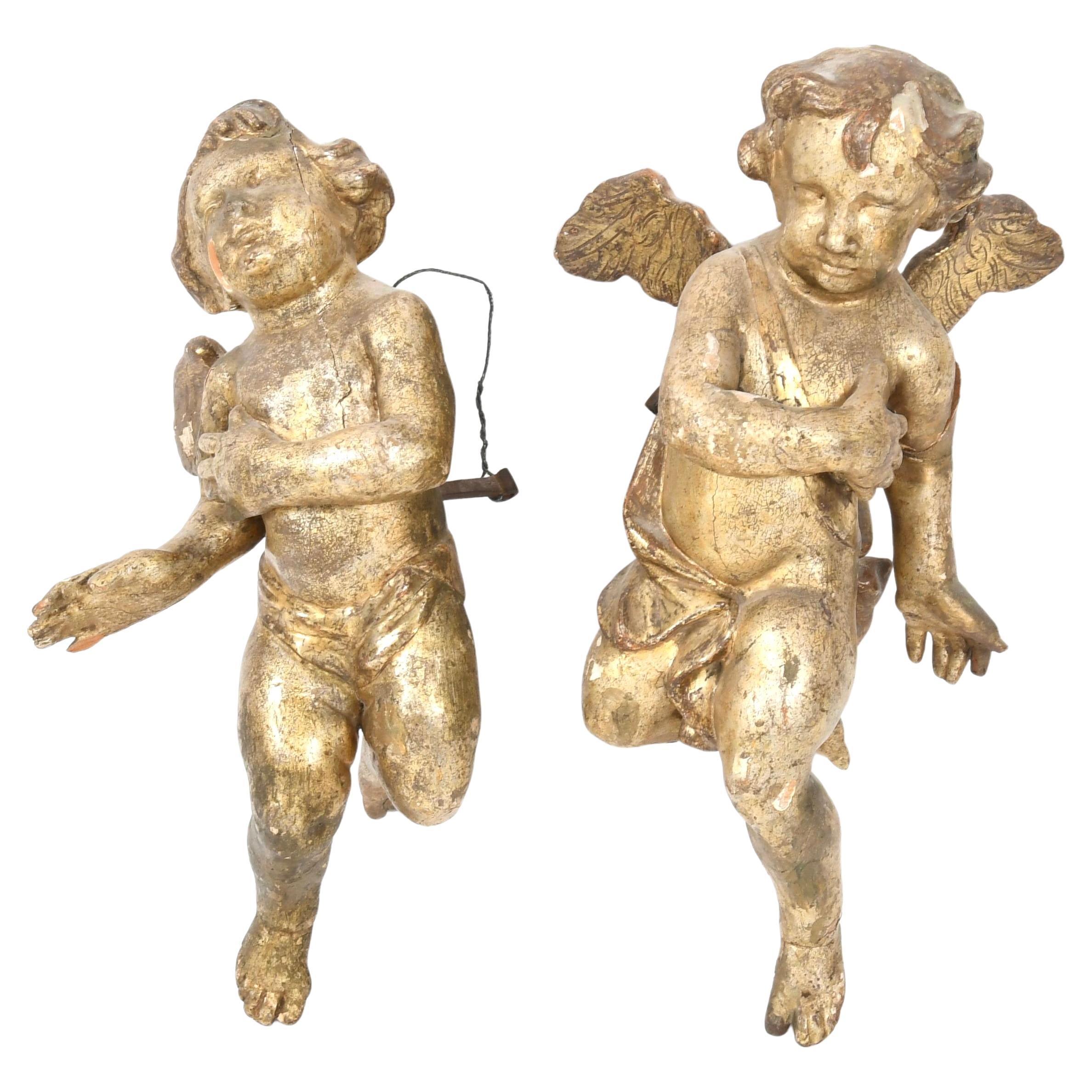
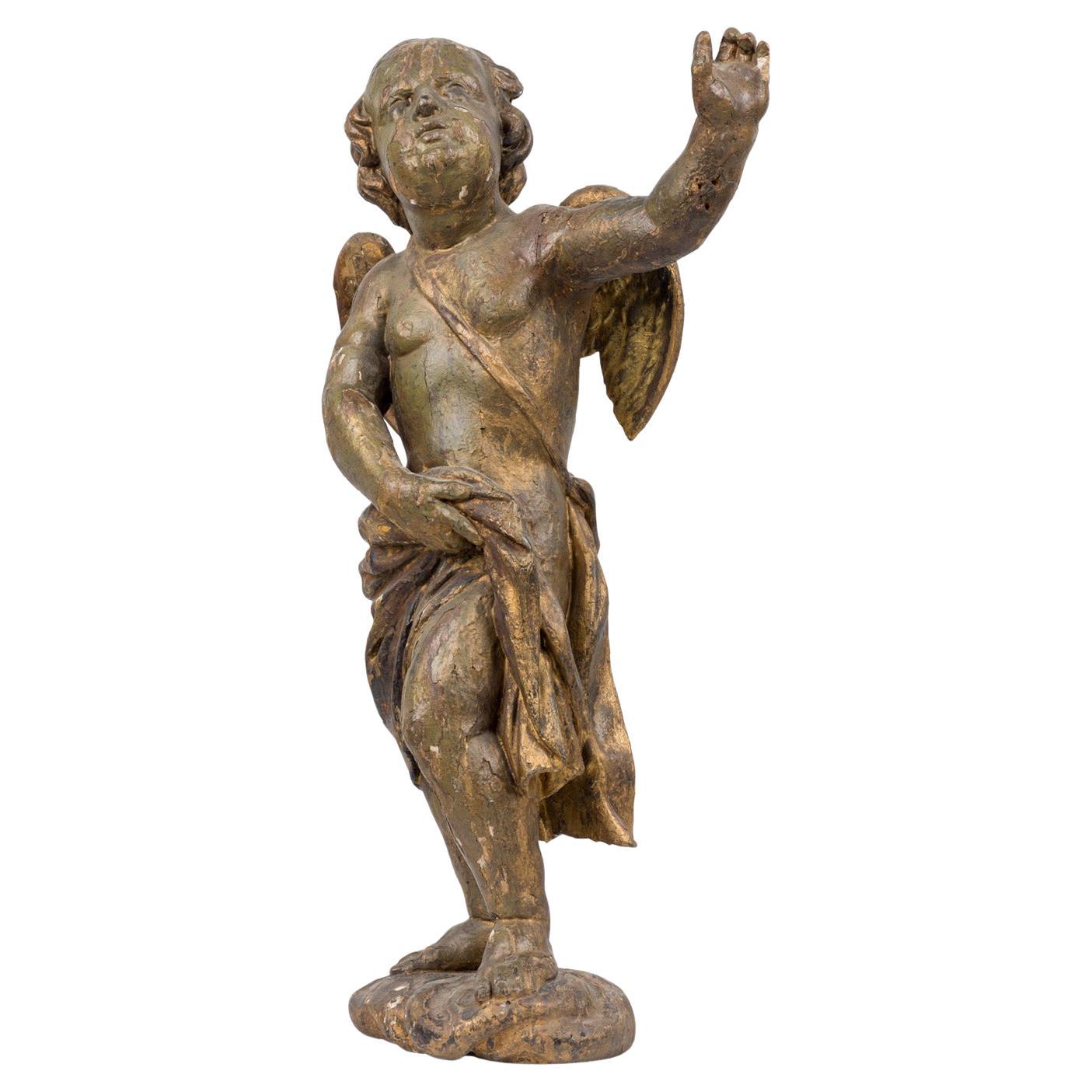
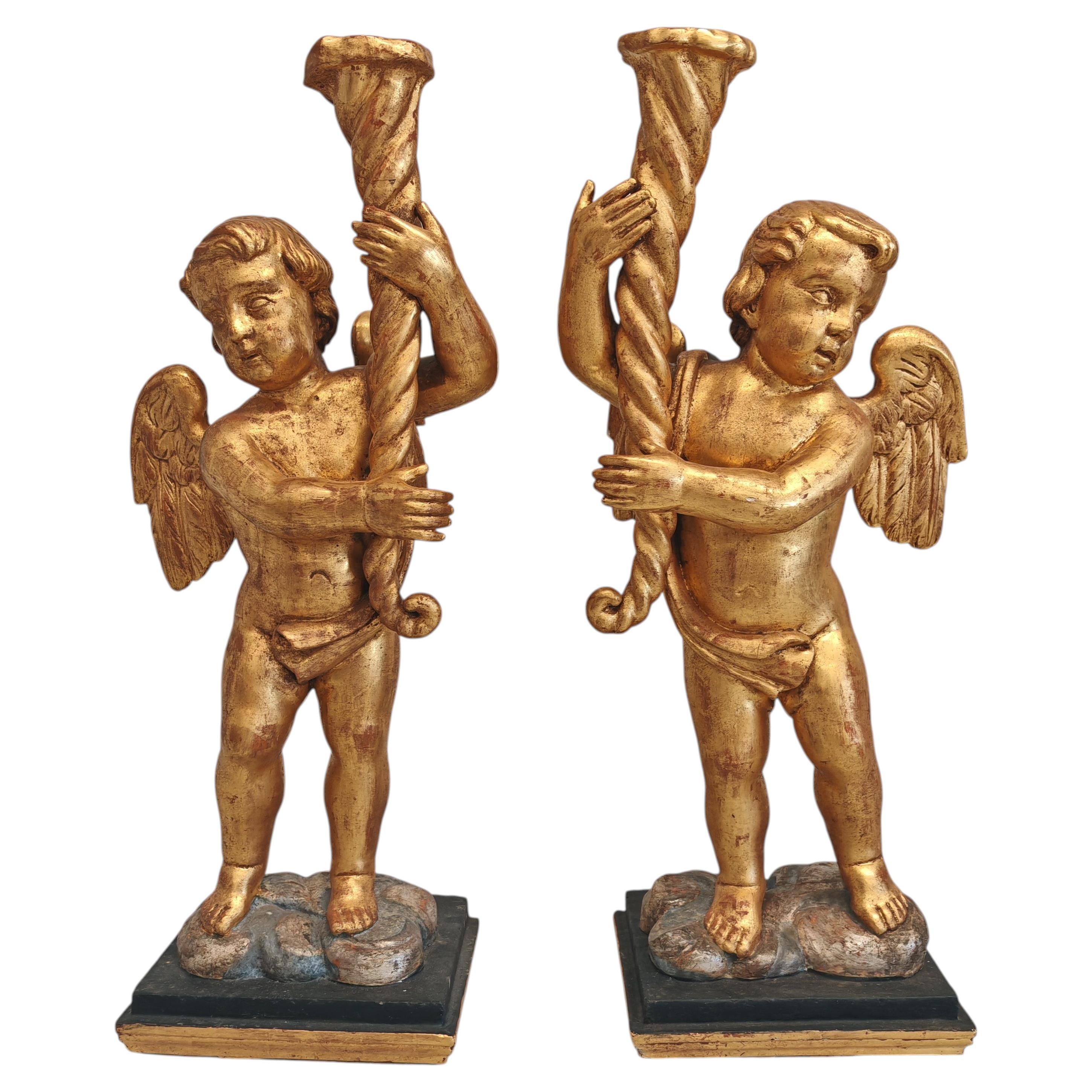
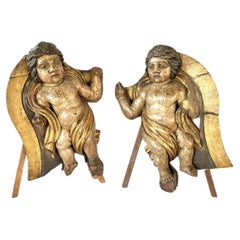
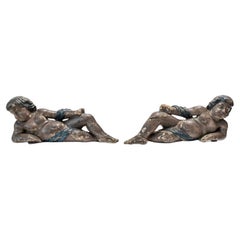
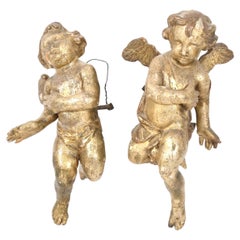
First half of the 18th century, Lombardy
Cherubs
(2) Gilded wood, 88 cm high
The work stands out for its high artistic quality and remarkable attention to detail, as evidenced by the delicate drapery formed by a single strip of fabric that wraps around the figures’ bodies and their curly, voluminous hair. Based on these observations, which reflect a technique typical of the 18th century, these charming little angels can be classified among the 18th-century Lombard sculptors, particularly those from Brescia, given their similarity to the works of Giovanni Battista Carboni (Brescia, March 29, 1729 – Brescia, December 29, 1790).
Giovanni Battista Carboni, who was not only a sculptor but also an art critic, was born in Brescia in 1725. His father, Rizzardo, was a modeler and stucco artist, but despite this, Giovanni Battista began his youth by studying the humanities at the school of the famous Rambaldini brothers.
Called back home by his father, he would have liked to study painting, but he was forced to join his father's business and learn the trade of stucco decoration and woodcarving.
As far as his work as a sculptor is concerned—based on what little we can glean from his surviving works—Carboni stands out as one of the most interesting figures to emerge after the advent of Antonio Calegari; his soft, fluid modeling, characterized by great refinement and elegance, is very similar to that of his master.
Few works from his career as a woodcarver can be definitively attributed to him; among them are the torch-bearing putti of Saint Gaetano, which are very similar in style to the ones on display here. His work as a stucco artist can still be seen in the little angels on the side altars of the Church of SS. Cosmas and Damian, who, while drawing on Calegari’s style, do not fail to add a personal touch, especially in their witty expressions.
He also designed the group depicting the Assumption and the angels on the pediment of the Duomo Nuovo in Brescia, created by Possenti of Bergamo, and personally created the two medallions depicting the evangelists St. Mark and St. Matthew, located in the spandrels beneath the great dome of the cathedral itself, which are remarkable for their grandeur and vivid pictorial quality.
Urged by the nobleman Luigi Chizzola to offer an assessment of Brescia’s painters and sculptors, he wrote a guide in 1759 (later published anonymously in 1760): The Paintings and Sculptures of Brescia on Public Display, with an Appendix on Some Private Galleries; a guide compiled according to criteria that remain valid today—one might even say highly modern—in terms of its structure, style, format, and the objectives it sets out to achieve. He is also the author of “Historical Notes on the Painters, Sculptors, and Architects of Brescia,” written in 1776 and preserved in the Archiginnasio Library.