Want more images or videos?
Request additional images or videos from the seller.

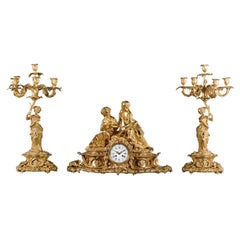
Napoleon III Clock Garniture Designed by Sévin, Cast by Barbedienne

$32,795.85per set
£24,000per set
€29,283.31per set
CA$45,837.11per set
A$46,664.55per set
CHF 27,017.55per set
MX$616,107.68per set
NOK 302,000.55per set
SEK 322,258.54per set
DKK 219,646.90per set

About the Item

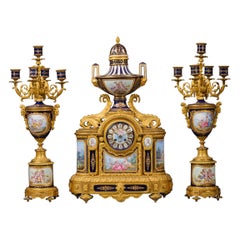
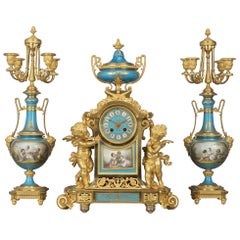
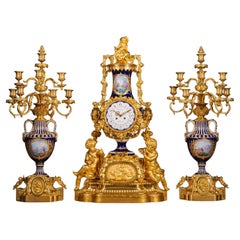
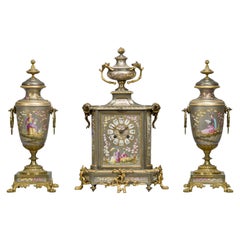
A fine Napoleon III gilt-bronze and porcelain mounted clock garniture, designed by Louis-Constant Sévin, cast by Ferdinand Barbedienne, The Movement by Japy Frères. Frédéric Japy (1749-1812) was apprenticed in Montbeliard to his clockmaker uncle, and returned to his home town of Beaucort, setting up as a clockmaker, and an organiser of local clockmakers into a company - the company expanded and were medal winners at many of the International Exhibitions throughout the 19th century under the aegis of his sons, eventually closing after the First World War. French, circa 1870. Ferdinand Barbedienne (1810-1892) was the inspiration and driving force behind one of the most important French art foundries. He pioneered the use of mounts and, more commonly, bronze sculpture including figures and animals. Barbedienne produced catalogues of bronze reproductions of Greek and Roman classical sculpture and experimented with champlevé and cloisonné enamels during the third quarter of the century. Barbedienne exhibited several pieces of furniture at the 1855 Paris Exhibition including an ormolu mounted oak dressing table and an ormolu mounted ebony veneered bookcase. Both pieces were executed in his favoured Renaissance revival style for furniture. Furniture with mounts signed by Barbedienne is extremely rare. The Barbedienne foundry handled the casting of numerous national monuments and architectural schemes. Ferdinand Barbedienne himself also took an active part in the promotion of contemporary sculpture and became one of the founders for David d'Angers' medallions as well as much of Rude's sculpture. His signature varied from hand written capitals to stamp in capitals, usually 'F. Barbedienne, Fondeur' or 'BARBEDIENNE PARIS'. In 1839 Barbedienne collaborated with the inventor Achille Collas who had succeeded in enlarging and reducing works of art to arbitrary sizes by a simple mathematical calculation, allowing the accurate reduction of classical and contemporary marbles for the purpose of reproduction in bronze. In 1850 Barbedienne was commissioned to furnish the Paris town hall for which he was awarded with the médaille d'honneur at the Paris Exposition Universelle in 1855. Bibliography: Barbedienne, Ferdinand. Catalogue des Bronzes d'art 1886. Fonderie d'art Français: Val d'Osne, Fonderie de Tusey, Antoine-Louis Barye, Fonderie Rudier, Charles Crozatier, Ferdinand Barbedienne' Livres Groupe, (Paris), 2010. Louis-Constant Sévin (1821-1888) was one of the most important French ornamental sculptors of the second half of the nineteenth century. He began his training at the early age of thirteen, when in 1834 he was apprenticed to the Parisian sculptor Antoine-André Marneuf. In 1839 he left Marneuf in order to join forces with the sculptors Phénix and Joyau, with whom he began designing objects for famous silversmiths including François-Désiré Froment-Meurice, Jean-Valentin Morel and Henri Duponchel. He fled to London during the 1848 Revolution and there worked at Morel’s recently opened studio on New Burlington Street. Under Morel’s auspices, Sévin designed many pieces that were presented at The Great Exhibition of 1851. Returning to France in 1851, he began designing porcelain models for the factories of Jouhanneaud and Dubois in Limoges, many of which featured at Paris’s 1855 Exposition Universelle. In 1855, Sévin took the position of ‘sculpteur-ornamentiste’ with Ferdinand Barbedienne (1810-1892), who had established one of the most highly esteemed bronze casting foundries of the nineteenth century. Sévin was to spend the remaining twenty-three years of his life there providing plans and instruction to the company’s craftsmen. Executing over two thousand designs in this time and often using novel techniques, his objects were some of the most stylistically diverse and innovative in the Barbedienne foundry and indeed in the wider production of decorative arts in France. Sévin regularly received commissions from European nobility and royalty, and his pieces were frequently displayed at the Great International Exhibitions of the period. His most prestigious commissions include his work for the chapel and tomb of Prince Albert at Frogmore House in Windsor, his bronze work at the Hôtel de la Païva in Paris, and the candelabras designed for the Kremlin. He was to achieve great recognition in his own time and was awarded many medals for artistic excellence.
  • Creator:
  • Attributed to:
    F. Barbedienne Foundry (Maker)
  • Dimensions:
    Height: 17.72 in (45 cm)Width: 16.54 in (42 cm)Depth: 7.09 in (18 cm)
  • Sold As:
    Set of 3
  • Style:
    Napoleon III (Of the Period)
  • Materials and Techniques:
  • Place of Origin:
  • Period:
  • Date of Manufacture:
    circa 1870
  • Condition:
    Wear consistent with age and use. The movement is in running order with the strikework functioning as it should when tested. We cannot however guarentee the movement or any mechanical operation following shipping and therefore recommend getting it overhauled by a clock restorer.
  • Seller Location:
    Brighton, GB
  • Reference Number:
    Seller: B734201stDibs: LU1028020087862

More From This Seller

View All
Napoléon III Sèvres Style Clock Garniture, Gilt-Bronze & Porcelain

Napoléon III Sèvres Style Clock Garniture, Gilt-Bronze & Porcelain

Located in Brighton, West Sussex

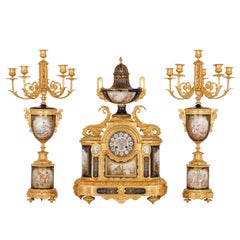
A fine Napoléon III gilt-bronze and sèvres style cobalt blue ground 'Jewelled' Porcelain Three-Piece Clock Garniture Comprising a mantel clock and a pair of five-light vase candel...

Category

Antique 19th Century French Napoleon III Mantel Clocks

Materials

Ormolu

Important Napoléon III Gilt-Bronze and Porcelain Clock Garniture, circa 1870

Important Napoléon III Gilt-Bronze and Porcelain Clock Garniture, circa 1870

Located in Brighton, West Sussex

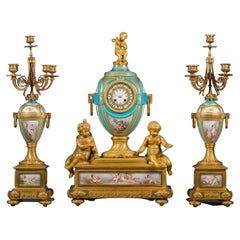
An important Napoléon III gilt bronze and turquoise porcelain clock garniture. French, circa 1870. This very fine clock garniture comprises of a clock and a pair of vase form candelabra. The finely cast and chiselled gilt bronze case has a jewelled turquoise porcelain face with Roman Numerals above a plaque depicting children in a wooded landscape, flanked by expressive male and female cherub figures, cast in the round, beneath a scrolled pediment with torches en flambeau and surmounted by a turquoise vase and cover. The pair of candelabra en-suite are in the form of turquoise porcelain vases...

Category

Antique Late 19th Century French Napoleon III Mantel Clocks

Materials

Bronze

A Napoleon III Period Sèvres Style Porcelain Three-Piece Clock Garniture

A Napoleon III Period Sèvres Style Porcelain Three-Piece Clock Garniture

By Jean-François Denière

Located in Brighton, West Sussex

A Large and Exceptional Napoleon III Period Gilt-Bronze and Sèvres Style Porcelain Three-Piece Clock Garniture. By Denière, Paris. Comprising a mantle clock and pair of eight-light...

Category

Antique 19th Century French Napoleon III Mantel Clocks

Materials

Enamel, Ormolu

Fine Napoléon III Gilt-Bronze Mounted Porcelain Clock Garniture, circa 1870

Fine Napoléon III Gilt-Bronze Mounted Porcelain Clock Garniture, circa 1870

Located in Brighton, West Sussex

A fine Napoléon III gilt-bronze mounted porcelain clock garniture. French, circa 1870. The movement stamped with the 'Japy Frères ' cachet. This fine porcelain clock set is...

Category

Antique Late 19th Century French Napoleon III Mantel Clocks

Materials

Bronze

A Fine Napoléon III Gilt-Bronze Three Piece Clock Garniture

A Fine Napoléon III Gilt-Bronze Three Piece Clock Garniture

Located in Brighton, West Sussex

A Fine Napoléon III Gilt-Bronze Three Piece Clock Garniture Comprising a mantel clock and a pair of seven-light figural candelabra. Designed as a celebration of music and lyric poe...

Category

Antique 19th Century French Napoleon III Mantel Clocks

Materials

Enamel, Ormolu

Napoleon III Gilt Bronze and Porcelain Three Piece Clock Garniture

Napoleon III Gilt Bronze and Porcelain Three Piece Clock Garniture

By Raingo Frères

Located in Brighton, West Sussex

A fine Napoleon III gilt bronze and porcelain three piece clock garniture by Raingo Freres. The circular gilt and 'jewel' decorated porcelain dial of the clock with Roman numerals an...

Category

Antique 19th Century French Napoleon III Mantel Clocks

Materials

Ormolu

You May Also Like

Fine Quality 19th Century Sevres Style Clock Garniture

Fine Quality 19th Century Sevres Style Clock Garniture

By Manufacture Nationale de Sèvres

Located in Brighton, Sussex

A fine quality 19th century French Sevres style porcelain and gilded ormolu clock garniture. The pair of five branch gilded ormolu candelabra each having Sevres style porcelain urns and pedestals with classical romantic scenes painted on them. The clock having an impressive lidded porcelain urn above with gilded handles either side, scrolling foliate ormolu mounts above the porcelain faced eight day duration clock that chimes...

Category

Antique 19th Century French Louis XVI Mantel Clocks

Materials

Ormolu

Circa 1870, French Napoleon III Gilt Bronze Clock Garniture by Japy Frères.

Circa 1870, French Napoleon III Gilt Bronze Clock Garniture by Japy Frères.

By Japy Frères

Located in SANT ADRIÀ DE BESÒS, ES

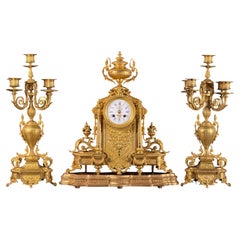
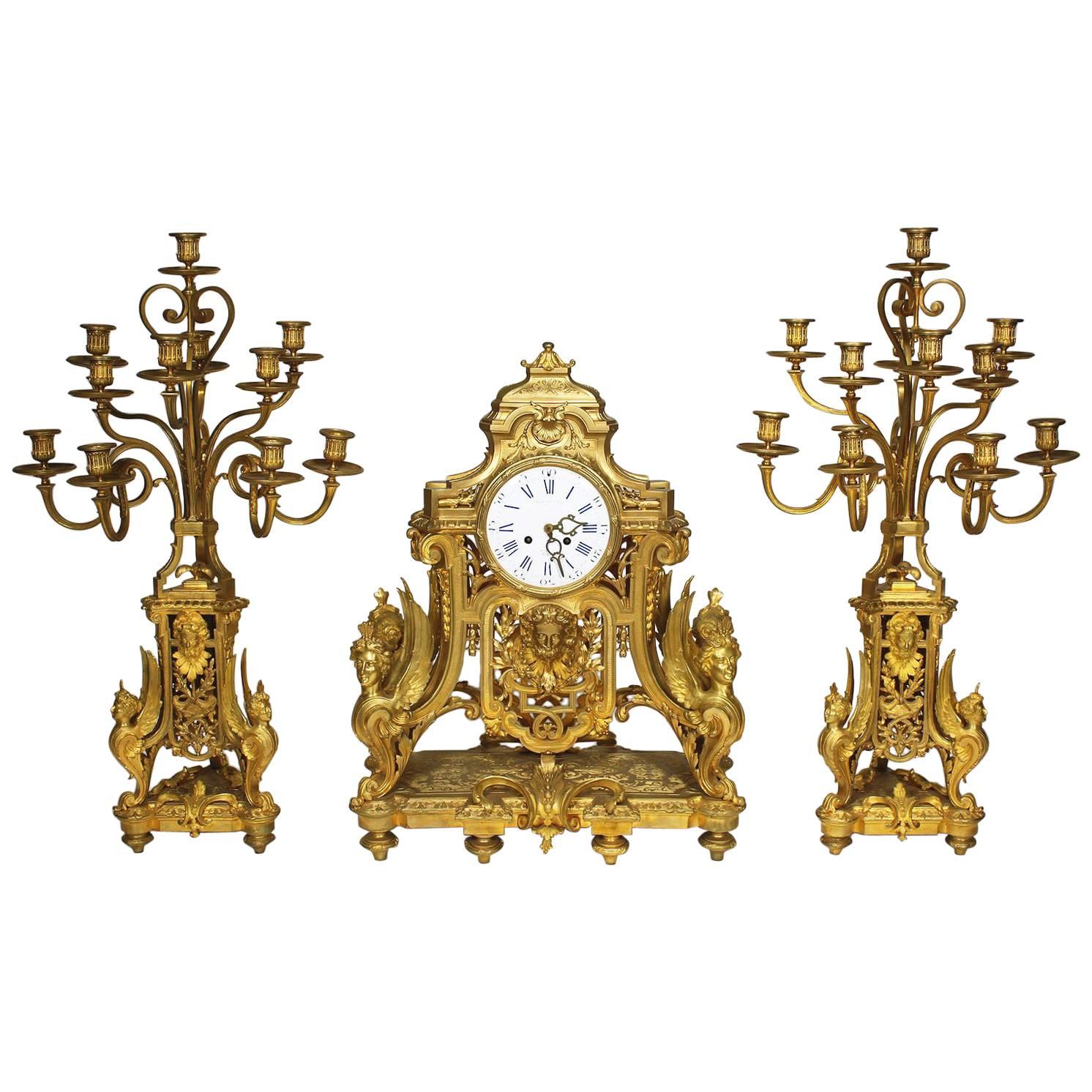
An exceptionally elaborate French three-piece mantel clock garniture dating to the second half of the 19th century, circa 1870, comprising a monumental mantel clock and its original pair of five-light candelabra. Richly conceived in the historicist taste of the Napoleon III period, the ensemble is distinguished by an extraordinary density of sculptural and architectural ornament. The clock is constructed as an elaborate architectural composition, its circular white enamel dial framed by a finely ornamented gilt surround and flanked by tall, fluted classical columns. Particularly striking is the large central decorative panel beneath the dial. It is modelled in high relief with a classical female mask emerging from an elaborate symmetrical arrangement of scrolling acanthus foliage, flowers and arabesques. The ornament continues throughout the case, with floral garlands, foliate scrolls, palmettes, beading, moulded borders and richly worked architectural details creating an exceptionally opulent surface. The upper section is crowned by a substantial classical urn with a domed cover and finial. Its fluted and lobed body is surrounded by sweeping foliate handles terminating in flame-like elements, giving the clock a particularly imposing vertical silhouette. On either side of the clock, scrolling architectural extensions are surmounted by smaller ornamental urns and richly modelled foliage. The lower section incorporates further floral panels, classical motifs and boldly scrolling feet, producing an unusually complex and balanced composition when viewed from the front. The white enamel dial displays blue Roman numerals for the hours and an outer Arabic minute track, complemented by an elaborate pair of pierced gilt hands. Two winding apertures indicate the time-and-strike movement. The movement bears the Japy Frères mark, one of the most important names associated with French clockmaking of the 19th century. The accompanying candelabra were conceived as an integral part of the garniture and repeat the ornamental vocabulary of the clock. Each rises from an architectural base richly decorated with floral reliefs, scrollwork and foliate feet. Above is a large classical urn-form body with fluting and applied ornament, from which emerge five candle branches. The branches form an elegant symmetrical arrangement of tightly coiled volutes and acanthus foliage. The central candleholder is elevated above the four surrounding lights, creating the characteristic tiered silhouette of an important French mantel garniture. The candle cups themselves are finely modelled with fluted classical decoration. The ensemble retains its gilt surface, whose warm tone beautifully emphasizes the remarkable depth and variety of the cast decoration. The clock is accompanied by its shaped wooden display base, finished to complement the architecture of the case. The original pendulum and two keys are also present. With the clock measuring approximately 47 cm (18.5 in.) high on its base and each candelabrum approximately 46 cm (18.1 in.) high, the complete garniture has considerable presence. The substantial weight — approximately 8 kg for the clock alone and approximately 3.5 kg for each candelabrum — further reflects the substantial construction of the ensemble. A highly decorative and imposing example of French 19th-century horological and decorative arts, conceived as a unified mantelpiece composition and particularly impressive for its elaborate sculptural ornament, substantial proportions and survival as a complete three-piece ensemble. Dimensions: Clock without wooden base: 38 cm wide × 43 cm high / 15.0 × 16.9 in. Clock with wooden base: 42 cm wide × 47 cm high / 16.5 × 18.5 in. Each candelabrum: 17 cm wide × 46 cm high / 6.7 × 18.1 in. Approximate weight of clock without base: 8 kg / 17.6 lb Approximate weight of each candelabrum: 3.5 kg / 7.7 lb Condition: The garniture is preserved in very good antique condition, with age-related wear consistent with its 19th-century date. The gilt surfaces remain remarkably well preserved overall, retaining a rich and visually impressive appearance. The enamel dial shows a small area of historic restoration around the Roman numeral IV, where part of the numeral and the adjacent enamel have been carefully restored. Minor surface traces consistent with age are also visible. The original convex front glass is no longer present. The rear glazed door and its glass remain in place. The clock has been wound and tested through one complete winding cycle and operated correctly during testing, including the striking mechanism. As with any antique mechanical clock...

Category

Antique 19th Century French Napoleon III Mantel Clocks
Materials

Bronze

Rare 19th Century Sevres Style Clock Set

Rare 19th Century Sevres Style Clock Set

By Manufacture Nationale de Sèvres

Located in Brighton, Sussex

A very fine quality French late 19th century Sevres style and gilded ormolu clock garniture. Having a pair of four branch candelabra, each with ram's head and female mask mounts, dra...

Category

Antique 19th Century French Louis XVI Mantel Clocks

Materials

Ormolu

Mantel Set with a Clock and Two Candelabras, 19th Century, Napoleon III Period.

Mantel Set with a Clock and Two Candelabras, 19th Century, Napoleon III Period.

Located in Saint-Ouen, FR

Mantel set with a clock and two candelabras, 19th century, Napoleon III period. A 19th century Napoleon III period Sèvres porcelain and gilt bronze mantelpiece with a clock and two...

Category

Antique 19th Century French Napoleon III Candelabras

Materials

Bronze

Napoleon III French Gilt Bronze & Patinated Three-Piece Clock Garniture

Napoleon III French Gilt Bronze & Patinated Three-Piece Clock Garniture

Located in Houston, TX

Exquisite set by Vincent &Cie Medaille d’ Argent circa 1855 clock works- the Medallion in the center en verso. It is in great working condition with Orig...

Category

Antique Mid-19th Century French Napoleon III Mantel Clocks

Materials

Bronze