Video Loading
Want more images or videos?
Request additional images or videos from the seller.

Chinese Export Porcelain Canton Famille Rose Iron-Red Elephant Candlestick

$2,000
£1,518.67
€1,821.57
CA$2,864.33
A$2,956.66
CHF 1,666.52
MX$38,252.39
NOK 19,013.21
SEK 20,058.10
DKK 13,615.09

About the Item

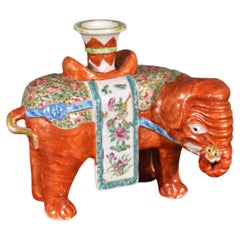
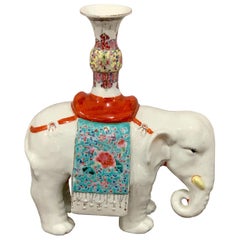
Chinese Export Porcelain Canton Famille Rose Iron-Red Elephant Candlestick Circa 1860 This Chinese export porcelain elephant is modeled as a figural candlestick, a form made at Canton for Western interiors in the mid-19th century. The animal stands four-square with its head lowered and turned slightly to one side, the trunk curled back beneath the open mouth and short white tusks. The body is painted in a rich iron-red enamel and finely hatched in gilt to follow the folds of the skin, with the toenails picked out in black. The elephant is caparisoned with a blue harness, the straps joined on each haunch by a pair of interlocked rings. On its back a raised green saddle supports a flared, vase-shaped candle holder painted with a band of upright green leaves beneath a gilt rim. A long saddle cloth hangs down on each side, painted with blue enamel clouds on a turquoise ground within a black border with gilt scrollwork. The underside is glazed white and left undecorated. Dimensions: Height: 4 inches (10.2 cm) Length: 5 inches (12.7 cm) Width: 4 inches (10.2 cm) Provenance: Earle D. Vandekar of Knightsbridge References: Terese Tse Bartholomew, Hidden Meanings in Chinese Art (San Francisco: Asian Art Museum, 2006), for the rebus of the elephant and vase. Carl L. Crossman, The Decorative Arts of the China Trade (Woodbridge: Antique Collectors’ Club, 1991), for Canton export wares of the 19th century generally. Historical Context: The elephant is an auspicious animal in Chinese art, associated with strength and wisdom. Its name, xiang, sounds like the word for a sign or portent, and an elephant carrying a vase (ping, a pun on “peace”) forms the rebus taiping youxiang, a wish for peaceful times. The vase-shaped holder on the back of this elephant keeps that traditional image in a form adapted for use; holders of this kind took a candle in Western houses and are also described as stands for sticks of incense. By the mid-19th century the enamelers of Canton were well practiced in supplying decorative figures of this kind to the export market, painting them in the opaque overglaze enamels of the famille rose palette with iron-red and gilding. (Ref: Ny9389-nulr)
  • Dimensions:
    Height: 4 in (10.16 cm)Width: 5 in (12.7 cm)Depth: 4 in (10.16 cm)
  • Style:
    Chinese Export (Of the Period)
  • Materials and Techniques:
  • Place of Origin:
  • Period:
  • Date of Manufacture:
    1860
  • Condition:
    Wear consistent with age and use. original firing mark on forehead.
  • Seller Location:
    Downingtown, PA
  • Reference Number:
    Seller: Ny9389-nulr1stDibs: LU861025872392

More From This Seller

View All
Chinese Export Porcelain Canton Famille Rose Caparisoned Elephant Candlestick

Chinese Export Porcelain Canton Famille Rose Caparisoned Elephant Candlestick

Located in Downingtown, PA

Chinese Export Porcelain Canton Famille Rose Caparisoned Elephant Candlestick Circa 1860 This Chinese export porcelain elephant is modeled as a figural candlestick, a form made at C...

Category

Antique Mid-19th Century Chinese Chinese Export Candlesticks

Materials

Porcelain

18th-century Whieldon Type Cow Creamer and Cover

18th-century Whieldon Type Cow Creamer and Cover

By Thomas Whieldon Pottery

Located in Downingtown, PA

Rural Charm: Whieldon-Type Creamware Cow Creamer Whieldon-Type Creamware Cow Creamer and Cover Circa 1770 This delightful and historically important piece is an 18th-century cow cr...

Category

Antique 1760s Georgian Pottery

Materials

Ceramic, Creamware, Pottery

French Majolica Camel-Form Lidded Box

French Majolica Camel-Form Lidded Box

Located in Downingtown, PA

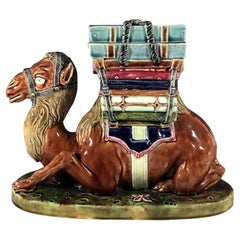
An Exotic Cargo: A French Majolica Camel-Form Lidded Box, St. Amand, Circa 1870 This charming French majolica lidded box is a delightful example of the imaginative and naturalistic forms that characterized 19th-century majolica production. Crafted by the St. Amand pottery in circa 1870, the piece is a sculptural rendering of a seated camel, a subject that would have appealed to the era's fascination with exoticism and global trade. The camel is naturalistically colored and rests on a raised, mottled green ground, suggesting a desert landscape. The lid of the box is formed by the camel's loaded pack, which is meticulously detailed with a variety of goods. This top section is removable, revealing a square, hollow interior in a contrasting light blue glaze—a small, hidden surprise. The impressed mark "St Ad" on the base confirms its origin from the Saint-Amand-les-Eaux pottery. This pottery, which was active from the 17th century to 1920, was renowned for its high-quality, brightly colored tin-glazed earthenware, a technique known as faience in France. St. Amand's work, often featuring rich glazes and creative forms, was widely exported and highly sought after for both tableware and decorative objects. Majolica, with its vibrant glazes and playful designs, saw a resurgence in popularity in the mid-19th century, particularly in England and France. This camel-form box is a perfect example of how the pottery of this period moved beyond purely functional forms to create whimsical and narrative pieces. It reflects a world increasingly connected by trade and travel, where images of distant lands and their inhabitants entered the domestic sphere. This piece, from a private New York collection and with a provenance tracing to Jesse Davis Antiques...

Category

Antique 1870s French Victorian Ceramics

Materials

Majolica

Large Chinese Export Famille Rose Porcelain Fish Bowl, Qianlong, on Carved Stand

Large Chinese Export Famille Rose Porcelain Fish Bowl, Qianlong, on Carved Stand

Located in Downingtown, PA

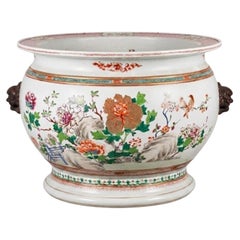
Large Chinese Export Famille Rose Porcelain Fish Bowl, Qianlong, on Carved Stand Qing Dynasty, Qianlong Period, Circa 1750–1770 This large fish bowl is painted in the famille rose palette with a continuous fenced garden in which flowering tree peonies, the “King of Flowers” and emblem of wealth and honor, rise among grisaille rockwork stippled in gilt, beside a blue garden fence, flowering prunus and chrysanthemums, with a pair of songbirds perched on a blossoming branch. The principal bloom is boldly drawn in iron-red over a gilt ground and the white peonies are feathered in crimson, the overglaze enamels applied with a painterly touch that lends the flowers a remarkable softness and depth. Two applied molded Buddhist lion-mask handles, finished in reddish-brown, provide an architectural counterpoint to the floral decoration. The shoulder is encircled by a turquoise band of cloud scrolls punctuated with iron-red flowerheads between raised gilt fillets, the waisted neck is painted with sprays of iron-red and gilt scrolling flowers, and the foot carries a green lappet band dotted in gilt between iron-red diaper and zigzag borders. The wide everted rim is painted inside with a pink diaper border reserved with six panels of famille rose flowering branches. Below, the interior is painted with goldfish swimming among green water weeds, accompanied by a small grisaille crab, a shrimp and a shell, with a further goldfish in the well, a scheme intended to be seen through clear water in lively interplay with the living fish kept within. The Chinese word for goldfish, jinyu, sounds the same as the words for gold and jade, so the fish carry the wish of the auspicious phrase jinyu mantang, “may gold and jade fill your hall.” Firing a thick-walled vessel of this size without warping or cracking was a considerable technical achievement for the potters of Jingdezhen. The bowl is presented on an associated European carved and ebonized wood stand of the nineteenth century, carved with drapery swags and acanthus and raised on lion-paw feet, the pairing of Chinese porcelain and Western carving characteristic of the grand interiors in which such bowls were displayed. Dimensions Height: 16¼ inches (41.3 cm) Width: 23 inches (58.4 cm) Height on stand: 25 inches (63.5 cm) Provenance Private Estate Collection. Condition The bowl is in remarkably good antique condition for its size and age, the enamels remaining vibrant with minimal rubbing. A firing crack to the interior, typical of vessels of this large scale, has been invisibly repaired. The stand with wear to the ebonized finish, consistent with age. References Christiaan J. A. Jörg, Chinese Ceramics in the Collection of the Rijksmuseum, Amsterdam: The Ming and Qing Dynasties (London, 1997), for a famille rose fish bowl with applied biscuit lion-mask handles, c. 1740–1760, from the collection of the Hague sinologist Jean Theodore Royer (1737–1807), Rijksmuseum, inv. no. AK-NM-6466. Bonhams, New York, 17 March 2025, lot 51, a pair of famille rose fish bowls, Qianlong, 1740–1760, with biscuit lion-mask handles and goldfish interiors, sold by the Philadelphia Museum of Art. Bonhams, London, New Bond Street, 8 November 2012, lot 100, a large famille rose fish bowl, Qianlong, painted with peonies and chrysanthemums issuing from rockwork, with applied biscuit animal-head handles and a goldfish interior. Historical Context Goldfish were bred as ornamental fish in China from the Song dynasty, and large porcelain bowls...

Category

Antique Mid-18th Century Chinese Georgian Ceramics
Materials

Porcelain

Chinese Export Porcelain Double Boy Figure Group of Hehe Erxian

Chinese Export Porcelain Double Boy Figure Group of Hehe Erxian

Located in Downingtown, PA

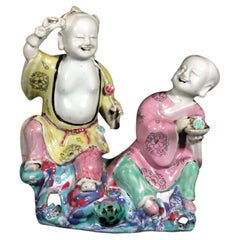
Chinese Export Porcelain Figure Group of the Hehe Erxian, Qianlong, Circa 1770 Two laughing boys sit side by side on a pierced outcrop of rock work in this Chinese Export porcelain ...

Category

Antique 1770s Chinese Chinese Export Porcelain

Materials

Porcelain

You May Also Like

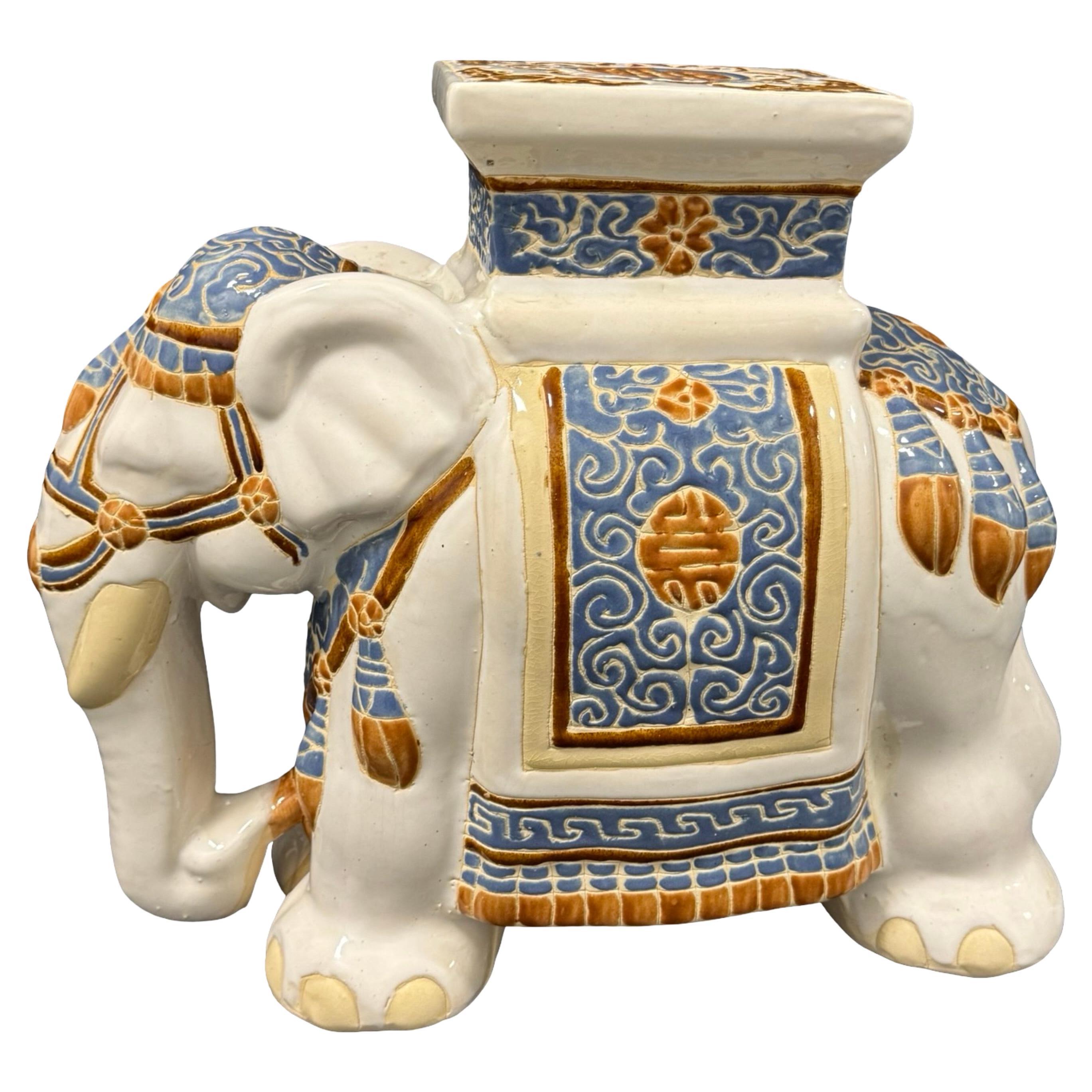
Chinese Famille Rose of Elephant Form Joss or Candlestick

Chinese Famille Rose of Elephant Form Joss or Candlestick

Located in Kilmarnock, VA

An exquisite Chinese porcelain joss stick holder dating to the early 19th century, crafted in the renowned famille rose palette. This piece is beautifully shaped in the form of a cap...

Category

Antique 1870s Chinese Candlesticks

Materials

Enamel

Vintage Asian Opposing Glazed Ceramic Elephant Candlesticks - A Pair

Vintage Asian Opposing Glazed Ceramic Elephant Candlesticks - A Pair

Located in West Palm Beach, FL

This captivating pair of vintage ceramic elephant figures pays homage to the classic Chinoiserie tradition, designed to serve as striking decorative objects or majestic candle holder...

Category

Mid-20th Century Chinese Chinoiserie Candlesticks

Materials

Ceramic

Chinese Famille Rose Pair of Elephant Candlesticks or Josh Sticks.

Chinese Famille Rose Pair of Elephant Candlesticks or Josh Sticks.

Located in Sarasota, FL

Chinese famille rose pair of candlesticks or josh sticks shaped as caparisoned elephants. The pair is finely decorated and gilded.

Category

Antique 1850s Chinese Ceramics

Materials

Porcelain