Want more images or videos?
Request additional images or videos from the seller.

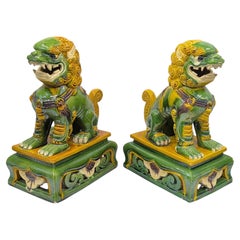
Pair of Celadon-Glazed Haitai Statues, Song to Ming

$5,525per set
$8,500per set35% Off
£4,258.75per set
£6,538.46per set35% Off
€5,094.36per set
€7,826.50per set35% Off
CA$8,034.84per set
CA$12,363.39per set35% Off
A$8,283.31per set
A$12,676.58per set35% Off
CHF 4,706.50per set
CHF 7,222.66per set35% Off
MX$104,851.55per set
MX$161,362.02per set35% Off
NOK 53,896.09per set
NOK 82,963.01per set35% Off
SEK 56,462.83per set
SEK 86,560.33per set35% Off
DKK 38,083.39per set
DKK 58,504.76per set35% Off

About the Item

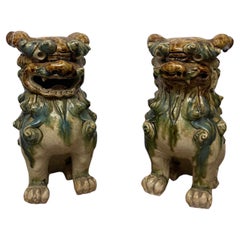
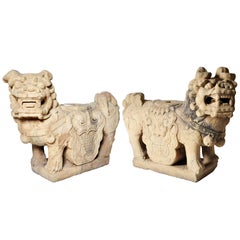
These celadon-glazed figures appear to be a pair of lion-form (獅子形) mythical guardian beasts made for altar use. The reddish-brown to ochre stoneware body visible at the exposed foot rim is characteristic of iron-rich southern Chinese stoneware clay. The densely layered carving — overlapping scale motifs on the qilin-type figure and curling mane with a saddle-cloth ornament on the lion-type figure — reflects a decorative sensibility consistent with production after the Song dynasty. The pierced, hollowed mouths on each figure suggest a function as incense holders, a form commonly produced in pairs to flank an incense burner on a ritual altar. Taken together, the clay body, glaze, carving style, and functional structure point toward a Song to Ming dynasty attribution, from a southern celadon kiln within the Longquan tradition. Period : Song to Ming dynasty Type : Haitai Statue Medium : Celadon Provenance : The piece was acquired in Hong Kong in the year late 1990s.
  • Dimensions:
    Height: 3.55 in (9 cm)Diameter: 4.14 in (10.5 cm)
  • Sold As:
    Set of 2
  • Materials and Techniques:
    Celadon,Glazed
  • Place of Origin:
  • Period:
  • Date of Manufacture:
    Song-Ming Dynasty
  • Condition:
    Repaired: Left statue's Right leg had been repaired. Minor fading. Overall good condition. The left figure has a hairline crack and old repair at the foreleg-to-base join.
  • Seller Location:
    seoul, KR
  • Reference Number:
    1stDibs: LU9577237947682

More From This Seller

View All
Two Green Glazed Court Figures, Ming Dynasty

Two Green Glazed Court Figures, Ming Dynasty

Located in seoul, KR

A pair of Ming dynasty green-glazed pottery court figures, fully glazed and modeled with neat court caps and long flowing robes forming a balanced silhouette. The surface shows natur...

Category

Antique 15th Century and Earlier East Asian Ming Antiquities

Materials

Pottery

Two Straw-Glazed Pottery Figures of Court, Sui-Tang dynasty

Two Straw-Glazed Pottery Figures of Court, Sui-Tang dynasty

Located in seoul, KR

Two standing court figures modeled in pottery with slender proportions and simplified facial features. A thin straw-toned glaze is applied over the surfaces, with areas of exposed bu...

Category

Antique 15th Century and Earlier East Asian Tang Antiquities

Materials

Stoneware

Longquan Celadon Figurine, Ming Dynasty (1368-1644)

Longquan Celadon Figurine, Ming Dynasty (1368-1644)

Located in seoul, KR

This Longquan celadon figure is defined by a composed frontal presence: half-lidded eyes, a calm oval face, and a hooded mantle that reads as a single, clean silhouette. The robe is modeled with restrained but deep folds—glaze pools in the recesses into a richer olive tone, while the raised edges fire thinner and lighter, sharpening the relief and giving the carving real definition. The color shifts naturally from jade-like grey-green to mossy depths, with fine peppered speckling and subtle kiln character on the surface—an understated, materially convincing piece where form and glaze do the work. Period: Ming Dynasty (1368-1644) Region: Longquan, China Medium: Stoneware - Celadon glazed, with a range from heavy grey to almost white porcelain-like material Type: Sculpture Height : 24.5 cm Provenance : Acquired in 1999, Hongkong * Ming Dynasty Longquan Celadon Longquan celadon from the Ming Dynasty typically exhibits a more robust and heavier stoneware body compared to its Song Dynasty predecessors. The Ming era saw an evolution in celadon glaze, achieving a wider spectrum of green hues, from olive to bluish-greens. Ming celadons...

Category

Antique 15th Century and Earlier East Asian Ming Antiquities

Materials

Celadon

Two Glazed Court Attendants, Ming Period (1368-1644)

Two Glazed Court Attendants, Ming Period (1368-1644)

Located in seoul, KR

Two finely hollow-moulded terracotta statuettes from ancient China, dating to the Ming Dynasty. The figure is depicted standing, dressed in long, flowing robes, painted in vibrant blue or green and deep amber yellow. The hair is styled into an elaborate top-knot, painted in a muted brown. Areas left unpainted would have been 'cold-painted' after firing, contrasting with the vivid fired blue or green and amber pigments. The figure is shown with the left hand raised to the chest, as if holding something, possibly an offering or incense. Figurines like this were placed in tombs to guide the deceased on their journey to the afterlife. The Ming Dynasty was known for its exceptional artistic achievements, partly due to its economic prosperity. Since the Han Dynasty, it was customary to bury terracotta miniatures of everyday objects with the deceased. These items, known as mingqi, or "spirit utensils" and "vessels for ghosts," were believed to help and assist the deceased in the afterlife. Mingqi were crafted in the form of cooking utensils, miniature replicas of houses, temples, furniture, and other items. Anthropomorphic and zoomorphic terracotta figures were also popular, designed to assist, entertain, and recreate the living world for the deceased. Period: Ming Dynasty Medium: Green/blue-glazed Pottery Type: Figure Provenance : Acquired in late 1990s from Hongkong Reference : 1) Ancient & Oriental - Terracotta Tomb Attendants (Type : Highly related) 2) La Maison De La Petite Sara S.r.l. - Archaeology section - A Black glazed Terracotta Statuette, Servant with Trumpet, Ming Dynasty (Price realised : 700 GBP / Type : Highly related) * Ming Dynasty Glazed Pottery Figures Ming Dynasty glazed pottery figures are renowned for their bold color palette, intricate detailing, and lifelike forms, distinguishing them from earlier traditions. These figures, which depict officials, warriors, animals, and mythical creatures, are characterized by high-gloss lead-based glazes in green, amber, ochre, and sancai (three-color) combinations. The thickly applied glaze pools in recesses, creating depth and enhancing sculptural details. With dynamic postures, expressive facial features, and meticulously rendered drapery, these figures reflect the period’s advancement in ceramic craftsmanship, offering a greater sense of movement and realism compared to the rigid and stylized forms of earlier dynasties. A defining characteristic of Ming glazed pottery is its elaborate surface detailing, often achieved through raised relief elements and contrasting glazes. Equestrian figures, for example, feature carefully sculpted saddles, harnesses, and decorative embellishments, while human figures are adorned with intricate robes and headdresses. The large scale of these tomb figures, often more imposing than those from previous periods, underscores the increasing importance of funerary art during the Ming era. Unlike later Qing Dynasty figures...

Category

Antique 15th Century and Earlier East Asian Ming Antiquities

Materials

Pottery

Pair of Olive-Green Glazed Longquan Celadon Vases, Sui-Song

Pair of Olive-Green Glazed Longquan Celadon Vases, Sui-Song

Located in seoul, KR

This pair of celadon vessels is entirely coated in a thick olive-green glaze, which retains a soft natural sheen. A network of crackles spreads across the surface. Along the ridges a...

Category

Antique 15th Century and Earlier East Asian Antiquities

Materials

Celadon

A Pair of Qingbai Incense Stands, Song-Yuan Dynasty

A Pair of Qingbai Incense Stands, Song-Yuan Dynasty

Located in seoul, KR

Qingbai porcelain incense stands of elegant baluster form, flanked by scroll-shaped handles and raised on an openwork square base. Covered overall in a soft bluish-white glaze, the p...

Category

Antique 15th Century and Earlier East Asian Antiquities

Materials

Porcelain

You May Also Like

Antique Chinese Celadon Ceramic Figures ~ a pair

Antique Chinese Celadon Ceramic Figures ~ a pair

Located in New York, NY

A fine pair of antique Chinese celadon glazed figures of a male and female. Dimensions: 8.5" H x 4.5" L x 5" D Provenance: From a New York Ci...

Category

Antique 19th Century More Asian Art, Objects and Furniture

Materials

Ceramic

Pair of European Porcelain Figures of Chinese Guardian Lions

Pair of European Porcelain Figures of Chinese Guardian Lions

Located in Essex, MA

Brightly painted with a male and female foo dog or Buddhistic lion one holding a ball for the material world and the female with the cub representing the spiritual.

Category

Antique Late 19th Century European Ceramics

Materials

Porcelain

Pair of Chinese Stone Guardian Lions

Pair of Chinese Stone Guardian Lions

Located in Chicago, IL

Often referred to as “Fu Dogs” in western culture, these handsome stone sentinels are iconic gatekeepers seen throughout China and elsewhere in Asia. Traditional symbols of protectio...

Category

Antique 19th Century Chinese Sculptures and Carvings

Materials

Limestone

Pair of Chinese Sancai Glazed Pottery Guardian Lions on Pierced Bases RoC c.1920

Pair of Chinese Sancai Glazed Pottery Guardian Lions on Pierced Bases RoC c.1920

Located in Richmond, CA

A striking pair of Chinese sancai-glazed pottery guardian lions dating to the early 20th century, circa 1920. Modelled as an opposing pair, each Buddhist lion is seated upright upon...

Category

Early 20th Century Chinese Chinese Export Ceramics

Materials

Ceramic, Earthenware

Vintage Asian Glazed Ceramic Guardian Lions - A Pair

Vintage Asian Glazed Ceramic Guardian Lions - A Pair

Located in West Palm Beach, FL

This striking pair of vintage guardian lions, traditionally known as Foo Dogs, is a vibrant example of mid-to-late 20th-century Chinoiserie decor. Handcrafted from high-quality ceram...

Category

Late 20th Century Chinese Animal Sculptures

Materials

Ceramic