Want more images or videos?
Request additional images or videos from the seller.

Japanese Smoking Set 'Tabac-Ire'

$5,649.65
£4,260.67
€5,000VAT Included
CA$8,056.38
A$8,260.46
CHF 4,706.51
MX$105,148.64
NOK 54,061.35
SEK 56,405.47
DKK 38,123.57

About the Item

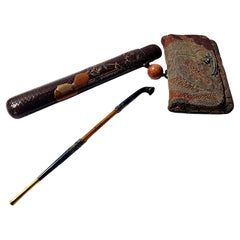
Smoking set (tabako-ire) composed of a pipe (kiseru), a pipe case (kiseruzutsu) and a tabacco pouch (tonkotsu) for women linked to a netsuke. Intended for a female use, the pipe is particularly thin. The pipe is made of bamboo with a dark brown varnish, while the mouthpiece decorated with flowers and the tip decorated with two butterflies are made of metal with a silver alloy. These are decorated by engraving and inlaying other colored metals in shades of orange and gray to obtain fine color highlights. The pipe case and tobacco pouch are made of smooth, brown, matte cowhide. The material has been partially rubbed to obtain two different shades. The pipe case opens by the edge. The tobacco pouch is decorated with a metallic decoration (menuki) of two peonies whose pistils are made of coral colored hard stone. Both parts are linked to a netsuke of kagamibuta type, made of two parts: a brass plate decorated with two cranes and an ivory bowl. They are connected using the ojime made of copper and hard stone, producing a clever recall of color with the stones of the tobacco pouch and the metal inlays on the pipe. In Japan, tobacco is consumed by both men and women. In his book Around the World on a Bicycle (London, 1888), Thomas Stevens describes this practice: “The girls who wait in the yadoya and teahouses store their tobacco in the large pockets of their sleeves, their pipes sometimes tucked into their scarves or belts, sometimes tucked into the back of their hair”. Our smoking kit was made to be worn at the belt thanks to the netsuke. Japan – Meiji era (1868-1912), second half of the 19th century Measures: Pipe (kiseru): length 7.1 in. (18 cm) – width 0.4 in. (1 cm) Pipe case (kiseruzutsu): lenght 8.5 in. (21.5 cm) – width 1.4 in. (3.6 cm) Tabacco pouch (tonkotsu): lenght 4.7 in. (12 cm) – width 29.5 in. (7.5 cm) Netsuke: diameter 1.7 in. (4.5 cm) Ojime: diameter 0.7 in. (1.7 cm).
  • Dimensions:
    Height: 2 in (5.08 cm)Width: 12 in (30.48 cm)Depth: 7.5 in (19.05 cm)
  • Materials and Techniques:
  • Place of Origin:
  • Period:
  • Date of Manufacture:
    1868-1912
  • Condition:
  • Seller Location:
    PARIS, FR
  • Reference Number:
    Seller: 2022-10521stDibs: LU8311233527552

More From This Seller

View All
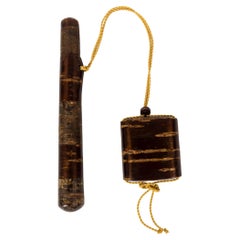
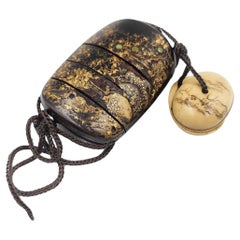
Japanese Tobacco smoking set made from cherry bark marquetry (Kabazaiku)

Japanese Tobacco smoking set made from cherry bark marquetry (Kabazaiku)

Located in PARIS, FR

A matching set consisting of an inrō and pipe (kiseru) holder crafted forming a kiserusu. This piece was made using chazutsu, ( or Kabazaiku) a technique involving the application of...

Category

Early 20th Century Japanese Taisho Scholar's Objects

Materials

Fruitwood

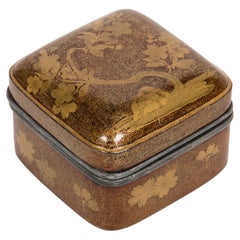
Japanese lacquered Cherry Tree Kobako

Japanese lacquered Cherry Tree Kobako

Located in PARIS, FR

Kobako in nashiji lacquer of square shape with a hira maki-e décor of a blossoming cherry tree. Both of the four sides are adorned with golden lacquer cherry flowers, represented i...

Category

Antique 19th Century Japanese Lacquer

Materials

Lacquer

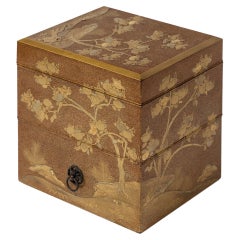
Japanese Lacquered Tebako 'Box'

Japanese Lacquered Tebako 'Box'

Located in PARIS, FR

Tebako box with three compartments in golden and nashi-ji lacquer, decorated with golden, red, and kirigane lacquer, golden persimmon tree leaves, among rocks. The compartments are of increasing size from the top. The decoration is in continuity. Persimmon has been cultivated in southern China for more than 2500 years and is believed to have been introduced to Japan in the 8th century. The veneer is a tree with very hard wood, similar to ebony. According to a legend, one specimen survived the atomic bombing of Nagasaki on August 9, 1945, close to the epicenter. It is therefore in Japan a symbol of strength and longevity. It is also the national fruit of the country. It is eaten as a traditional dish during New Year's Day celebrations. Tebako literally means "portable box...

Category

Antique 1860s Japanese Lacquer

Materials

Lacquer

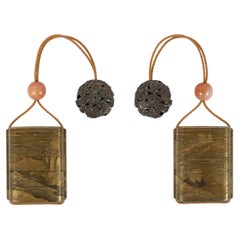
Gold Lacquer Inro Decorated with a Lake Landscape

Gold Lacquer Inro Decorated with a Lake Landscape

Located in PARIS, FR

Inro with four gold lacquer boxes, decorated with a lake landscape. Accompanied by a bronze ryusa manju. Small boxes formed of compartments that fit one on top of the other, inro (? ?) are traditional Japanese clothing...

Category

Antique Mid-19th Century Lacquer

Materials

Lacquer

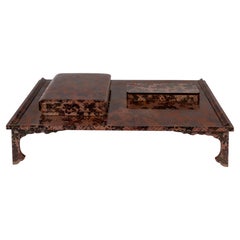
Japanese writting set in waqasa lacquer including bundai ryoshibako and fudebako

Japanese writting set in waqasa lacquer including bundai ryoshibako and fudebako

Located in PARIS, FR

Set of bundai, ryōshibako and fudebako in wakasa lacquer with an old rose background and black traditional Japanese patterns. The saya pattern (or sayagata) is composed by Chinese svastikas. This symbol linked to Buddhism, mean intelligence, power and peace. It is a good omen sign. The kanoko pattern reminds stains on fawn back. The sakura (cherry blossom) pattern is emblematic of Japan. The blossoming in a short time marks spring beginning and is a symbol of renewal and ephemeral beauty. There are also traces of calligraphy brush, in reference to the function of the objects. Bundai is a low table used to put books or scrolls and, later, to write. Rectangular ryōshibako (letter and document box) with a slightly domed Fudebako (pencil case) of rectangular format very narrow in its length with two rounded corners, flat cover. Wakasa lacquerware...

Category

Early 20th Century Japanese Taisho Lacquer

Materials

Lacquer

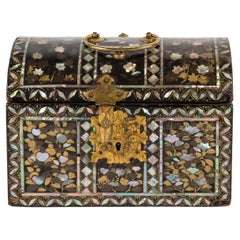
Momoyama Namban Chest

Momoyama Namban Chest

Located in PARIS, FR

Namban chest with a semi-cylindrical lid made of black lacquered wood (urushi) with gold lacquer (maki-e) and inlaid with mother-of-pearl (raden). Decorated with three main bands o...

Category

Antique 17th Century Japanese Antiquities

Materials

Lacquer

You May Also Like

Three Antique Japanese Items

Three Antique Japanese Items

Located in West Palm Beach, FL

Three Antique Japanese Items 1) An antique Japanese tabako-ire' with hand tooled gilded kane mono of fuji chrysanthemum. Bronze and shakudo oj...

Category

Antique 1880s Antiquities

Materials

Wood

Traditional Japanese Inro box with five compartments

Traditional Japanese Inro box with five compartments

Located in Autonomous City Buenos Aires, CABA

Traditional Japanese Inro Box with Five Compartments Traditional Japanese inro box with five compartments. Classic design with dark lacquer and gold ...

Category

20th Century Japanese Japonisme Antiquities

Materials

Wood

Antique German Humidor

Antique German Humidor

Located in Tampa, FL

A wonderful antique German humidor. Mostly copper with some metal and a wood interior. The interior is about 3" deep. there isn't a key. Circa 1890s.

Category

Antique 1890s German Decorative Boxes

Materials

Metal, Copper

A Set of Lacquer Kiseruzutsu, Tabako-ire, and Kiseru, Signed Sesshin, Meiji Era

A Set of Lacquer Kiseruzutsu, Tabako-ire, and Kiseru, Signed Sesshin, Meiji Era

Located in Norton, MA

A fine set of a lacquer kiseruzutsu (pipe case), tabako-ire (tobacco pouch), and kiseru (pipe), signed on both the Pipe and Pipe Case. Decorated with a sake gourd suspended from a ma...

Category

Antique Late 19th Century Japanese Antiquities

Materials

Stone, Gold, Silver, Copper

Italian Ceramic Box

Italian Ceramic Box

Located in Los Angeles, CA

Drip glaze ceramic box made in Italy, circa 1970s. Grainy finish along with high gloss accents in a beautiful chocolate brown and tan giving it great depth...

Category

Vintage 1970s Italian Ceramics

Materials

Ceramic

Antique Chinese Opium Pipe Asian art  中国古董

Antique Chinese Opium Pipe Asian art 中国古董

Located in London, GB

A fine antique Chinese opium pipe Bamboo Wood stem with brass bowl with original ceramic damper Period late 19th century.

Category

Early 20th Century Chinese Tribal Art

Materials

Wood