Terry Rose Art

to
1
2
2
2
1
2

Use search to find more

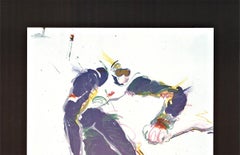
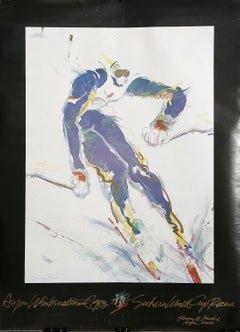
Apen Wintern National 1982 original ski vintage poster

Apen Wintern National 1982 original ski vintage poster

By Terry Rose

Located in Spokane, WA

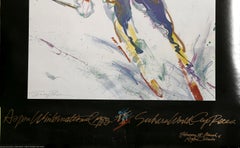
Original vintage poster: Aspen Winternational 1983 and Subaru World Cup Races, printed 1982 by artist Terry Rose. The ASPEN WINTER NATIONAL skiing poster...

Category

1980s 85 New Wave Terry Rose Art

Materials

Lithograph

Aspen Winter National, Pop Art Poster by Terry Rose

Aspen Winter National, Pop Art Poster by Terry Rose

By Terry Rose

Located in Long Island City, NY

Terry Rose, American (1939 - ) - Aspen Winter National, Year: 1983, Medium: Poster, Size: 30 x 22 in. (76.2 x 55.88 cm)

Category

1980s Pop Art Terry Rose Art

Materials

Offset

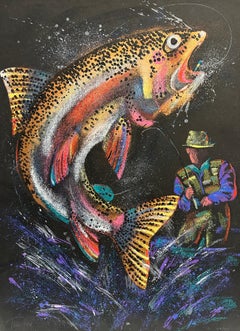
Striker
Striker

Striker

By Terry Rose

Located in Toronto, ON

20" x 27" Unframed Limited Edition Serigraph of 225 Hand Signed by Terry Rose

Category

21st Century and Contemporary Terry Rose Art

Materials

Screen

Related Items
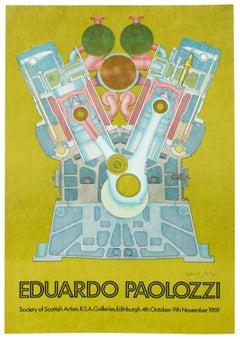
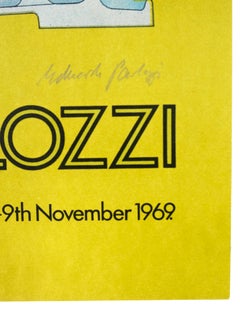
Vintage SIGNED 1969  Eduardo Paolozzi Poster avocado green psychedelic pop art

Vintage SIGNED 1969 Eduardo Paolozzi Poster avocado green psychedelic pop art

By Eduardo Paolozzi

Located in New York, NY

A vibrant vintage poster in blue, pink, brown, and classic 1960's avocado green, by Scottish Pop art progenitor Eduardo Paolozzi. Machinery extends upward in two arms like a space-age car engine...

Category

1960s Pop Art Terry Rose Art

Materials

Offset

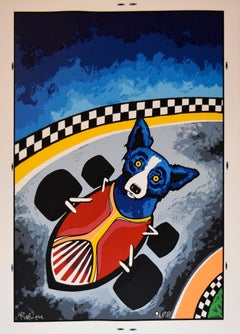
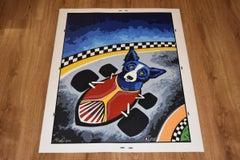
Thunder Road - Signed Silkscreen Print Blue Dog

Thunder Road - Signed Silkscreen Print Blue Dog

By George Rodrigue

Located in Mount Laurel, NJ

This Blue Dog work consists of the dog in a red race car on an asphalt racetrack, blue sky and checkered wall strips. The blue dog has blissful yellow eyes. This pop art animal original silkscreen print on paper is hand signed by the artist. Artist: George Rodrigue Title: Blue Dog “Thunder Road...

Category

Early 2000s Pop Art Terry Rose Art

Materials

Screen

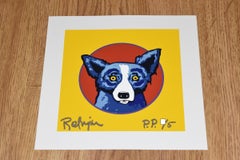
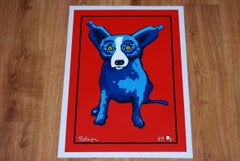
Bullseye Yellow - Signed Silkscreen Print Blue Dog

Bullseye Yellow - Signed Silkscreen Print Blue Dog

By George Rodrigue

Located in Mount Laurel, NJ

This Blue Dog work consists of a blue dog in the center of a red circle on a yellow background. The dog has soulful yellow eyes. This pop art animal original silkscreen print on pa...

Category

1990s Pop Art Terry Rose Art

Materials

Screen

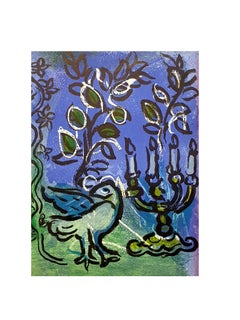
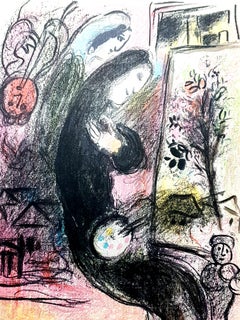
Marc Chagall - Inspiration - Original Lithograph from "Chagall Lithographe" v. 2

Marc Chagall - Inspiration - Original Lithograph from "Chagall Lithographe" v. 2

By Marc Chagall

Located in Collonge Bellerive, Geneve, CH

Marc Chagall Original Lithograph from Chagall Lithographe 1957-1962. VOLUME II. 1963 Dimensions: 32 x 24 cm From the unsigned edition of 10000 copies without margins Reference: Mourlot 398 Condition : Excellent Marc Chagall (born in 1887) Marc Chagall was born in Belarus in 1887 and developed an early interest in art. After studying painting, in 1907 he left Russia for Paris, where he lived in an artist colony on the city’s outskirts. Fusing his own personal, dreamlike imagery with hints of the fauvism and cubism popular in France at the time, Chagall created his most lasting work—including I and the Village (1911)—some of which would be featured in the Salon des Indépendants exhibitions. After returning to Vitebsk for a visit in 1914, the outbreak of WWI trapped Chagall in Russia. He returned to France in 1923 but was forced to flee the country and Nazi persecution during WWII. Finding asylum in the U.S., Chagall became involved in set and costume design before returning to France in 1948. In his later years, he experimented with new art forms and was commissioned to produce numerous large-scale works. Chagall died in St.-Paul-de-Vence in 1985. The Village Marc Chagall was born in a small Hassidic community on the outskirts of Vitebsk, Belarus, on July 7, 1887. His father was a fishmonger, and his mother ran a small sundries shop in the village. As a child, Chagall attended the Jewish elementary school, where he studied Hebrew and the Bible, before later attending the Russian public school. He began to learn the fundamentals of drawing during this time, but perhaps more importantly, he absorbed the world around him, storing away the imagery and themes that would feature largely in most of his later work. At age 19 Chagall enrolled at a private, all-Jewish art school and began his formal education in painting, studying briefly with portrait artist Yehuda Pen. However, he left the school after several months, moving to St. Petersburg in 1907 to study at the Imperial Society for the Protection of Fine Arts. The following year, he enrolled at the Svanseva School, studying with set designer Léon Bakst, whose work had been featured in Sergei Diaghilev's Ballets Russes. This early experience would prove important to Chagall’s later career as well. Despite this formal instruction, and the widespread popularity of realism in Russia at the time, Chagall was already establishing his own personal style, which featured a more dreamlike unreality and the people, places and imagery that were close to his heart. Some examples from this period are his Window Vitebsk (1908) and My Fianceé with Black Gloves (1909), which pictured Bella Rosenfeld, to whom he had recently become engaged. The Beehive Despite his romance with Bella, in 1911 an allowance from Russian parliament member and art patron Maxim Binaver enabled Chagall to move to Paris, France. After settling briefly in the Montparnasse neighborhood, Chagall moved further afield to an artist colony known as La Ruche (“The Beehive”), where he began to work side by side with abstract painters such as Amedeo Modigliani and Fernand Léger as well as the avant-garde poet Guillaume Apollinaire. At their urging, and under the influence of the wildly popular fauvism and cubism, Chagall lightened his palette and pushed his style ever further from reality. I and the Village (1911) and Homage to Apollinaire (1912) are among his early Parisian works, widely considered to be his most successful and representative period. Though his work stood stylistically apart from his cubist contemporaries, from 1912 to 1914 Chagall exhibited several paintings at the annual Salon des Indépendants exhibition, where works by the likes of Juan Gris, Marcel Duchamp and Robert Delaunay were causing a stir in the Paris art world. Chagall’s popularity began to spread beyond La Ruche, and in May 1914 he traveled to Berlin to help organize his first solo exhibition, at Der Sturm Gallery. Chagall remained in the city until the highly acclaimed show opened that June. He then returned to Vitebsk, unaware of the fateful events to come. War, Peace and Revolution In August 1914 the outbreak of World War I precluded Chagall’s plans to return to Paris. The conflict did little to stem the flow of his creative output, however, instead merely giving him direct access to the childhood scenes so essential to his work, as seen in paintings such as Jew in Green (1914) and Over Vitebsk (1914). His paintings from this period also occasionally featured images of the war’s impact on the region, as with Wounded Soldier (1914) and Marching (1915). But despite the hardships of life during wartime, this would also prove to be a joyful period for Chagall. In July 1915 he married Bella, and she gave birth to a daughter, Ida, the following year. Their appearance in works such as Birthday (1915), Bella and Ida by the Window (1917) and several of his “Lovers” paintings give a glimpse of the island of domestic bliss that was Chagall’s amidst the chaos. To avoid military service and stay with his new family, Chagall took a position as a clerk in the Ministry of War Economy in St. Petersburg. While there he began work on his autobiography and also immersed himself in the local art scene, befriending novelist Boris Pasternak, among others. He also exhibited his work in the city and soon gained considerable recognition. That notoriety would prove important in the aftermath of the 1917 Russian Revolution when he was appointed as the Commissar of Fine Arts in Vitebsk. In his new post, Chagall undertook various projects in the region, including the 1919 founding of the Academy of the Arts. Despite these endeavors, differences among his colleagues eventually disillusioned Chagall. In 1920 he relinquished his position and moved his family to Moscow, the post-revolution capital of Russia. In Moscow, Chagall was soon commissioned to create sets and costumes for various productions at the Moscow State Yiddish Theater...

Category

1960s Surrealist Terry Rose Art

Materials

Lithograph

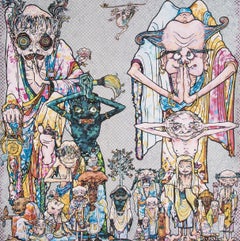
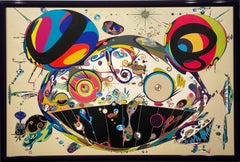
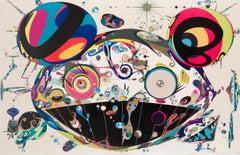
Clairvoyance. Limited Edition (print) by Takashi Murakami signed, numbered

Clairvoyance. Limited Edition (print) by Takashi Murakami signed, numbered

By Takashi Murakami

Located in Hong Kong, HK

Clairvoyance, 2015 by Takashi Murakami Offset print, numbered and signed by the artist Edition 205/300 Takashi Murakami is best known for his contemporary combination of fine art a...

Category

2010s Pop Art Terry Rose Art

Materials

Lithograph, Offset

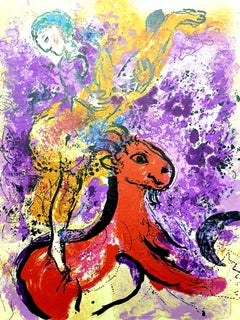
Marc Chagall - The Red Rider - Original Lithograph

Marc Chagall - The Red Rider - Original Lithograph

By Marc Chagall

Located in Collonge Bellerive, Geneve, CH

Marc Chagall - Original Lithograph The Red Rider From the unsigned, unnumbered lithograph printed in the literary review XXe Siecle 1957 See Mourlot 191 Dimensions: 32 x 24 cm Publisher: G. di San Lazzaro. Marc Chagall (born in 1887) Marc Chagall was born in Belarus in 1887 and developed an early interest in art. After studying painting, in 1907 he left Russia for Paris, where he lived in an artist colony on the city’s outskirts. Fusing his own personal, dreamlike imagery with hints of the fauvism and cubism popular in France at the time, Chagall created his most lasting work—including I and the Village (1911)—some of which would be featured in the Salon des Indépendants exhibitions. After returning to Vitebsk for a visit in 1914, the outbreak of WWI trapped Chagall in Russia. He returned to France in 1923 but was forced to flee the country and Nazi persecution during WWII. Finding asylum in the U.S., Chagall became involved in set and costume design before returning to France in 1948. In his later years, he experimented with new art forms and was commissioned to produce numerous large-scale works. Chagall died in St.-Paul-de-Vence in 1985. The Village Marc Chagall was born in a small Hassidic community on the outskirts of Vitebsk, Belarus, on July 7, 1887. His father was a fishmonger, and his mother ran a small sundries shop in the village. As a child, Chagall attended the Jewish elementary school, where he studied Hebrew and the Bible, before later attending the Russian public school. He began to learn the fundamentals of drawing during this time, but perhaps more importantly, he absorbed the world around him, storing away the imagery and themes that would feature largely in most of his later work. At age 19 Chagall enrolled at a private, all-Jewish art school and began his formal education in painting, studying briefly with portrait artist Yehuda Pen. However, he left the school after several months, moving to St. Petersburg in 1907 to study at the Imperial Society for the Protection of Fine Arts. The following year, he enrolled at the Svanseva School, studying with set designer Léon Bakst, whose work had been featured in Sergei Diaghilev's Ballets Russes. This early experience would prove important to Chagall’s later career as well. Despite this formal instruction, and the widespread popularity of realism in Russia at the time, Chagall was already establishing his own personal style, which featured a more dreamlike unreality and the people, places and imagery that were close to his heart. Some examples from this period are his Window Vitebsk (1908) and My Fianceé with Black Gloves (1909), which pictured Bella Rosenfeld, to whom he had recently become engaged. The Beehive Despite his romance with Bella, in 1911 an allowance from Russian parliament member and art patron Maxim Binaver enabled Chagall to move to Paris, France. After settling briefly in the Montparnasse neighborhood, Chagall moved further afield to an artist colony known as La Ruche (“The Beehive”), where he began to work side by side with abstract painters such as Amedeo Modigliani and Fernand Léger as well as the avant-garde poet Guillaume Apollinaire. At their urging, and under the influence of the wildly popular fauvism and cubism, Chagall lightened his palette and pushed his style ever further from reality. I and the Village (1911) and Homage to Apollinaire (1912) are among his early Parisian works, widely considered to be his most successful and representative period. Though his work stood stylistically apart from his cubist contemporaries, from 1912 to 1914 Chagall exhibited several paintings at the annual Salon des Indépendants exhibition, where works by the likes of Juan Gris, Marcel Duchamp and Robert Delaunay were causing a stir in the Paris art world. Chagall’s popularity began to spread beyond La Ruche, and in May 1914 he traveled to Berlin to help organize his first solo exhibition, at Der Sturm Gallery. Chagall remained in the city until the highly acclaimed show opened that June. He then returned to Vitebsk, unaware of the fateful events to come. War, Peace and Revolution In August 1914 the outbreak of World War I precluded Chagall’s plans to return to Paris. The conflict did little to stem the flow of his creative output, however, instead merely giving him direct access to the childhood scenes so essential to his work, as seen in paintings such as Jew in Green (1914) and Over Vitebsk (1914). His paintings from this period also occasionally featured images of the war’s impact on the region, as with Wounded Soldier (1914) and Marching (1915). But despite the hardships of life during wartime, this would also prove to be a joyful period for Chagall. In July 1915 he married Bella, and she gave birth to a daughter, Ida, the following year. Their appearance in works such as Birthday (1915), Bella and Ida by the Window (1917) and several of his “Lovers” paintings give a glimpse of the island of domestic bliss that was Chagall’s amidst the chaos. To avoid military service and stay with his new family, Chagall took a position as a clerk in the Ministry of War Economy in St. Petersburg. While there he began work on his autobiography and also immersed himself in the local art scene, befriending novelist Boris Pasternak, among others. He also exhibited his work in the city and soon gained considerable recognition. That notoriety would prove important in the aftermath of the 1917 Russian Revolution when he was appointed as the Commissar of Fine Arts in Vitebsk. In his new post, Chagall undertook various projects in the region, including the 1919 founding of the Academy of the Arts. Despite these endeavors, differences among his colleagues eventually disillusioned Chagall. In 1920 he relinquished his position and moved his family to Moscow, the post-revolution capital of Russia. In Moscow, Chagall was soon commissioned to create sets and costumes for various productions at the Moscow State Yiddish Theater, where he would paint a series of murals titled Introduction to the Jewish Theater as well. In 1921, Chagall also found work as a teacher at a school for war orphans. By 1922, however, Chagall found that his art had fallen out of favor, and seeking new horizons he left Russia for good. Flight After a brief stay in Berlin, where he unsuccessfully sought to recover the work exhibited at Der Sturm before the war, Chagall moved his family to Paris in September 1923. Shortly after their arrival, he was commissioned by art dealer and publisher Ambroise Vollard to produce a series of etchings for a new edition of Nikolai Gogol's 1842 novel Dead Souls. Two years later Chagall began work on an illustrated edition of Jean de la Fontaine’s Fables, and in 1930 he created etchings for an illustrated edition of the Old Testament, for which he traveled to Palestine to conduct research. Chagall’s work during this period brought him new success as an artist and enabled him to travel throughout Europe in the 1930s. He also published his autobiography, My Life (1931), and in 1933 received a retrospective at the Kunsthalle in Basel, Switzerland. But at the same time that Chagall’s popularity was spreading, so, too, was the threat of Fascism and Nazism. Singled out during the cultural "cleansing" undertaken by the Nazis in Germany, Chagall’s work was ordered removed from museums throughout the country. Several pieces were subsequently burned, and others were featured in a 1937 exhibition of “degenerate art” held in Munich. Chagall’s angst regarding these troubling events and the persecution of Jews in general can be seen in his 1938 painting White Crucifixion. With the eruption of World War II, Chagall and his family moved to the Loire region before moving farther south to Marseilles following the invasion of France. They found a more certain refuge when, in 1941, Chagall’s name was added by the director of the Museum of Modern Art (MOMA) in New York City to a list of artists and intellectuals deemed most at risk from the Nazis’ anti-Jewish campaign. Chagall and his family would be among the more than 2,000 who received visas and escaped this way. Haunted Harbors Arriving in New York City in June 1941, Chagall discovered that he was already a well-known artist there and, despite a language barrier, soon became a part of the exiled European artist community. The following year he was commissioned by choreographer Léonide Massine to design sets and costumes for the ballet Aleko, based on Alexander Pushkin’s “The Gypsies” and set to the music of Pyotr Ilyich Tchaikovsky. But even as he settled into the safety of his temporary home, Chagall’s thoughts were frequently consumed by the fate befalling the Jews of Europe and the destruction of Russia, as paintings such as The Yellow Crucifixion...

Category

1950s Surrealist Terry Rose Art

Materials

Lithograph

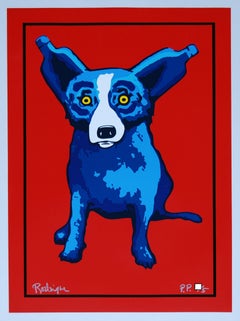
Absolut Dog - Signed Silkscreen Blue Dog Print

Absolut Dog - Signed Silkscreen Blue Dog Print

By George Rodrigue

Located in Mount Laurel, NJ

This Blue Dog work consists of the dog sitting on a red background with a frame of blue. The dogs ears are in the shape of Absolut Vodka bottles. The dog has soulful yellow eyes. ...

Category

1990s Pop Art Terry Rose Art

Materials

Screen

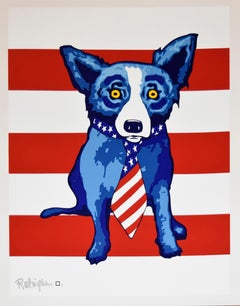
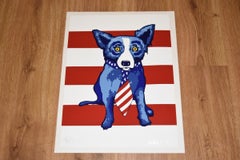
Stripes - Signed Silkscreen Print Blue Dog

Stripes - Signed Silkscreen Print Blue Dog

By George Rodrigue

Located in Mount Laurel, NJ

This Blue Dog work consists of a blue dog sporting a tie with the appearance of an American flag of stars and stripes. The background is alternating red and white stripes as on an A...

Category

1990s Pop Art Terry Rose Art

Materials

Screen

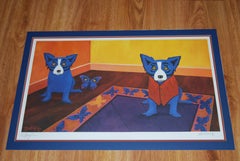
Butterflies Are Free - Signed Silkscreen Print Blue Dog

Butterflies Are Free - Signed Silkscreen Print Blue Dog

By George Rodrigue

Located in Mount Laurel, NJ

This Blue Dog work consists of 2 dogs; one with a brown vest sitting on a blue rug with a tan border and decorated with blue butterflies. One butterfly has released itself from the ...

Category

1990s Pop Art Terry Rose Art

Materials

Screen

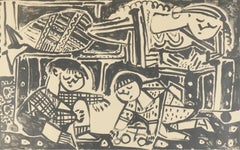
La Mère et les Enfants

Pablo PicassoLa Mère et les Enfants, 1953

$32,000

H 19.75 in W 29.25 in

La Mère et les Enfants

By Pablo Picasso

Located in New York, NY

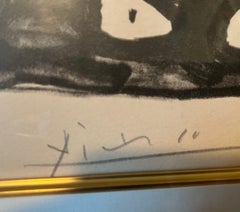
Signed by Picasso in pencil lower left. Numbered 32/50 in pencil lower right. Catalogue raisonne references: Bloch 739; Mourlot 239; Reuße 625. Framed print. Framed dimensions ...

Category

1950s Cubist Terry Rose Art
Materials

Lithograph

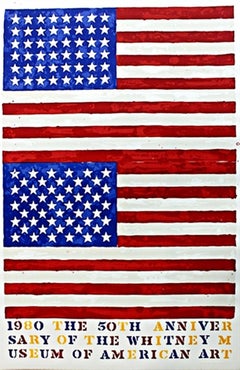
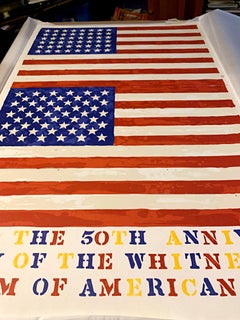
Two Flags, Large (46" x 30") Limited Edition 5000 Lithograph for Whitney Museum

Two Flags, Large (46" x 30") Limited Edition 5000 Lithograph for Whitney Museum

By Jasper Johns

Located in New York, NY

Jasper Johns 50th Anniversary of the Whitney Museum of American Art in New York City, 1979 Original lithograph on heavy wove paper 46 × 30 inches Limited Edition of 5000 (unnumbered) Stamped with copyright mark and publisher's blindstamp Published by Stony Johns, Inc. and Gemini G.E.L. Accompanied by Certificate of Guarantee issued by Alpha 137 Gallery Unframed This stunning, impressive, large vintage lithograph...

Category

1970s Pop Art Terry Rose Art
Materials

Lithograph, Offset

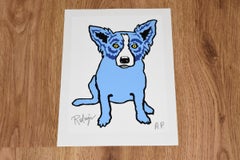
La Petite Femme Chere - Signed Silkscreen Print - Blue Dog

La Petite Femme Chere - Signed Silkscreen Print - Blue Dog

By George Rodrigue

Located in Mount Laurel, NJ

This Blue Dog work consists of a single dog sitting in the middle of a pure white background. The dog has soulful yellow eyes. This pop art animal original silkscreen print on paper is hand signed by the artist. Artist: George Rodrigue Title: Blue Dog “La Petite Femme...

Category

1990s Pop Art Terry Rose Art

Materials

Screen

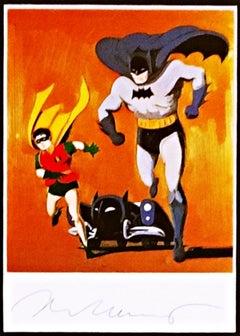
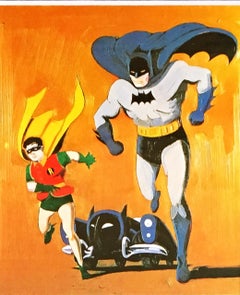
Batman and Robin offset lithograph card hand signed by Mel Ramos fine provenance

Batman and Robin offset lithograph card hand signed by Mel Ramos fine provenance

By Mel Ramos

Located in New York, NY

Mel Ramos Batman and Robin (Hand signed Postcard), ca. 1991 Offset Lithograph on Card Hand signed by the artist on the lower front Held in original vintage frame This vintage offset...

Category

1990s Pop Art Terry Rose Art
Materials

Ink, Postcard, Offset

Terry Rose art for sale on 1stDibs.

Find a wide variety of authentic Terry Rose art available for sale on 1stDibs. You can also browse by medium to find art by Terry Rose in lithograph and more. Not every interior allows for large Terry Rose art, so small editions measuring 24 inches across are available. Customers who are interested in this artist might also find the work of and Pater Sato. Terry Rose art prices can differ depending upon medium, time period and other attributes. On 1stDibs, the price for these items starts at $975 and tops out at $975, while the average work can sell for $975.

Artists Similar to Terry Rose