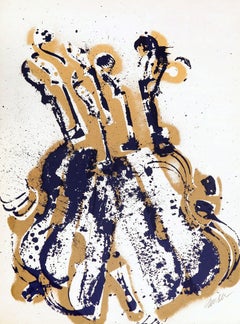
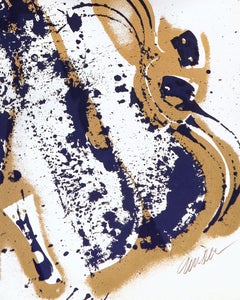
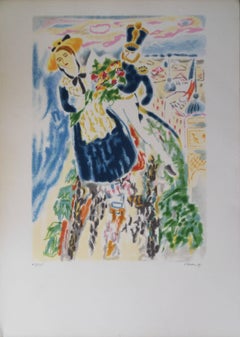
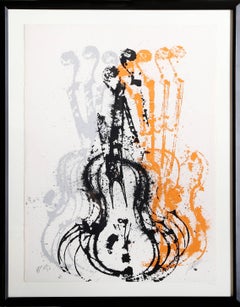
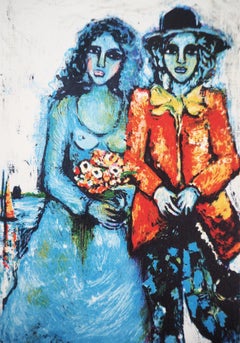
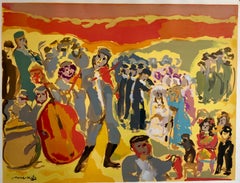
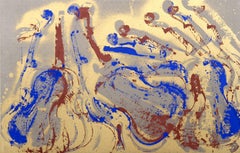
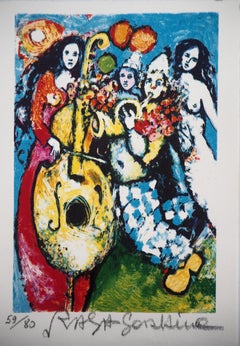
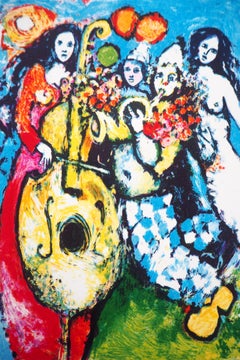
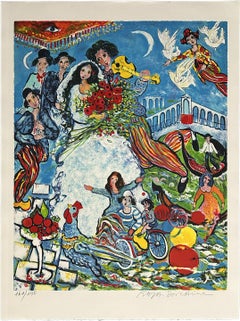
An assortment of violin signed prints is available on 1stDibs. Finding the ideal
modern,
contemporary or
Surrealist examples of these works for your living room, whether you’re looking for small- or large-size pieces, is no easy task — start by shopping our selection today. These items have been produced for many years, with earlier versions available from the 18th Century and newer variations made as recently as the 21st Century. If you’re looking to add violin signed prints that pop against an otherwise neutral space in your home, the works available on 1stDibs include that feature elements of
beige,
gray,
black,
white and more.
Arman,
Lucien Clergue,
Fernandez Arman,
Carmen de Vos and
Henri Matisse took a thoughtful approach to this subject that are worth considering. The range of these distinct pieces — often created in
lithograph,
screen print and
paper — can elevate any room of your home.
Violin signed prints can differ in price owing to various characteristics — the average selling price for items in our inventory is $1,314, while the lowest priced sells for $69 and the highest can go for as much as $38,000.
Arman was born in Nice, France, in 1928, and showed a talent for painting and drawing as a child. He studied at the the Ecole Nationale des Art Décoratifs in Nice followed by studies at the École du Louvre in Paris.
In his early years he focused on abstract paintings. Then, in 1957, he became interested in common objects as works of art. He first did what came to be called his "allures d"objet" (object impressions), where he would dip an object into paint and press it on canvas thus leaving the object's shadow or impression. Then he decided the object itself was worth paying attention to and started to treat them in his own way. His intention was to remove the material purpose of an object so that its only remaining function was to "feed the mind" as a work of art. What better way to achieve that result than by breaking, slicing or even burning objects such as violins, telephones, typewriters or even whole cars? He also made objects useless by accumulating them, such as 2,000 wristwatches in a Plexiglass box that all kept different time.
Once emotionally detached from the circumstances associated with a broken object, the viewer could grow to appreciate its abstract beauty; so, in a sense, Arman was literally teaching that things one never thought could be regarded as attractive could indeed turn out to be so. Through this achievement, Arman gained worldwide recognition and is regarded as one of the most prolific and inventive creators of the late 20th century.
His work can be found in the collections of numerous museums including the Metropolitan Museum of Art in New York, the Tate Gallery in London and the Centre Pompidou in Paris.
Arman’s work has also been exhibited in galleries, museums and public spaces worldwide including the Musée D’Art Contemporain in Tehran, Iran; the Museum of Art in Tel Aviv, Israel; the Musée Des Arts Decoratifs and Opéra De Paris in France; the La Jolla Museum of Contemporary Art in California; and the Museum of Arts and Design and the Guggenheim in New York
He died in 2005 in New York.
Decorating with fine art prints — whether they’re figurative prints, abstract prints or another variety — has always been a practical way of bringing a space to life as well as bringing works by an artist you love into your home.
Pursued in the 1960s and ’70s, largely by Pop artists drawn to its associations with mass production, advertising, packaging and seriality, as well as those challenging the primacy of the Abstract Expressionist brushstroke, printmaking was embraced in the 1980s by painters and conceptual artists ranging from David Salle and Elizabeth Murray to Adrian Piper and Sherrie Levine.
Printmaking is the transfer of an image from one surface to another. An artist takes a material like stone, metal, wood or wax, carves, incises, draws or otherwise marks it with an image, inks or paints it and then transfers the image to a piece of paper or other material.
Fine art prints are frequently confused with their more commercial counterparts. After all, our closest connection to the printed image is through mass-produced newspapers, magazines and books, and many people don’t realize that even though prints are editions, they start with an original image created by an artist with the intent of reproducing it in a small batch. Fine art prints are created in strictly limited editions — 20 or 30 or maybe 50 — and are always based on an image created specifically to be made into an edition.
Many people think of revered Dutch artist Rembrandt as a painter but may not know that he was a printmaker as well. His prints have been preserved in time along with the work of other celebrated printmakers such as Pablo Picasso, Salvador Dalí and Andy Warhol. These fine art prints are still highly sought after by collectors.
“It’s another tool in the artist’s toolbox, just like painting or sculpture or anything else that an artist uses in the service of mark making or expressing him- or herself,” says International Fine Print Dealers Association (IFPDA) vice president Betsy Senior, of New York’s Betsy Senior Fine Art, Inc.
Because artist’s editions tend to be more affordable and available than his or her unique works, they’re more accessible and can be a great opportunity to bring a variety of colors, textures and shapes into a space.
For tight corners, select small fine art prints as opposed to the oversized bold piece you’ll hang as a focal point in the dining area. But be careful not to choose something that is too big for your space. And feel free to lean into it if need be — not every work needs picture-hanging hooks. Leaning a larger fine art print against the wall behind a bookcase can add a stylish installation-type dynamic to your living room. (Read more about how to arrange wall art here.)
Find fine art prints for sale on 1stDibs today.