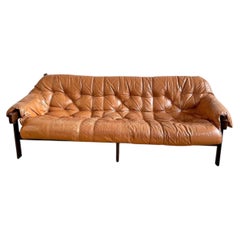
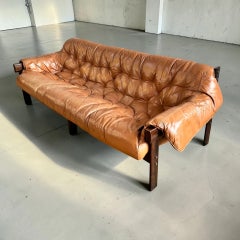
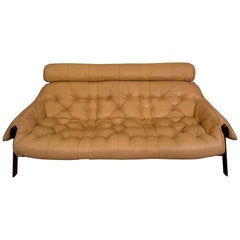
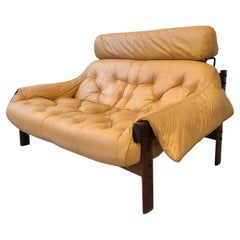
When it comes to mid-century furniture, the innovative work of the Brazilian Modernists has often been overlooked, including the designs of prolific maker Percival Lafer. Lafer studied architecture at São Paulo’s Universidade Mackenzie. After he graduated, his father passed away suddenly, leaving a furniture business that Lafer took over with his brothers.
Taking up the mantle, Lafer made the jump from architecture to furniture design in 1961, putting a focus on thoughtfully designed pieces available at affordable prices. That year, Lafer introduced his supremely popular MP-1 chair, a plush piece of furniture made with iron and wood that he has riffed on throughout his entire career.
The silhouettes of Lafer lounge chairs, armchairs and other seating were distinct from streamlined American and European mid-century modernism, taking on casual, puffed forms thanks to his use of polyurethane layers as padding. He combined such contemporary industrial materials with local natural ones, namely Brazilian hardwoods, which delighted customers around the world as Lafer became one of the country’s leading exporters of furniture.
Lafer has continued to design furniture throughout his career, branching into sofas, tables and lighting. He was at the forefront of mechanical furniture movements, debuting the MP-7 sofa, which could turn into a twin bed, in 1965, the first such piece on the market. One of his most intriguing projects was the MP Lafer, a two-seat fiberglass roadster designed to emulate British sports cars. Some 4,300 units were produced over its 16-year manufacturing run in the ’70s and ’80s, with several ending up in the collections of major car museums.
Still, Lafer’s biggest claim to fame is his seating, which he continues to design, drawing inspiration from modern shapes and local materials. In 2017, a retrospective of his work was organized as part of the São Paulo Design Weekend.
Find vintage Percival Lafer furniture for sale on 1stDibs.
More often than not, vintage mid-century Brazilian furniture designs, with their gleaming wood, soft leathers and inviting shapes, share a sensuous, unique quality that distinguishes them from the more rectilinear output of American and Scandinavian makers of the same era.
Commencing in the 1940s and '50s, a group of architects and designers transformed the local cultural landscape in Brazil, merging the modernist vernacular popular in Europe and the United States with the South American country's traditional techniques and indigenous materials.
Key mid-century influencers on Brazilian furniture design include natives Oscar Niemeyer, Sergio Rodrigues and José Zanine Caldas as well as such European immigrants as Joaquim Tenreiro, Jean Gillon and Jorge Zalszupin. These creators frequently collaborated; for instance, Niemeyer, an internationally acclaimed architect, commissioned many of them to furnish his residential and institutional buildings.
The popularity of Brazilian modern furniture has made household names of these designers and other greats. Their particular brand of modernism is characterized by an émigré point of view (some were Lithuanian, German, Polish, Ukrainian, Portuguese, and Italian), a preference for highly figured indigenous Brazilian woods, a reverence for nature as an inspiration and an atelier or small-production mentality.
Hallmarks of Brazilian mid-century design include smooth, sculptural forms and the use of native woods like rosewood, jacaranda and pequi. The work of designers today exhibits many of the same qualities, though with a marked interest in exploring new materials (witness the Campana Brothers' stuffed-animal chairs) and an emphasis on looking inward rather than to other countries for inspiration.
Find a collection of vintage Brazilian furniture on 1stDibs that includes chairs, sofas, tables and more.
Vintage couches and antique sofas have anchored living rooms for generations. The pieces most sought after today carry the deep-buttoned tufting of a Chesterfield or the low, sculptural ease of mid-century modern and Hollywood Regency design.
Styles to Know
Rolled arms and tufted backs point to Mid-Century Modern or Hollywood Regency pieces, while tight backs and turned legs skew more traditional. Velvet is enjoying a renewed moment across most of these silhouettes; see our velvet chesterfield sofa trend report for examples. A mid-century modern coffee table within reach and a vintage mirror nearby round out the seating area.
How to Choose the Right Vintage Sofa
A sofa's frame and upholstery history can be difficult to judge from photographs alone. Ask a seller for more information when a listing doesn't show the fabric or joinery clearly, and confirm whether the upholstery is original or has been redone. Each piece comes from a vetted 1stDibs seller, with era, designer and condition detailed, and the 1stDibs Promise stands behind every purchase.