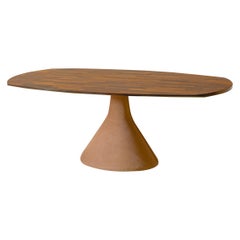
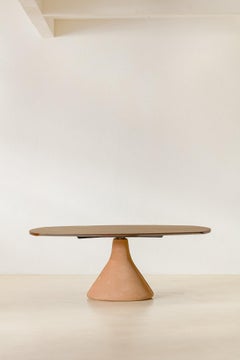
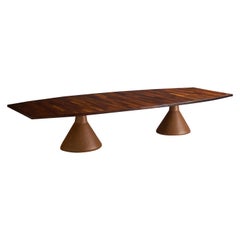
Find many varieties of an authentic guanabara dining table available at 1stDibs. A guanabara dining table — often made from
wood,
animal skin and
leather — can elevate any home. Your living room may not be complete without a guanabara dining table — find older editions for sale from the 20th Century and newer versions made as recently as the 20th Century. When you’re browsing for the right guanabara dining table, those designed in
Mid-Century Modern styles are of considerable interest.
Just as emigrant Europeans — from Kem Weber and Paul Frankl to Marcel Breuer and Ludwig Mies van der Rohe — helped establish modernist design and architecture in the United States, so too did many of their peers foster the new design aesthetic in Brazil in the middle decades of the 20th century. Along with architect Lina Bo Bardi (from Italy) and Joaquim Tenreiro (from Portugal) — both of whom helped popularize Brazilian modern design and influenced today's generation of Brazilian designers — there was Jorge Zalszupin, who arrived from Poland in 1949 and created consistently sleek and elegant chairs, tables and case pieces using the South American country’s vibrantly grained tropical hardwoods.
Zalszupin was born in Warsaw (his given first name is Jerzy) and went on to study architecture at the École des Beaux Arts in Bucharest, Romania, graduating in 1945. Zalszupin moved to Paris but found few opportunities in the postwar City of Light. He was impressed by articles on the work of Brazilian architect Oscar Niemeyer that he saw in the André Bloc–edited magazine L’Architecture d’Aujourd’hui (Architecture Today). And after sailing to South America, Zalszupin went to work with his fellow Pole and architect Luciano Korngold in São Paulo. Zalszupin began designing furniture as part of his architectural commissions and created several pieces for Niemeyer for use in the new capital city, Brasília. He opened his own design and manufacturing firm, L’Atelier, in 1959.
While Zalszupin cannot be said to have had a signature style, his furniture designs all share a characteristic simplicity and purity of line and form. His work is often compared to that of Danish designers, most especially in their shared commitment to quality construction. He was a master of many materials: travertine marble for tabletops, slung leather for seating, man-made fabrics for upholstery and — his forte — highly figured woods such as jacaranda and rosewood. The latter plays prominently in two of Zalszupin’s best-known lounge chairs: the Brasiliana, with its austere, angular wood frame, and the Presidencial, with its curved seating shell and slatted backrest. Both chairs feature deep cushions and generous proportions in deference to the Brazilian proclivity for long and languid conversations. Yet both pieces — like all Zalszupin designs — possess a striking, tailored grace that would be perfect in any environment.
Find vintage Jorge Zalszupin furniture on 1stDibs.
More often than not, vintage mid-century Brazilian furniture designs, with their gleaming wood, soft leathers and inviting shapes, share a sensuous, unique quality that distinguishes them from the more rectilinear output of American and Scandinavian makers of the same era.
Commencing in the 1940s and '50s, a group of architects and designers transformed the local cultural landscape in Brazil, merging the modernist vernacular popular in Europe and the United States with the South American country's traditional techniques and indigenous materials.
Key mid-century influencers on Brazilian furniture design include natives Oscar Niemeyer, Sergio Rodrigues and José Zanine Caldas as well as such European immigrants as Joaquim Tenreiro, Jean Gillon and Jorge Zalszupin. These creators frequently collaborated; for instance, Niemeyer, an internationally acclaimed architect, commissioned many of them to furnish his residential and institutional buildings.
The popularity of Brazilian modern furniture has made household names of these designers and other greats. Their particular brand of modernism is characterized by an émigré point of view (some were Lithuanian, German, Polish, Ukrainian, Portuguese, and Italian), a preference for highly figured indigenous Brazilian woods, a reverence for nature as an inspiration and an atelier or small-production mentality.
Hallmarks of Brazilian mid-century design include smooth, sculptural forms and the use of native woods like rosewood, jacaranda and pequi. The work of designers today exhibits many of the same qualities, though with a marked interest in exploring new materials (witness the Campana Brothers' stuffed-animal chairs) and an emphasis on looking inward rather than to other countries for inspiration.
Find a collection of vintage Brazilian furniture on 1stDibs that includes chairs, sofas, tables and more.
Antique and vintage dining room tables have long been the anchor of the home's most social room. The round pedestal and long banquet forms most collected today trace back to the 18th and 19th centuries, when the dining room itself first came into fashion.
Styles to Know
Round and oval tables suit smaller or open-plan rooms, while rectangular pedestal and trestle tables remain the standard for larger, more formal spaces. A credenza adds extra serving storage nearby, and a vintage wall mirror overhead opens up the room. For layout ideas, browse 20 dining rooms arranged for entertaining.
How to Choose the Right Vintage Dining Table
A dining table is usually the largest piece in the room, which makes delivery details worth confirming: White Glove service, disassembly options, and the table's full length, leaves included, measured against the space you have. Every table comes from a vetted 1stDibs seller, with era, designer and condition detailed, backed by the 1stDibs Promise.