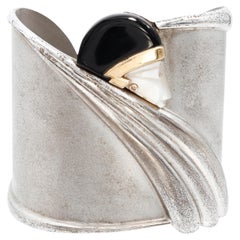
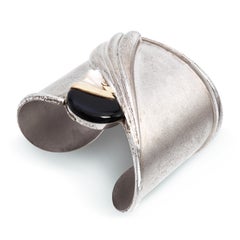
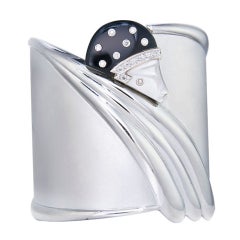
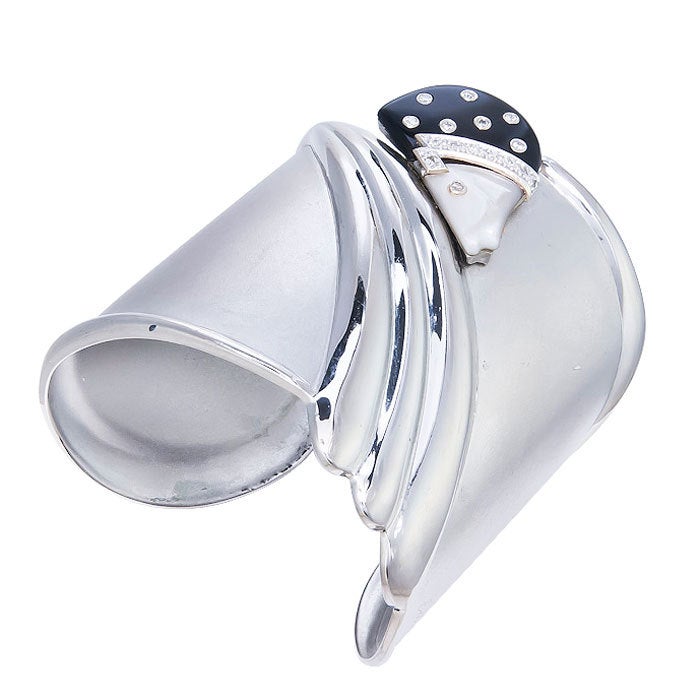
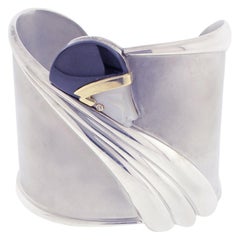
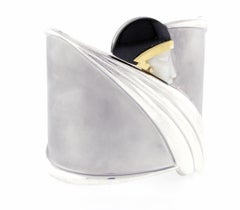
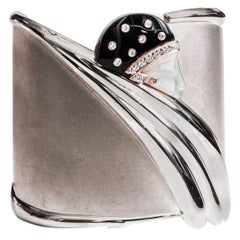
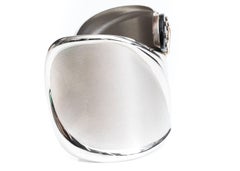
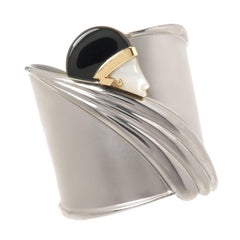
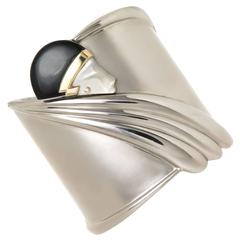
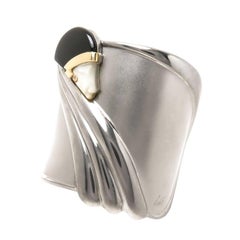
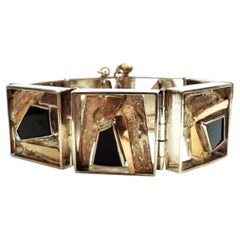
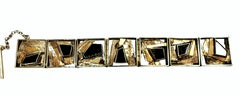
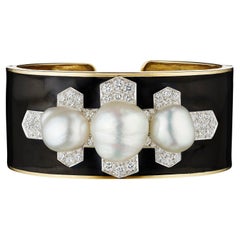
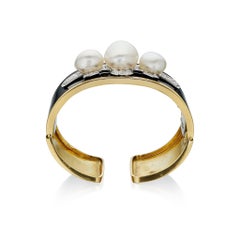
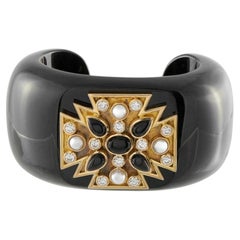
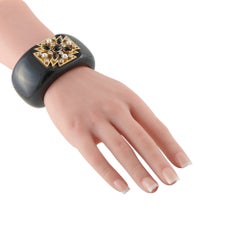
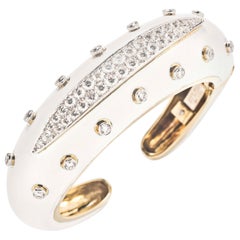
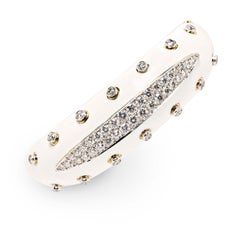
You are likely to find exactly the erte cuff you’re looking for on 1stDibs, as there is a broad range for sale. Every item for sale was constructed with extraordinary care, often using
Gold,
Silver and
Sterling Silver. Making the right choice when shopping for a erte cuff may mean carefully reviewing examples of this item dating from different eras — you can find an early iteration of this piece from the 20th Century and a newer version made as recently as the 21st Century, both of which have proven very popular over the years. Creating a erte cuff has been a part of the legacy of many jewelers, but those produced by
Erté are consistently popular. A erte cuff of any era or style can lend versatility to your look, but a version featuring
Onyx, from our inventory of 7, is particularly popular. Most of our erte cuff for sale are for
women, but there are 4 pieces available to browse for
men.
Prices for a erte cuff can differ depending upon size, time period and other attributes — at 1stDibs, these accessories begin at $588 and can go as high as $5,500, while this accessory, on average, fetches $1,895.
Born Romain de Tirtoff (1892–1990) in St. Petersburg, Russia, to an aristocratic family, the artist known as Erté — a pseudonym derived from the French pronunciation of his initials — was a Renaissance man of the art and design world. He worked in graphic arts, interior design, fashion, jewelry and set design for the stage and silver screen, becoming a leader of the Art Deco style.
Moving to Paris in 1912, Erté worked as a fashion designer under couturier Paul Poiret before securing a job with Harper’s Bazaar as a cover artist. Over 22 years, Erté created more than 240 magazine covers alongside his ongoing work in fashion design.
Extending his prolific career into theater sets, costumes, prints and lithographs, Erté became one of the most famous artists of the era. His style — a combination of the nature-inspired flourishes of Art Nouveau and bold, geometric linework — directly contributed to the birth of Art Deco, earning him the nickname “the Father of Art Deco.”
After a lull of creative production in the 1940s and 1950s, Erté reentered the public eye in the 1960s, when a renewed interest in Art Deco had taken shape.
Creating colorful lithographs, bold serigraphs (silk-screen prints) and bronze sculptures, he contributed to a resurgence of the style in France and beyond. This late-life acclaim for his art led to exhibitions in museums and galleries all over the world as well as his first published monograph in 1970. That same year he was awarded the title of Chevalier du Mérite Artistique et Cultural and in 1976 was named Officier des Arts et Lettres by the French government.
Today, Erté’s works are in the collections of the Metropolitan Museum of Art and the Cooper Hewitt, Smithsonian Design Museum, in New York, the Victoria and Albert Museum in London and LACMA in Los Angeles.
On 1stDibs, browse a collection of Erté art, including fine art prints, paintings and other works.
There is no shortage of iconic bracelet designs out there: Cartier’s Love bracelet, the widely admired Panthère, the Croisillon bracelet crafted by Jean Schlumberger for Tiffany & Co., to name a few. And while you don’t necessarily need one of history’s most coveted versions of this accessory, you’re likely going to want at least a reliable collection of vintage cuff bracelets in your jewelry box.
Cuff bracelets are fashion staples. This stylish go-to — a rigid bracelet, open or outfitted with a clasp that snaps shut, understated and unadorned or enameled and flecked with gemstones — goes back thousands of years.
Cuffs were worn by Greek and Roman soldiers as they headed into battle as well as by the men and women of Ancient Egypt as statement-making jewelry. In ancient China, jade was considered the most precious of stones, and a jade cuff bracelet or bangle was associated with purity and goodness. Jewelers also employed jade, as well as coral and lapis lazuli, during the Art Deco period, finding inspiration in all kinds of influences and frequently working geometric motifs into their Art Deco cuff bracelets.
Today, people love how a bejeweled cuff bracelet elevates a simple jeans-and-T-shirt ensemble or that a minimalist one pairs with formal wear so well. Indeed, it’s a fine finishing touch whether you’re dining with friends in your neighborhood or pairing your silver or gold cuff with an elegant evening dress on the red carpet.
On 1stDibs, find a wide variety of vintage cuff bracelets today.