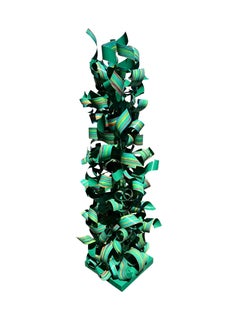
Artist: Nancy Graves (American, 1939-1995)
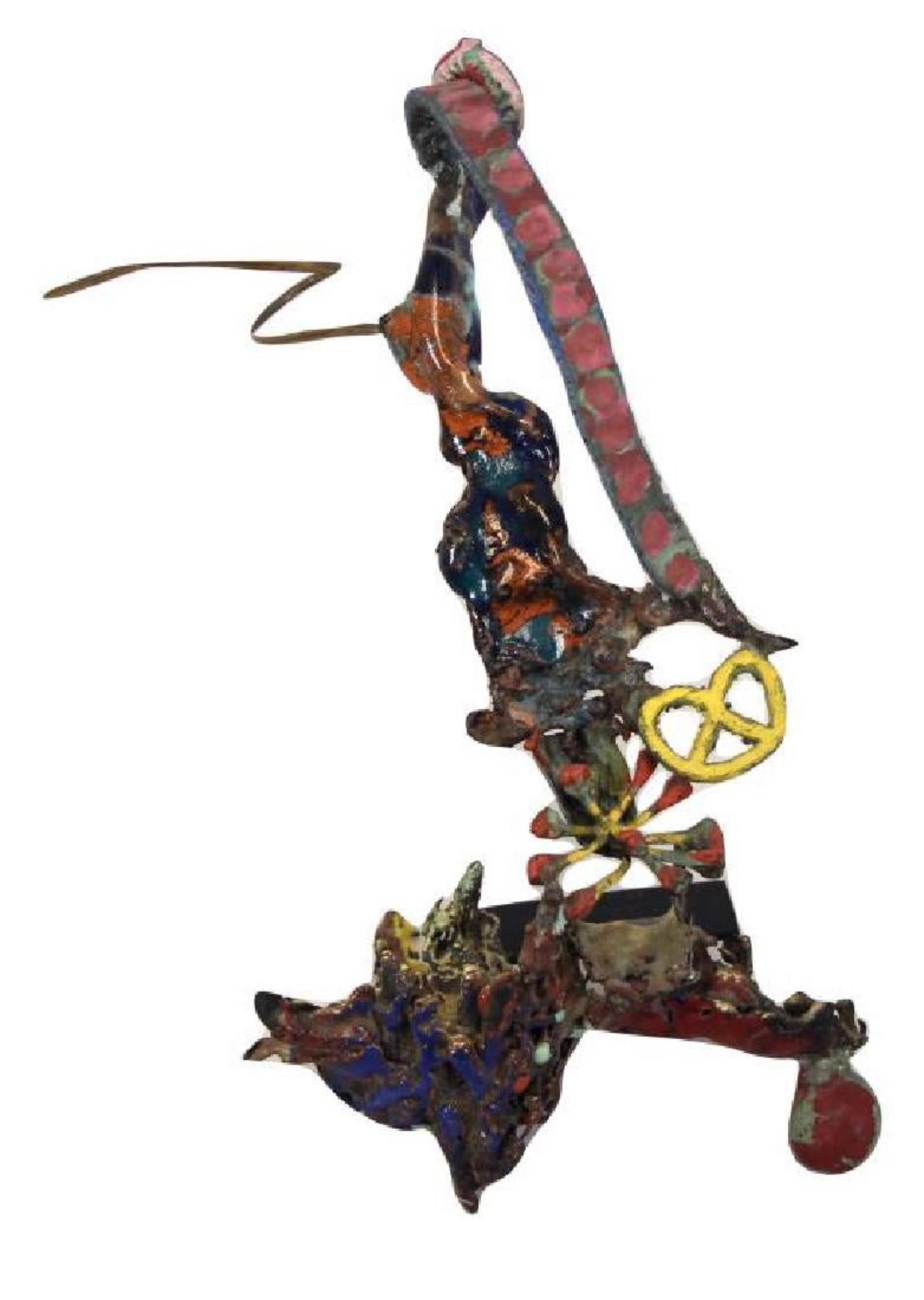
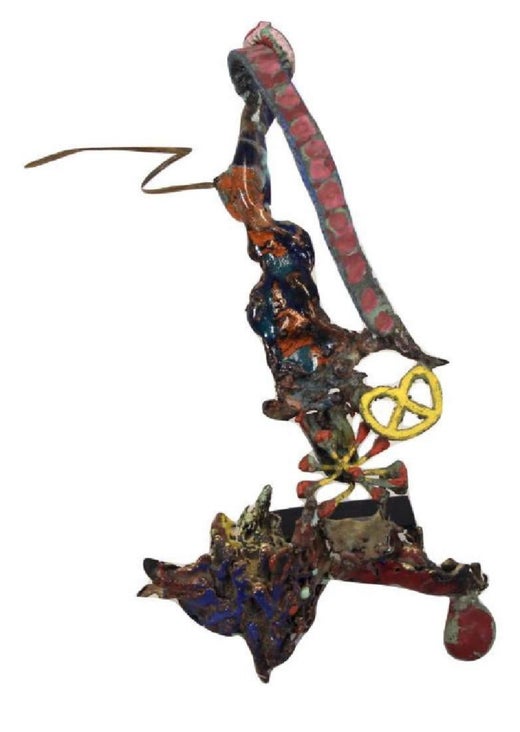
Title: "Rope Trap"
*Titled, signed, and dated by Graves (inscribed into the metal) on red cylinder lower right
Year: 1985
Medium: Original Bronze with Polyurethane Paint
Fabricator: Dick Polich and staff, Tallix Foundry, Peekskill, NY
Dimensions: 56" high x 65" wide x 38" deep
Weight: approx. 400 lbs
Reference: "The Sculpture of Nancy Graves: A Catalogue Raisonné" - Carmean No. 207, page 157 (illustrated)
Condition: Some minor cosmetic wear. In excellent condition
A grand work with impressive provenance
Notes:
This work will be included within the new upcoming comprehensive catalogue raisonné of painting, sculpture, drawing, and film by the artist being prepared by the Nancy Graves Foundation, Long Island City, NY.
Provenance: one owner ever - Mr. and Mrs. Robert Dubofsky/Dubofsky Family, Kings Point/Roslyn, NY; acquired from M. Knoedler & Co., Inc., New York, NY in 1986; acquired directly from the artist, New York, NY. This work is unique, a one of a kind. It is entirely hand-painted by Graves. The work is inscribed approx. 13" high on the red cylinder: "ROPE TRAP" N. S. Graves 8-85 TX. The "TX" is the fabricator's stamp of Tallix Foundry, Peekskill, NY which was founded by Dick Polich (1932-2022). "Rope Trap" (checklist No. 1) and eight other sculptures, (Carmean Nos. 186, 188, 193, 210, 211, 223, 225, and 227, pages 145-167), were displayed at a special exhibition "Nancy Graves: New Sculpture" at M Knoedler & Co., Inc., New York, NY from December 7, 1985 - January 8, 1986. "Rope Trap" was made with direct casts, fabricated parts, sand casting, and polyurethane paint. This sculpture is an outdoor piece of one unit.
"One limitation of Graves's special polychrome patinas has been their vulnerability to weather. This, combined with her interest in making larger outdoor works, led her and (Dick) Polich to look for a safe, weatherproof, and brilliantly colored patina. Their search ended in the selection of polyurethane paint, which has now become her preferred method of patination for outdoor sculpture. The intensity of its pigmentation and its glossy, reflective qualities make the previous colored patinas seem muted. Not since Augustus Saint-Gaudens and other turn-of-the-century French and American sculptors favored gilded bronzes has an American sculptor pushed the limits of coloration in sculpture to this extreme." - The Sculpture of Nancy Graves: A Catalogue Raisonné - Carmean page 34.
"Nancy Graves is one of the truly remarkable art talents of the current generation. A protean creator, she has produced work of startling originality and beauty as a painter, graphic artist, filmmaker, and sculptor. From Graves's first three-dimensional work - her camels - to her most recent works in bronze, her sculpture has been innovative and influential not only for its aesthetic impact but also because it has stretched the boundaries of sculptural media. Graves's bronzes are composed of a variety of elements, many of which are cast from such natural, organic, and/or everyday objects as pretzels, sardines, leaves, and cooking scissors. These works are then colored through a combination of techniques - polyurethane paint, fired enamel, and patination - to an extent that is unmatched in the work of any other modernist sculptor." - The Sculpture of Nancy Graves: A Catalogue Raisonné - Carmean, left inside jacket.
Biography:
Nancy Graves (1939-1995) was an American artist, best known for her abstract paintings, drawings, sculptures, and installations. Her work focused on exploring natural systems and environments, veiled by an aesthetic layer of ambiguity and colorful composition. “She sensed she was making art in the ‘information age,’” the director of the present-day Nancy Graves foundation, Christina Hunter, has said of her work. “And people like Julie Mehretu have looked very closely at her work.” Born on December 23, 1939 in Pittsfield, MA, Graves graduated from Vassar College before earning her BFA and MFA at Yale University, where she befriended fellow prominent artists such as Brice Marden, Janet Fish, and Richard Serra, whom she would go on to marry in 1965. Graves was celebrated as an influential figure in Post-Minimalist art, and in 1969 was the youngest person to ever have a solo exhibition at the Whitney Museum of American Art at the age of 29. She was the recipient of numerous honors and awards, such as a 1964 Fulbright Scholarship and the Skowhegan Medal for Drawing/Graphics in 1980. The artist died following a diagnosis of ovarian cancer in New York, NY on October 21, 1995 at the age of 55.