Khang Pham-New
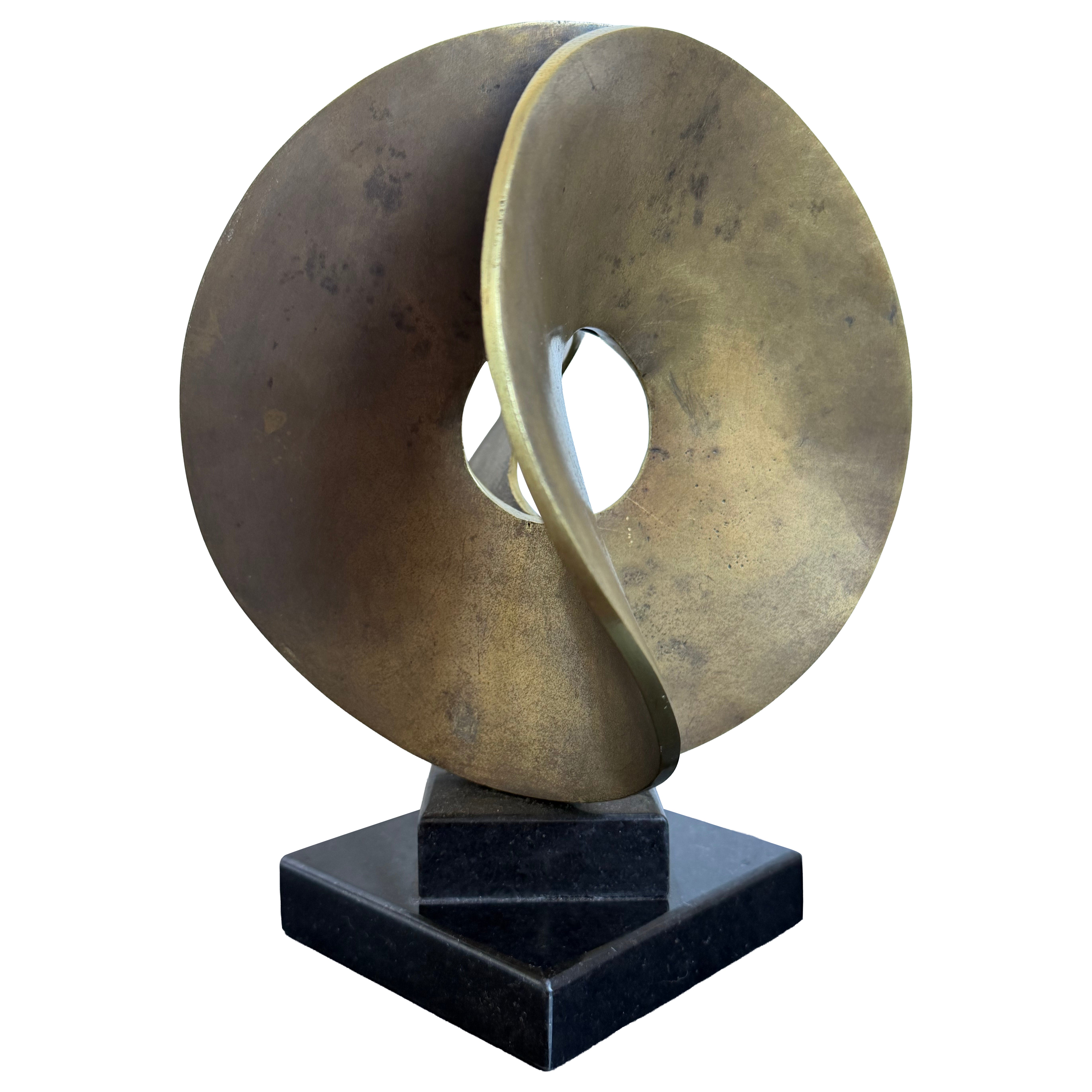
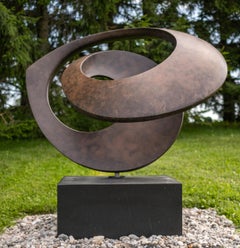
The more one knows about granite, the more impossible the sculpture of Khang Pham- New seems. His designs – small, medium and massive – flow, swoop, curve and surrender, plus a host of other verbs that are an unlikely match for a medium so rigid and unforgiving as granite. Yet, there they are, looking fluid, elegant and full of motion.
In choosing granite as his medium, the Canadian-Vietnamese sculptor did not carve out an easy path for himself. Touchy, inflexible and impervious, granite’s interlocking crystalline structure makes it able to stand up to decades – even centuries – of weather. Throughout history, granite has been used as a construction material or for monuments intended to stand the test of time. Unlike marble – its softer, more porous cousin – granite does not easily yield to the stonemason’s mallet or the sculptor’s chisel.
Khang’s expressive abstract works look as though they might have been molded from soft clay. That they were shaped by hand from solid blocks of granite almost defies imagination. Khang’s sculptures are shaped over months, born of imagination, inspired by vision and fueled by arduous labor. What might not be readily apparent in looking at Khang’s work is the fact that the sculptor carefully works out each sculpture’s mathematical proportions so the piece is not only visually appealing, but physically balanced—extremely important.
Born in Vietnam in 1968, the year of the Têt offensive, Khang knew conflict and war from his earliest years. One day, as he sat in his home in a village in south Vietnam, his uncle rushed in, told him to grab what he could carry and to come with him. The uncle had intended to take Khang’s siblings with him, but a shift in the political winds meant that they had to get out in a hurry and join the thousands of other “boat people” who
fled Vietnam in practically any vessel that would float and take them out of the
chaos of Vietnam after the long war. Khang was 11 when he made a journey that many of his fellow countrymen never survived. Khang’s luck turned when an Australian family living in Canada sponsored – and ultimately adopted – the young boy. They were very supportive of me and whatever I was interested in. That, as it turned out, was art – specifically sculpture.
All those curves and arches take significant work – over many months – to produce. Khang sometimes goes through 20 angle grinders and thousands of circular diamond blades to complete a piece. To create the depth of polish he achieves, he begins with 50 grit paper, then goes up to 300, then 1,000 and so on until he reaches 3,500 or so and begins to buff the surface. “When you do that many steps,” he says, “that’s how it gets that ultimate surface.” He is currently experimenting with various textures and says future works will feature contrasts with smooth and rough surfaces.