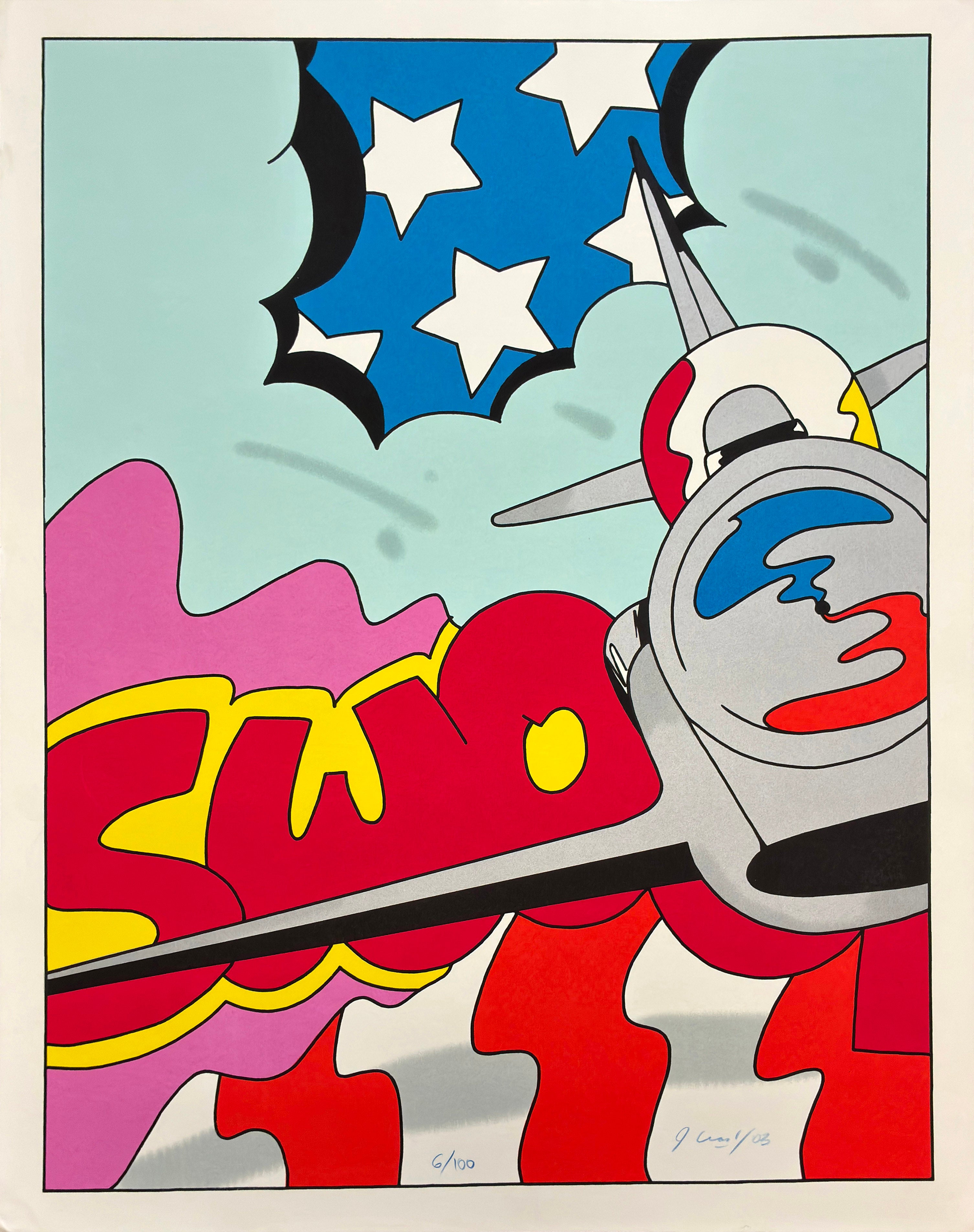
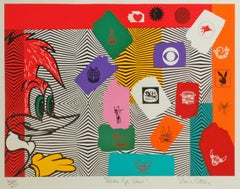
Artist: John Matos (1961- )
Title: American Thunderbird
Year: 2003
Medium: Lithograph in colors on velin paper
Edition: 96/100
Paper size: 27.5 x 21.75 inches overall; 25.5 x 19.75 inches image (69.85 x 55.25 cm overall; 64.77 x 50.17 cm image)
Condition: Well preserved, consistent with age and medium
Inscription: Hand signed and numbered by the artist
JOHN “CRASH” MATOS (b. 1961), internationally known simply as CRASH, is an American painter, graffiti pioneer, printmaker, and contemporary street artist whose explosive fusion of subway writing, Pop Art, comic-book graphics, advertising imagery, and abstract color established him as one of the foundational figures in the transformation of New York graffiti from an underground urban movement into an internationally recognized form of contemporary fine art. Born and raised in the Bronx, New York, CRASH began painting at approximately thirteen years old, following older neighborhood writers into the New York City train yards and adopting the name CRASH after accidentally crashing a computer at school; by the mid-1970s his distinctive lettering and increasingly ambitious compositions were appearing on subway trains traveling throughout New York, placing him within the generation that transformed the city’s transit system into an unprecedented moving gallery of popular visual culture. Emerging from this intensely competitive environment, CRASH developed a visual language distinguished by sharply defined lettering, fractured geometric forms, brilliant color, cartoon imagery, explosive starbursts, eyes, faces, and graphic fragments that combined the improvisational energy of graffiti with the compositional sophistication of modern painting. His artistic vocabulary belongs to the larger history of modernism established by Pablo Picasso, Alexander Calder, Alberto Giacometti, Salvador Dali, Joan Miro, Wassily Kandinsky, Marcel Duchamp, and Man Ray, whose radical approaches to fragmentation, abstraction, movement, Surrealism, conceptual experimentation, and popular imagery dismantled traditional distinctions between high art and everyday visual experience; CRASH extended that modernist revolution into the streets of late twentieth-century New York, transforming spray enamel, subway lettering, comics, commercial graphics, and urban vernacular culture into the materials of serious contemporary painting. The relationship to Pablo Picasso can be sensed in CRASH’s fragmentation and reconstruction of pictorial space, while the visual rhythms of Joan Miro and Wassily Kandinsky provide important historical precedents for his floating signs, energetic color relationships, and dynamic abstraction; the conceptual challenges introduced by Marcel Duchamp and Man Ray likewise helped establish the broader avant-garde tradition within which an object, gesture, commercial image, or unconventional medium could become legitimate art, while Alexander Calder, Alberto Giacometti, and Salvador Dali represent parallel twentieth-century investigations into movement, psychological intensity, spatial invention, and the transformation of recognizable imagery. Yet CRASH’s most immediate artistic education came not from museums or academies but from the Bronx streets and New York subway system, where speed, visibility, originality, scale, and stylistic identity were essential. By 1980, at only nineteen years old, CRASH curated the groundbreaking exhibition Graffiti Art Success for America at Fashion Moda in the South Bronx, an important moment in the movement of graffiti from subway trains and city walls into alternative galleries and eventually the international art market. His transition from trains to canvas placed him among the earliest graffiti writers to translate the visual power of aerosol art into portable paintings without sacrificing the immediacy and cultural authenticity of its street origins, and in 1983 Sidney Janis Gallery in New York presented his first solo gallery exhibition, providing significant establishment recognition for an artist who had begun by painting trains. CRASH emerged alongside an extraordinary generation of New York artists that included Jean-Michel Basquiat, Keith Haring, FUTURA 2000, Lee Quiñones, Lady Pink, Daze, Rammellzee, and other pioneering figures who challenged entrenched distinctions between graffiti, street culture, popular imagery, and contemporary fine art. While Basquiat combined street language with expressionistic drawing and historical references and Haring developed an instantly recognizable vocabulary of simplified figures and symbols, CRASH pursued an especially vivid synthesis of graffiti lettering and American Pop imagery, producing paintings whose hard-edged forms, saturated color, and comic-inspired fragments reveal affinities with Roy Lichtenstein, Andy Warhol, and James Rosenquist while retaining the speed, scale, and aggressive graphic impact of New York subway painting. His compositions often explode across the picture plane, with letters colliding against eyes, faces, arrows, stars, and abstract shapes in carefully orchestrated fields of movement, demonstrating that the apparent spontaneity of graffiti could coexist with sophisticated formal organization. CRASH was particularly important in demonstrating that aerosol paint could function as a serious studio medium and that the vocabulary developed by subway writers could survive—and even expand—when transferred to canvas. His early paintings of the 1980s are now historically significant documents of the moment when graffiti entered major galleries and international collections, and examples from this period have appeared at Christie’s and Sotheby’s, reflecting the increasing art-historical recognition of first-generation New York graffiti. Over subsequent decades, CRASH continually expanded his practice while preserving the instantly recognizable visual energy that made his earliest work distinctive, working in acrylic, spray enamel, oil, silkscreen, drawing, printmaking, murals, shaped canvases, and large-scale public projects. His imagery increasingly incorporated elements of Pop Art, cartoons, advertising, consumer graphics, and mass-media culture, reinforcing his position as a crucial bridge between the Pop generation and the later global street-art movement. CRASH’s willingness to cross traditional boundaries between gallery painting, street art, commercial design, and popular culture led to collaborations with internationally recognized brands including Fender, Absolut Vodka, Levi’s, and others, extending his imagery into objects and environments beyond conventional painting while demonstrating the cultural adaptability of graffiti aesthetics. Particularly celebrated are his painted guitars for Fender, which translated the energy of his canvases onto instruments already associated with music, rebellion, and American popular culture, creating a natural dialogue between graffiti’s visual rhythm and rock-and-roll performance. Yet despite the increasing commercialization and worldwide acceptance of street art, CRASH has remained deeply connected to the Bronx and to the cultural environment from which his practice emerged, reinforcing his historical authenticity within a field that has expanded dramatically since the 1970s. His importance becomes especially clear when viewed against the subsequent global rise of street art: the enormous international markets now surrounding artists such as Banksy, KAWS, Shepard Fairey, RETNA, and numerous contemporary muralists were made possible in part by pioneers like CRASH who demonstrated decades earlier that imagery born on city walls and subway trains could sustain serious gallery careers, institutional collections, and international audiences. Later generations of graffiti writers, street artists, graphic artists, illustrators, designers, and contemporary painters have been inspired by CRASH’s seamless integration of lettering, figuration, abstraction, comic-book aesthetics, and Pop imagery, as well as by his ability to move between street and studio without abandoning the visual identity of graffiti culture. His work also helped establish a vocabulary that now permeates fashion, advertising, music, product design, digital imagery, and contemporary visual culture worldwide, making CRASH important not only within the history of graffiti but within the larger history of how urban imagery transformed late twentieth- and early twenty-first-century aesthetics. His paintings are particularly compelling because they preserve the physical immediacy of aerosol painting while revealing an increasingly sophisticated understanding of composition, color, and visual rhythm; hard-edged passages collide with atmospheric spray, tightly controlled lettering intersects with apparently spontaneous marks, and recognizable fragments emerge and disappear within fields of abstraction, producing an energetic tension between order and improvisation. This duality places CRASH simultaneously within the histories of American abstraction, Pop Art, graffiti, and contemporary street art, giving his work unusual relevance across multiple collecting categories. Institutional recognition has accompanied this long career: Christie’s notes that CRASH’s work has entered prominent museum collections including the Museum of Modern Art in New York, the Brooklyn Museum, and the Stedelijk Museum in Amsterdam, underscoring the transition of his visual language from New York subway culture into the established international history of contemporary art. For collectors, John “CRASH” Matos occupies an especially important historical position as an authentic first-generation New York graffiti artist whose career connects the legendary subway era of the 1970s with the emergence of gallery graffiti in the 1980s and the enormous international street-art movement of the twenty-first century. His early aerosol paintings, large canvases, shaped works, murals, drawings, and limited-edition prints offer direct connections to a pivotal moment when the boundaries separating street culture and fine art were permanently dismantled, while his continuing practice demonstrates the durability of a visual language developed more than five decades ago. Today, CRASH remains an active and influential presence within contemporary art, admired for the immediacy of his color, the graphic sophistication of his compositions, and his central role in establishing graffiti as a legitimate international art form. His combination of historical importance, instantly recognizable style, Bronx authenticity, Pop Art connections, museum representation, and influence upon subsequent generations makes his work particularly relevant to collectors of Jean-Michel Basquiat, Keith Haring, Banksy, KAWS, Pop Art, contemporary street art, New York graffiti, and postwar American painting. The highest publicly documented auction record for John “CRASH” Matos is held by Call Card, which achieved approximately $63,527 USD at Artcurial in 2008, confirming sustained international collector interest in one of the foundational figures of New York graffiti and contemporary street art.