Want more images or videos?
Request additional images or videos from the seller.

Anton Schutz
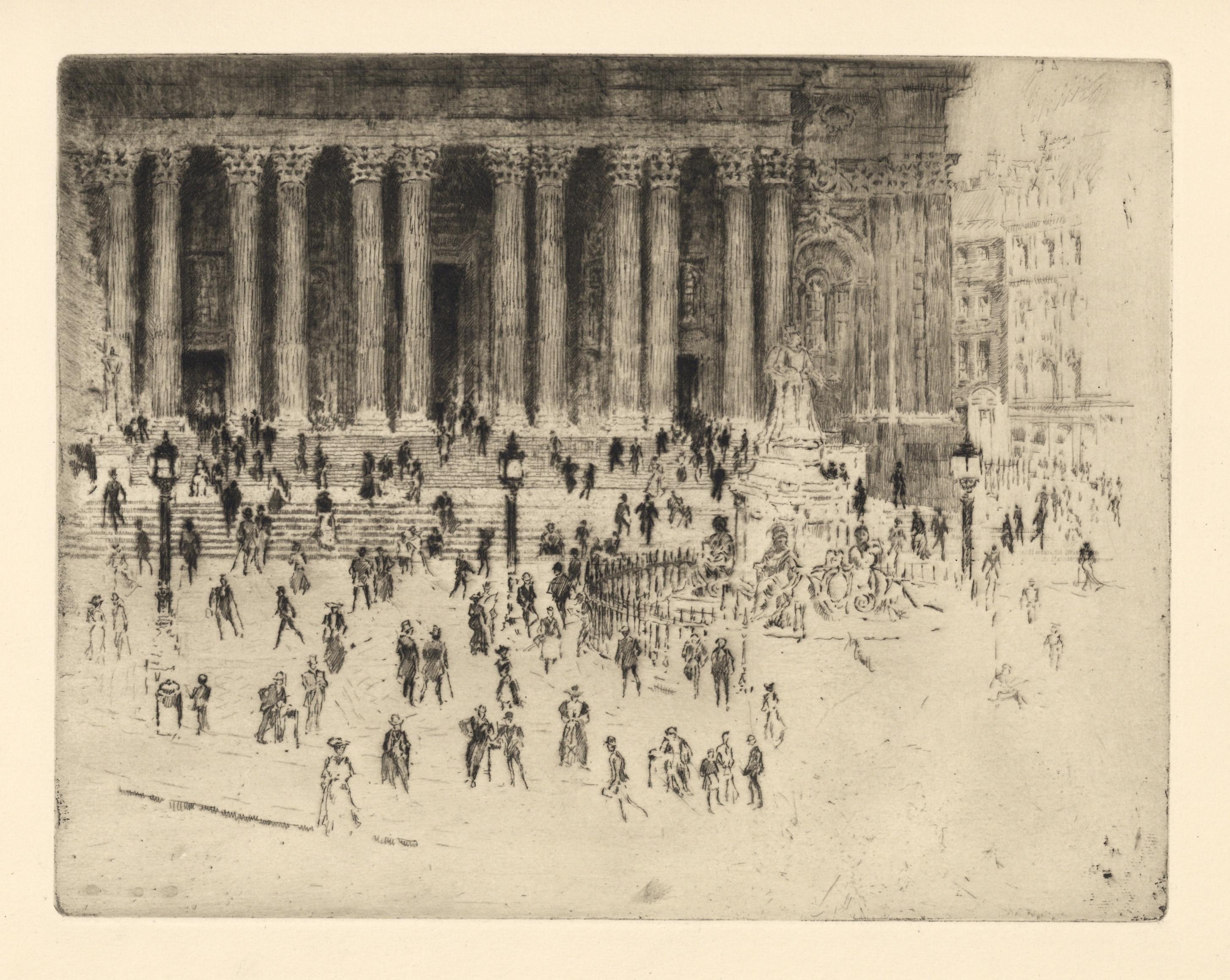
'Westminster Abbey' — Royal Church (London), Signed Etching, 1927

1927

$350
£267.44
€319.73
CA$506.93
A$519.03
CHF 294.79
MX$6,637.68
NOK 3,391.10
SEK 3,523.81
DKK 2,390.04

About the Item

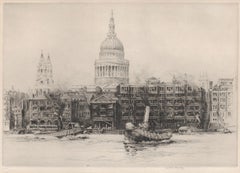
Anton Schutz, 'Westminster Abbey', etching, edition not stated, 1927. Signed in pencil. Signed and dated in the plate, lower left. A superb, richly-inked impression, with skillfully-controlled plate tone, on cream wove paper; the full sheet with margins (3/4 to 2 inches), in excellent condition. Archivally matted to museum standards, unframed. Image size 11 7/8 x 8 7/8 inches (302 x 225 mm); sheet size 15 5/8 x 10 3/4 inches (397 x 273 mm). ABOUT THE IMAGE Westminster Abbey, formally titled the Collegiate Church of Saint Peter at Westminster, is an Anglican church in the City of Westminster, London, England. Since 1066, it has been the location of the coronations of 40 English and British monarchs and a burial site for 18 English, Scottish, and British monarchs. At least 16 royal weddings have taken place at the abbey since 1100. Although the church's origins are obscure, an abbey housing Benedictine monks was on the site by the mid-10th century. The church got its first large building in the 1040s, commissioned by King Edward the Confessor, who is buried inside. Construction of the present church began in 1245 on the orders of Henry III. The monastery was dissolved in 1559, and the church was made a royal peculiar – a Church of England church, accountable directly to the sovereign – by Elizabeth I. The abbey, the Palace of Westminster and St Margaret's Church became a UNESCO World Heritage site in 1987 because of their historic and symbolic significance. 13th-century French and English styles chiefly inspire the church's Gothic architecture, although some sections have earlier Romanesque or later Baroque and modern styles. The Henry VII Chapel, at the east end of the church, is a typical example of Perpendicular Gothic architecture; antiquarian John Leland called it orbis miraculum ("the wonder of the world"). The abbey is the burial site of more than 3,300 people, many prominent in British history: monarchs, prime ministers, poets laureate, actors, musicians, scientists, military leaders, and the Unknown Warrior. Due to the fame of the figures buried there, artist William Morris described the abbey as a "National Valhalla". ABOUT THE ARTIST Etcher, painter, and architect Anton Schutz was born in Germany in 1894. He studied at the University of Munich, earning a double degree in mechanical engineering and architecture. His interests then turned to art, and he attended the Academy of Fine Arts in Munich. After completing his artistic studies, Schutz came to the United States in 1924, where he met Joseph Pennell. He assisted Pennell in his classes at the Art Students League, New York, and became his professional associate. Schutz was commissioned by The New York Times to make etchings of New York and other American cities. He completed a series of illustrations for the magazine section, traveling as far west as San Francisco. Schutz then traveled to Japan, Russia, and China in 1928 and 1929, creating etchings published by The New York Times and the New York Herald Tribune. The United States Chamber of Commerce commissioned him to create a series of twelve etchings on American cities, later reproduced in Nation’s Business Magazine. Other of his etchings featuring European and American cities were included in publications of the Encyclopaedia Britannica. Schutz also served as the president of the New York Graphic Society and the Louis Icart Society. The works of Anton Schutz are represented in numerous museum collections, including the Library of Congress, the New York Public Library, the Brooklyn Museum, the Chicago Art Institute, the Cleveland Museum of Arts, the British Museum, the Bibliotheque Nationale de Paris, and the Uffizi Galleries in Florence.
  • Creator:
    Anton Schutz (1894-1977, American)
  • Creation Year:
    1927
  • Dimensions:
    Height: 11.88 in (30.18 cm)Width: 8.88 in (22.56 cm)
  • Medium:
  • Movement & Style:
  • Period:
  • Condition:
  • Gallery Location:
    Myrtle Beach, SC
  • Reference Number:
    Seller: 1039901stDibs: LU53239216322

More From This Seller

View All
'The Plaza, Sunset Glow' — 1920s Signed Drypoint, Central Park, NYC

'The Plaza, Sunset Glow' — 1920s Signed Drypoint, Central Park, NYC

By Walter Tittle

Located in Myrtle Beach, SC

Walter Tittle, 'The Plaza, Sunset Glow', drypoint, c. 1920s, edition not stated. Signed in pencil and initialed in the plate, lower right. Titled 'The Plaza, Sunset' and annotated 'no. 165' in ink, in the bottom left sheet corner. A superb, luminous impression in dark brown ink, with selectively wiped plate tone; on cream wove paper; the full sheet with margins (1 to 2 1/4 inches). Pale tape stains on the top sheet edge, recto, well away from the image, otherwise in excellent condition. Matted to museum standards, unframed. Image size 11 3/4 x 6 15/16 inches (299 x 176 mm); sheet size 15 11/16 x 9 inches (399 x 229 mm). A view across 'The Pond' in New York City's Central Park, toward Grand Army Plaza...

Category

1920s American Impressionist Landscape Prints

Materials

Drypoint

'Grand Central Station' — New York City Landmark, Signed Etching, 1927

'Grand Central Station' — New York City Landmark, Signed Etching, 1927

By Otto Kuhler

Located in Myrtle Beach, SC

Otto Kuhler, 'Grand Central Station', etching and drypoint, 1927, edition c. 50, Kennedy 27. Signed and titled in pencil. A superb, richly-inked impression, in brown/black ink, with ...

Category

1920s American Impressionist Figurative Prints

Materials

Drypoint, Etching

'Downtown, New York' — 1920s Modernism, Signed Aquatint

'Downtown, New York' — 1920s Modernism, Signed Aquatint

By John Taylor Arms

Located in Myrtle Beach, SC

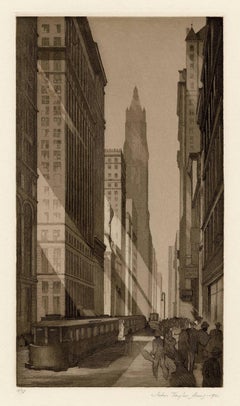
John Taylor Arms, 'Downtown, New York', etching with aquatint, 1921, edition 75, Fletcher 108. Signed, dated, and numbered 14/75 in pencil. A superb, finely nuanced impression, in da...

Category

Early 20th Century American Modern Landscape Prints

Materials

Etching

'U.S. Chamber of Commerce' — 1920s Realism, Washington D.C.

'U.S. Chamber of Commerce' — 1920s Realism, Washington D.C.

By Anton Schutz

Located in Myrtle Beach, SC

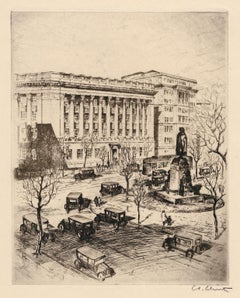
Anton Schutz, 'U.S. Chamber of Commerce', etching, edition not stated, 1928. Signed in pencil. Annotated 'U.S. Chamber of Commerce S/516', in another hand, in the bottom right margin. A fine, richly-inked impression, with skillfully-controlled plate tone, on cream wove Japan paper; the full sheet with margins (1 3/4 to 2 3/8 inches), in excellent condition. Image size 9 7/8 x 7 7/8 inches; sheet size 14 1/8 x 11 5/8 inches. Matted to museum standards, unframed. ABOUT THE ARTIST Etcher, painter, and architect, Anton Schutz was born in Germany in 1894. He studied at the University of Munich, earning a double degree in mechanical engineering...

Category

1920s American Realist Landscape Prints

Materials

Etching

Hungerford Bridge, London

Hungerford Bridge, London

By Kerr Eby

Located in Myrtle Beach, SC

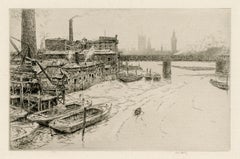
Kerr Eby 'Hungerford Bridge, London', etching and sandpaper ground, 1929, edition 90, Giardina 144. Signed, titled, and annotated 'Ed 90' in pencil. Signed again in the bottom right sheet corner. A fine, atmospheric impression, with delicate plate tone, on cream wove paper; the full sheet with margins (1 1/2 to 1 5/8 inches), in excellent condition. Matted to museum standards, unframed. Hungerford Foot Bridge spans the River Thames in London, between Westminster Bridge and Waterloo Bridge. Eby visited Great Britain and France during 1924 and 1925. Impressions of this work are in the permanent collection of the following institutions: American Academy and Institute of Arts and Letters, Arizona State University, Boston Public Library, Davison Art Center (Wesleyan University), Herbert F, Johnson Museum of Art, Huntington Museum of Art, Hood Museum of Art (Dartmouth College), Metropolitan Museum of Art, Montgomery Museum of Fine Arts, National Museum of American Art, New York Public Library, Smithsonian Museum of American Art. ABOUT THE ARTIST Kerr Eby was born in 1890 in Tokyo, Japan, the son of Methodist missionaries from Canada. The family returned to Vancouver when Eby was only three, and he grew up studying art encouraged by his parents as his mother was from a family of prominent artists. By age twelve, he had lived in Vancouver, Kingston, Toronto and Bracebridge where he found work as a ‘printer’s devil’ on the local Bracebridge newspaper. After graduating from high school in 1907, Eby moved to New York City to study art, first at the Pratt Institute, and later at the Art Students League. He enrolled in art classes at Pratt Institute while working for a lithographic firm earning $4.00 a week. His pay barely covered his room and drawing supplies. Within a year, starving and feeling defeated, he returned to Canada and was employed by a surveying party in Northern Ontario. Eby gradually regained his dream of becoming an artist, and in his spare time, he began to draw the surrounding wilderness landscapes. By fall he had returned to New York to attend night classes at the Art Students League while working for another lithographic firm. He spent several more summers surveying in Northern Ontario before he was able to make a living as an illustrator. During this period he formed several friendships with influential artists including John Henry Twachtman and Childe Hassam and joined a summer artists' colony founded by them at Cos Cob, Connecticut. He supported himself by working as a magazine illustrator and at the American Lithographic Company. Through diligent study and practice, Eby refined both his drawing and printmaking techniques. In 1917, when the United States entered World War I, Eby joined the U.S. Army. Failing to obtain a commission as an artist, he was assigned first to ambulance duty and later as a sergeant in the 40th Engineers in France. He spent most of WWI on the front line as a camouflager of the field artillery ‘big guns”. On his time off duty, he would sketch everything he witnessed, from the explosive big guns and men in action to the dead soldiers in the field. He sent the drawings home each week, and upon his return from the war, they became the basis for his first successful group of etchings. He continued creating his war-related prints throughout the 1920s and '30s as his work became widely exhibited Frederick Keppel, the renowned print dealer and a relative of Eby, became the exclusive agent for many of his print editions. With another global conflict beginning in the mid-1930s, Eby wanted to show the world the true face of war...

Category

1920s Impressionist Landscape Prints

Materials

Etching

You May Also Like

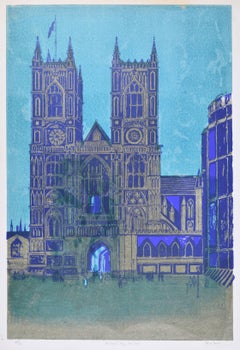
Robert Tavener Westminster Abbey London Lithograph Modern British Art

Robert Tavener Westminster Abbey London Lithograph Modern British Art

By Robert Tavener

Located in London, GB

To see our other Modern British Art and views of London, scroll down to "More from this Seller" and below it click on "See all from this Seller" - or send us a message if you cannot ...

Category

1970s Modern Prints and Multiples

Materials

Lithograph

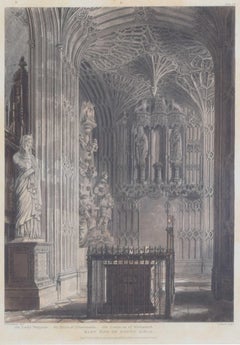
Westminster Abbey South Aisle engraving by John Bluck for Ackermann

Westminster Abbey South Aisle engraving by John Bluck for Ackermann

By Rudolph Ackermann

Located in London, GB

To see our other Oxford and Cambridge pictures, including an extensive collection of works by Ackermann, scroll down to "More from this Seller" and below it click on "See all from this Seller" - or send us a message if you cannot find the view you want. John Bluck (early 19th century) after Frederick Mackenzie (1788 - 1854) East End of South Aisle, Westminster Abbey (1812) Hand-coloured aquatint 31 x 24 cm Published by Rudolph Ackermann...

Category

1810s Realist Prints and Multiples

Materials

Aquatint

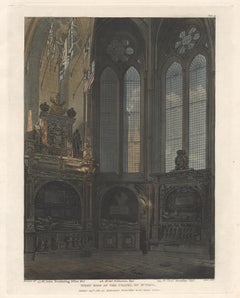
West Side of the Chapel of St Paul, Westminster Abbey, architecture aquatint

West Side of the Chapel of St Paul, Westminster Abbey, architecture aquatint

By John Bluck (active 1791-1819) after Frederick Mackenzie (1788-1854)

Located in Melbourne, Victoria

Colour aquatint by John Bluck (active 1791-1819) after Frederick Mackenzie (1788-1854). Architectural interior with superb original colour. From 'Westminster Abbey', published by Ru...

Category

Early 19th Century Naturalistic Landscape Prints

Materials

Engraving, Etching, Aquatint