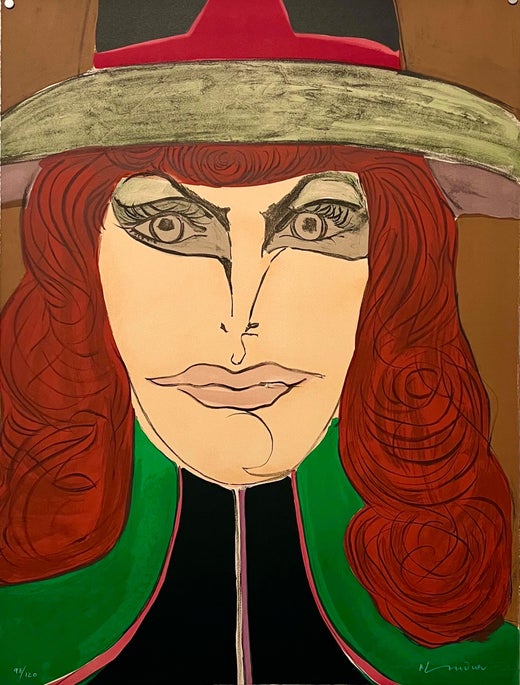
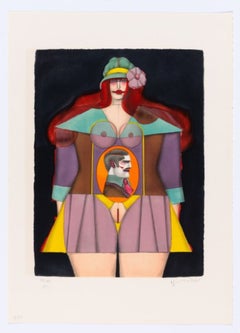
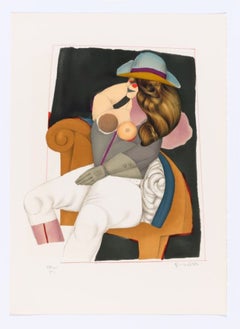
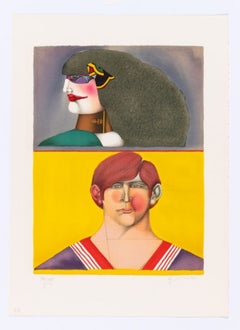
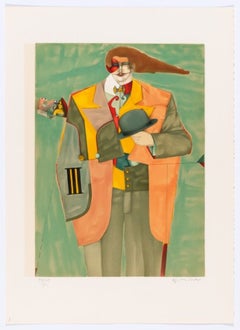
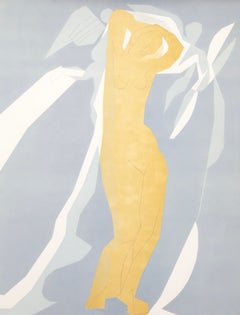
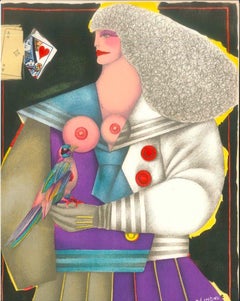
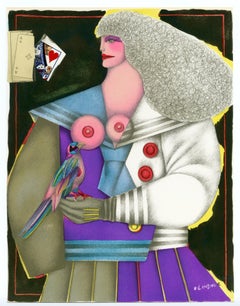
Artist: Richard Lindner (1901–1978)
Title: Woman on yellow background
Year: 1975
Medium: Lithograph in colors on velin paper
Edition: 79/125
Paper size: 28.25 x 20.38 inches overall (71.76 x 51.75 cm overall)
Condition: Well preserved, consistent with age and medium
Inscription: Hand signed and numbered by the artist
Publisher: Mourlot Freres, Paris
Notes: This print is one of 10 pieces in the Eugene Ionesco portfolio
RICHARD LINDNER (1901–1978) was a German-born American painter, draughtsman, and printmaker whose provocative fusion of Expressionism, Surrealism, Cubism, and Pop Art established him as one of the most distinctive and psychologically compelling figurative artists of the twentieth century. Celebrated for his boldly colored paintings of stylized women, enigmatic couples, theatrical characters, and mechanized human figures, Lindner developed an immediately recognizable visual language characterized by sharply defined contours, flattened geometric forms, exaggerated anatomy, saturated color, and compositions that explore the tensions between sexuality, power, fashion, technology, and modern urban existence. Born in Hamburg, Germany, and raised in Nuremberg, Lindner received formal artistic training at the Kunstgewerbeschule in Nuremberg and subsequently studied at the Munich Academy of Fine Arts, developing a sophisticated understanding of European painting, graphic design, illustration, and the expressive possibilities of modern figuration. His early career unfolded within the culturally dynamic environment of Weimar Germany, where avant-garde painting, political satire, theater, advertising, fashion, and experimental graphic design increasingly intersected, exposing him to artistic traditions that would remain central to his mature work. The psychological intensity of German Expressionism, the grotesque social observations of Neue Sachlichkeit, the structural innovations of Cubism, and the imaginative possibilities of Surrealism contributed to the development of his distinctive aesthetic, while his professional experience in illustration and commercial design strengthened his command of graphic clarity, compositional structure, and the visual language of modern consumer culture. Lindner’s artistic development belonged to the broader modernist revolution shaped by Pablo Picasso, Alexander Calder, Alberto Giacometti, Salvador Dali, Joan Miro, Wassily Kandinsky, Marcel Duchamp, and Man Ray, whose innovations in Cubism, abstraction, Surrealism, sculpture, photography, and conceptual experimentation fundamentally transformed twentieth-century art. Picasso’s fragmentation and reconstruction of the human figure, Calder’s investigations into geometric movement and spatial balance, Giacometti’s psychological engagement with bodily presence, Dali’s dreamlike manipulation of recognizable imagery, Miro’s poetic symbolism, Kandinsky’s expressive use of color and form, and the experimental approaches of Duchamp and Man Ray provide important historical reference points for understanding the modernist traditions against which Lindner developed his mature artistic identity. Particularly significant to his work are the satirical and psychologically charged paintings of George Grosz and Otto Dix, the theatrical figuration of Max Beckmann, the formal innovations of Fernand Léger, and the expressive distortions associated with German Expressionism, all of which provide close stylistic and historical parallels for his investigations into modern identity, sexuality, and the mechanization of human experience. His paintings also reveal an affinity with the visual language of fashion illustration, advertising, theatrical costume, and commercial graphics, reflecting his conviction that the imagery of contemporary urban culture could become a powerful subject for serious artistic exploration. Following the rise of National Socialism in Germany, Lindner left the country and eventually settled in Paris, where he worked as a commercial illustrator and became increasingly familiar with the artistic environment of the European avant-garde. The outbreak of World War II forced him to flee Europe, and he immigrated to the United States in 1941, settling in New York City, where he established a successful career as an illustrator for major magazines and publishing companies. His commercial work appeared in prominent American publications and helped refine the bold graphic language that would later distinguish his paintings, while his immersion in New York’s rapidly developing cultural environment introduced him to the visual spectacle of American consumer society, fashion, advertising, nightlife, and metropolitan life. During the 1950s, Lindner increasingly devoted himself to painting, developing the mature style for which he would become internationally celebrated. His compositions began to feature highly stylized human figures constructed from geometric shapes, exaggerated anatomical forms, and sharply contrasting colors, often presented within ambiguous environments that suggest theatrical stages, urban interiors, or psychologically charged encounters. These figures frequently appear simultaneously human and mechanical, with bodies resembling elaborate constructions of cylindrical limbs, angular torsos, rigid costumes, and exaggerated physical attributes, creating a sense of tension between organic identity and artificial structure. His women, in particular, became among the most recognizable subjects in his oeuvre, frequently depicted as imposing, enigmatic, and psychologically complex figures whose exaggerated proportions, elaborate clothing, and commanding presence challenge conventional expectations of femininity and sexuality. Lindner’s treatment of the female figure reflects his fascination with fashion, eroticism, power, and the theatrical construction of identity, creating images that oscillate between attraction and unease, humor and psychological intensity. His paintings often suggest the influence of mannequins, mechanical dolls, and commercial fashion displays, transforming the human body into a symbolic structure through which broader questions concerning desire, control, alienation, and modern social behavior can be explored. The relationship between figure and costume is especially important to his compositions, as clothing frequently becomes an extension of anatomy, creating complex arrangements of geometric forms that blur the boundaries between body, ornament, and machinery. This fusion of figuration and design gives Lindner’s paintings a distinctive sculptural quality, with figures appearing almost assembled from independent components rather than organically modeled through traditional perspective and shading. His bold use of color reinforces this effect, with saturated reds, yellows, blues, greens, oranges, and purples arranged in sharply defined fields that emphasize the architectural structure of the composition. Unlike the gestural spontaneity associated with Abstract Expressionism, Lindner employed controlled contours and carefully organized shapes, creating paintings whose visual precision reflects his extensive background in graphic design and illustration. His work emerged during a period when American painting was increasingly dominated by abstraction, yet Lindner maintained a commitment to recognizable imagery and psychological narrative, anticipating aspects of the renewed interest in figuration that would become central to Pop Art and subsequent contemporary painting. His peers and contemporaries included artists such as Andy Warhol, Roy Lichtenstein, James Rosenquist, Tom Wesselmann, Robert Rauschenberg, and other practitioners who incorporated imagery drawn from advertising, commercial design, and popular culture into the vocabulary of fine art. Although Lindner’s paintings share important affinities with Pop Art, particularly their graphic clarity, bold color, and engagement with consumer imagery, his work remains distinguished by its European Expressionist roots, psychological complexity, and surreal treatment of the human figure. Where Warhol frequently explored celebrity and mechanical reproduction and Lichtenstein transformed comic-book imagery into monumental graphic compositions, Lindner investigated the emotional and psychological consequences of modern urban existence through stylized bodies that appear both seductive and alienated. His paintings frequently evoke the atmosphere of theatrical performance, fashion photography, and commercial spectacle, yet beneath their polished surfaces lies a sustained investigation of the instability of personal identity and the relationship between desire and social convention. Lindner’s work also developed in dialogue with the broader history of European modernism, particularly the mechanical figures of Fernand Léger and the distorted bodies of German Expressionist painters, whose formal innovations helped establish the possibilities of psychologically charged modern figuration. His compositions often employ a shallow pictorial space in which figures dominate the surface, their bold contours and saturated colors creating an immediate visual impact while resisting conventional narrative interpretation. This combination of graphic simplicity and psychological ambiguity gives his work a distinctive character, allowing recognizable subjects to become enigmatic symbols of modern experience. Throughout the 1960s and 1970s, Lindner achieved increasing international recognition, exhibiting extensively in the United States and Europe and becoming associated with major developments in postwar figurative painting. His work was included in important exhibitions that examined the relationship between European modernism, American Pop Art, and contemporary representation, while his distinctive imagery attracted collectors interested in its provocative subject matter and sophisticated formal construction. Lindner’s paintings frequently addressed themes of sexual tension, urban alienation, artificiality, consumer culture, and the theatrical presentation of identity, subjects that resonated with the broader cultural transformations of the 1960s and 1970s. His figures often appear isolated within ambiguous environments, suggesting the psychological distance that can exist between individuals even within densely populated modern cities. This sense of alienation connects his work to the existential concerns of postwar European art, while his engagement with fashion and commercial imagery reflects the increasingly important role of consumer culture in shaping contemporary identity. Beyond painting, Lindner developed an important body of drawings, lithographs, screenprints, and other graphic works that extended his distinctive visual language into fine-art printmaking. His prints frequently preserve the bold contours, saturated color, and geometric figuration that distinguish his paintings, while the technical possibilities of lithography and screenprinting allowed him to explore variations in color, composition, and graphic structure. His original graphic works became important components of his international collecting market, introducing his imagery to a broader audience while reinforcing his position within the history of modern figurative printmaking. His drawings reveal the underlying structural intelligence of his paintings, demonstrating how carefully organized lines and simplified forms could produce figures of remarkable psychological intensity. Lindner’s artistic practice also reflects the broader twentieth-century relationship between fine art and illustration, demonstrating that techniques associated with commercial imagery could become the foundation for sophisticated contemporary painting. His ability to transform the visual vocabulary of fashion, advertising, and graphic design into psychologically charged figurative compositions helped challenge conventional distinctions between high art and popular culture, anticipating later developments in contemporary painting and illustration. His influence extends to subsequent generations of artists working in Neo-Expressionism, Pop-inspired figuration, contemporary Surrealism, fashion-related painting, and psychologically charged portraiture. His work provides an important historical precedent for later artists who explore the relationship between the human body, artificiality, consumer imagery, and the theatrical construction of identity, including practitioners whose compositions combine geometric distortion with symbolic and psychological content. The stylized figures of contemporary artists such as George Condo and the provocative figurative imagery of artists including David Salle and Lisa Yuskavage provide useful points of comparison, although specific relationships of direct influence should be distinguished from broader stylistic affinities. Lindner’s paintings also anticipate contemporary discussions concerning gender, sexuality, consumerism, and the representation of the body, demonstrating the continuing relevance of his artistic investigations within twenty-first-century visual culture. His work occupies a distinctive position within the history of American modernism because it combines the psychological intensity of European Expressionism with the graphic clarity and popular imagery of postwar American painting, creating a visual language that is simultaneously theatrical, provocative, and formally sophisticated. His paintings, drawings, and prints are represented in major museum collections, including the Museum of Modern Art in New York, the Whitney Museum of American Art, the Metropolitan Museum of Art, the Solomon R. Guggenheim Museum, the Smithsonian American Art Museum, and numerous international institutions. His extensive exhibition history and continued presence in museum collections reinforce his significance within the development of postwar figurative painting and the broader dialogue between European modernism and American Pop Art. For collectors, Richard Lindner occupies a particularly important position at the intersection of German Expressionism, Neue Sachlichkeit, Surrealism, Pop Art, and contemporary figuration, making his original paintings, drawings, lithographs, and screenprints relevant to several established collecting categories. His distinctive depictions of stylized women, enigmatic couples, mechanical figures, and psychologically charged urban subjects remain highly recognizable, while his sophisticated combination of geometric structure, expressive color, and provocative imagery continues to attract collectors interested in twentieth-century figurative art. Lindner’s artistic achievement lies in his ability to transform the human figure into a complex symbol of modern identity, combining the visual language of fashion and commercial design with the psychological concerns of European Expressionism and the formal innovations of modern painting. His work remains compelling for its extraordinary graphic clarity, theatrical imagination, and exploration of the relationship between desire, artificiality, and human experience, securing his place among the most distinctive and influential figurative artists of the twentieth century. The highest auction record for Richard Lindner was achieved in November 2010, when his painting West 48th Street sold for $1,022,500 USD at Christie’s New York, establishing a significant benchmark for his work in the international market for postwar figurative painting.