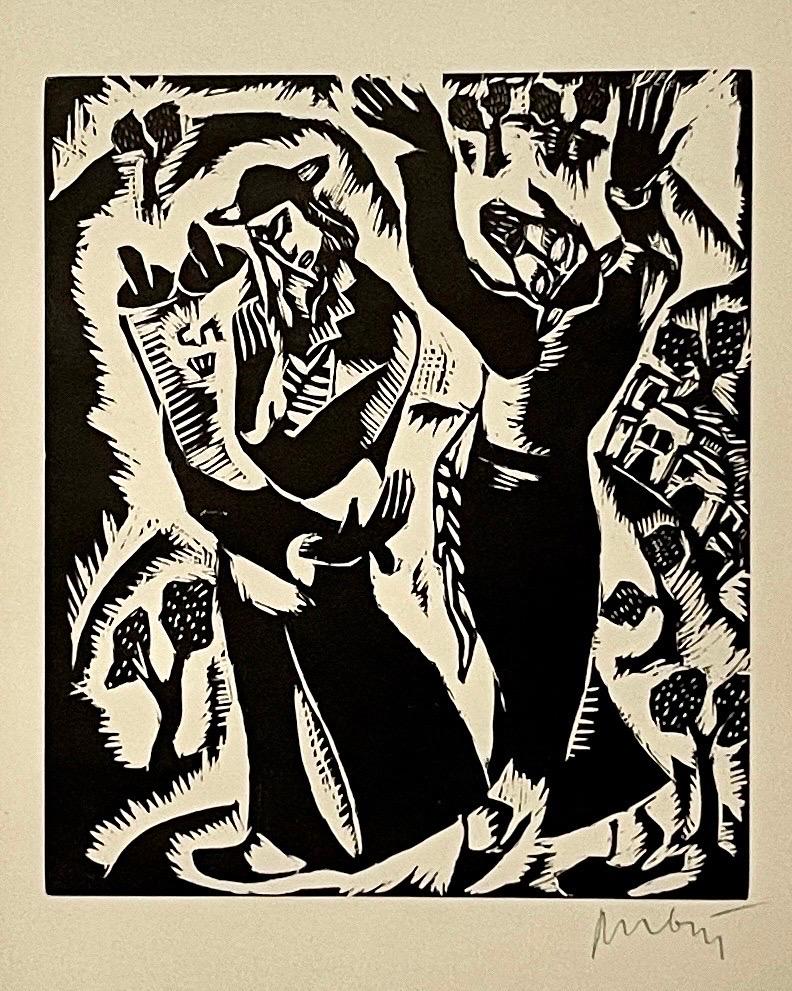
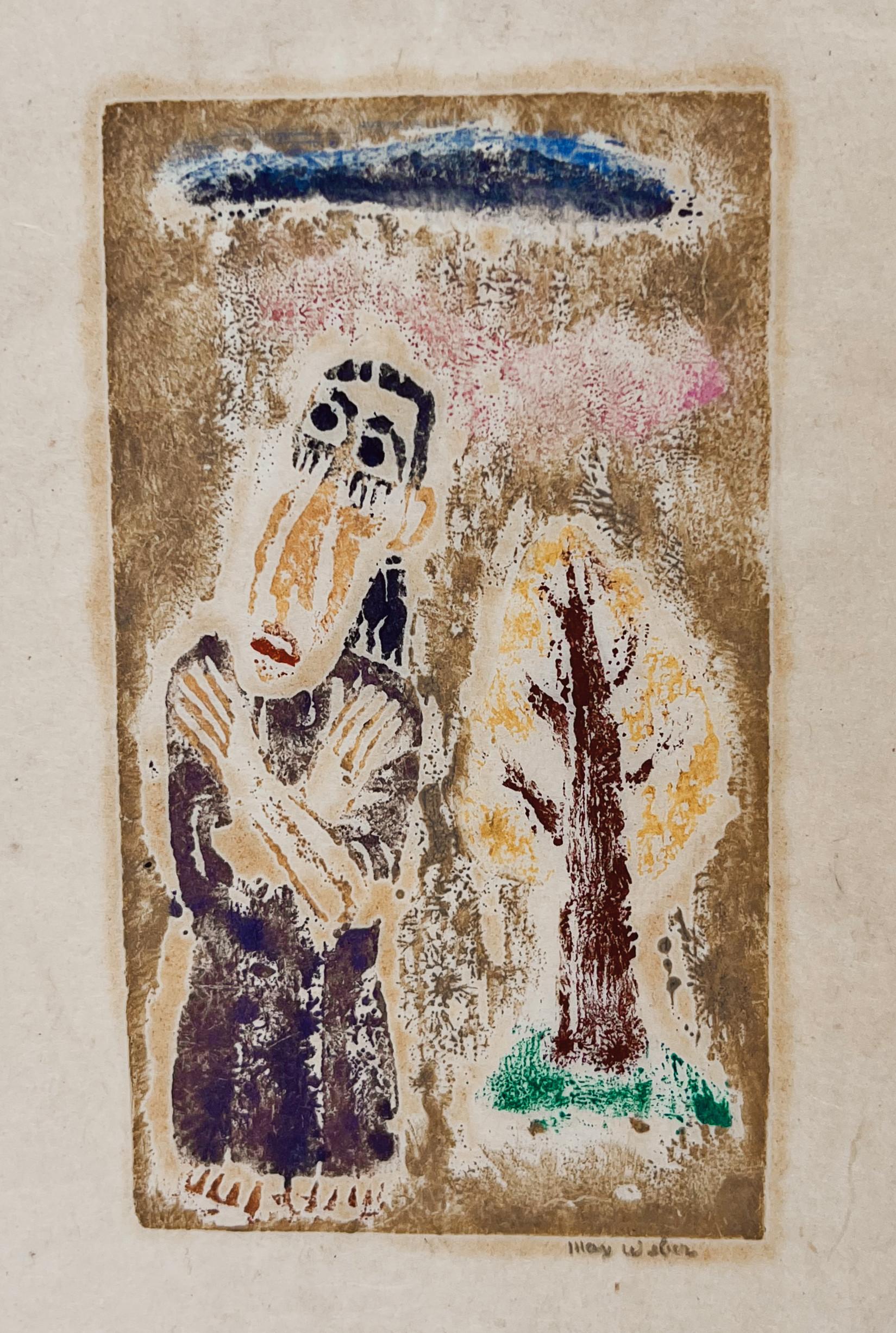
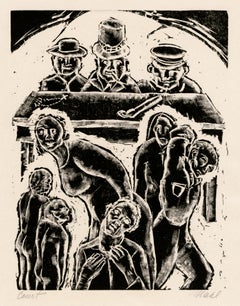
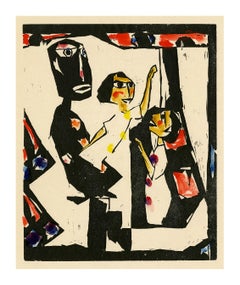
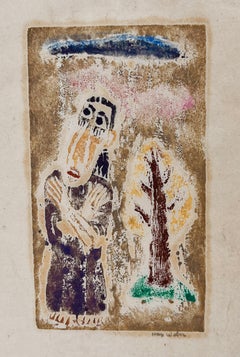
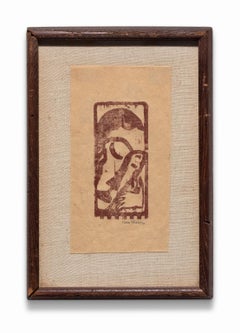
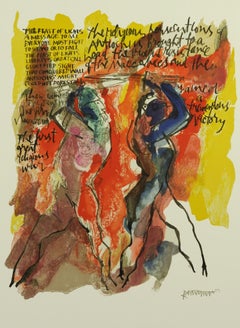
Max Weber, Untitled 'Feast of Passover', woodcut, 1920, edition proofs—this impression from the edition of 25 printed in 1956, Rubenstein 30. Signed in pencil. A fine impression, on cream Japan paper; the full sheet with wide margins (1 1/2 to 4 1/4 inches), in excellent condition. Image size 5 x 5 15/16 inches (127 x151 mm); sheet size 12 1/2 x 9 inches (318 x 229 mm). Scarce. Matted to museum standards, unframed.
Printed, at the artist’s request, by Joseph Blumenthal, The Spiral Press, New York. Included in the suite 'FIVE PRINTS BY MAX WEBER' published by Erhard Weyhe, director of Weyhe Gallery Inc., the renowned New York gallery established in 1919 to specialize in fine prints.
Collections: Brooklyn Museum, Detroit Institute of Arts, National Gallery of Art, Los Angeles County Museum of Art, Metropolitan Museum of Art, Museum of Modern Art, Philadelphia Museum of Art, Smithsonian American Art Museum.
ABOUT MAX WEBER'S RELIEF PRINTS
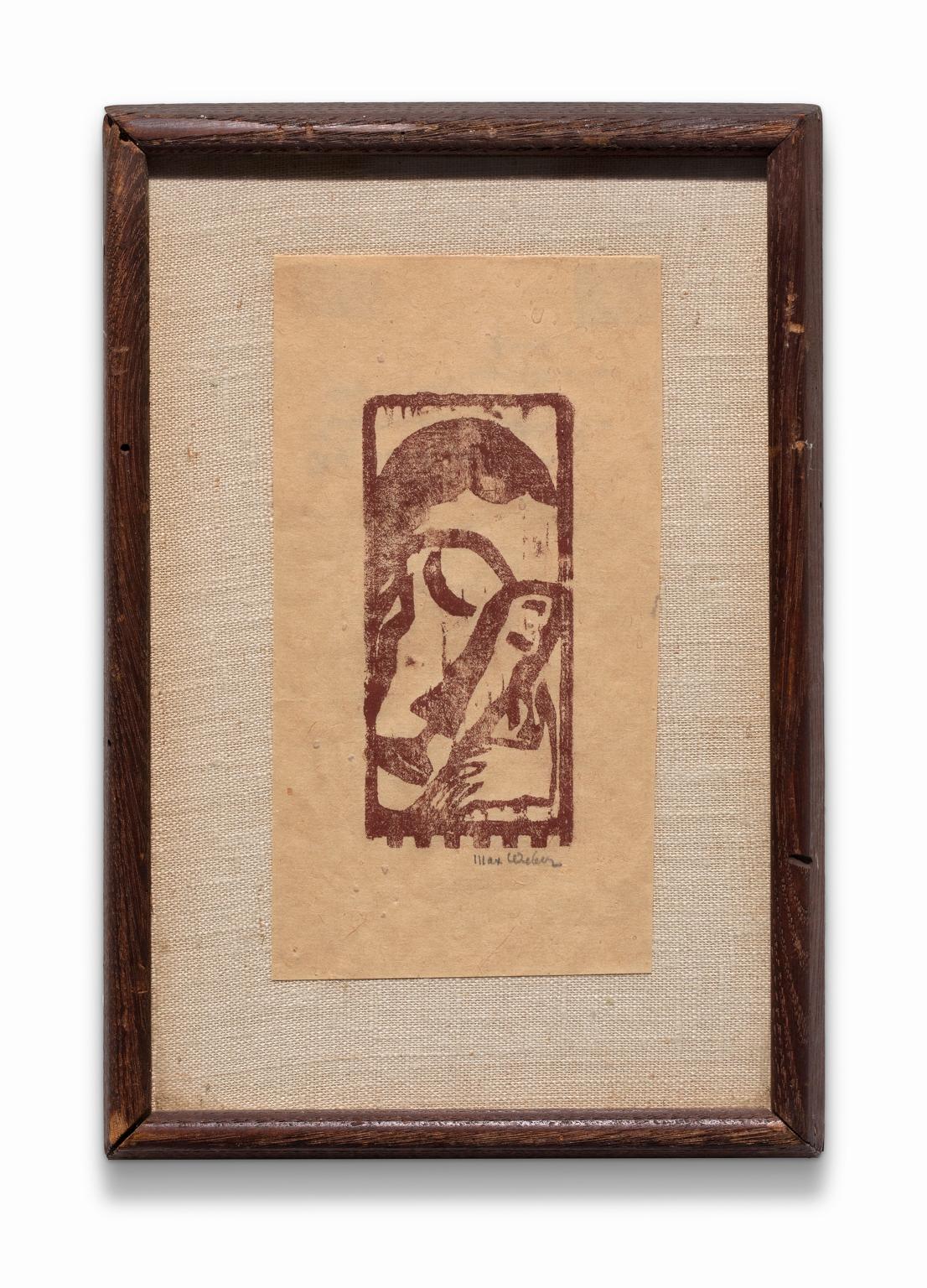
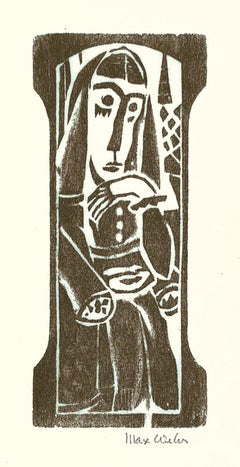
"In summary, Weber’s relief prints cannot be called just primitives or cubist forms. No single stylistic term is a satisfactory label. Collectively they suggest some common denominators: independence from academic traditions, interest in the element of design rather optical realism, simplicity and unpretentiousness in execution, craftlike tradition underlying their formulation and the desire to eschew the exactitude and dryness of wood engraving for the imprecision and painterly of hand-blocked work. The work was not a conscious effort at naiveté or lack of sophistication; on the contrary, it was an attempt to approach the origins of art.
ABOUT THE ARTIST
"To fill eternity with the ripest and the sanest expression of our consciousness is the essence as well as the purpose of life.” —Max Weber
Max Weber (1881-1961) was born in Bialystok, western Russia. When he was ten, his family came to America, settling in Brooklyn. While enrolled at nearby Pratt Institute from 1898 to 1900, he was a student of the modernist artist and influential teacher Arthur Wesley Dow who advocated for art as self-expression rather than traditional ornament.
Weber became an art teacher, first in the public schools in Lynchburg, Virginia, and beginning in 1903 at the Minnesota Normal School in Duluth. Inspired by Dow’s experience, Weber longed to continue his studies in Europe, and after years of prudent saving, he traveled to Paris in 1905.
He became a devoted disciple of Paul Cézanne, and met Guillaume Apollinaire, Robert Delaunay, Pablo Picasso, and Leo and Gertrude Stein. He became close friends with Henri Rousseau, later organizing the first exhibition of Rousseau’s work in the United States. A pupil of Matisse in 1908, he was deeply affected by the great artist’s expressive freedom and boldness of color. In recognition of his gifted assimilation of these many influences, one of Weber’s paintings was accepted for exhibition at the prestigious Salon d’Automne in 1907.
Weber returned to New York and had his first one-man show at the Haas Gallery in April of 1909, revealing himself as one of America’s earliest modernist artists. Although, as might have been expected, his cutting-edge work was mostly misunderstood and widely criticized, the show introduced the artist to Arthur B. Davies, who became a supporter and friend. Weber credited Davies with teaching him lithography in 1916, which enabled him to produce some of the earliest American modernist lithographs.
In 1919 Weber created his first group of woodcuts, many in color, which was exhibited in 1920 at the Montross Gallery in New York. Davies purchased some of the works, and the esteemed critic and gallery director Carl Zigrosser took other prints to sell at the Weyhe Gallery. That spring, ten of Weber’s poems with ten woodcuts were published in the Yiddish literary journal 'Schriften'. These early figurative abstractions display Weber’s unique melding of Cubist vernacular with primitivist sensibilities and stand among the most avant-garde American prints of the first quarter of the 20th century.
Weber’s subsequent relief prints represented Jewish themes, reflecting his heritage and spiritual convictions. Some of these works, such as ‘Feast of Passover’, expanded the artist’s repertoire to depict the interplay of multi-figure groupings. Weber’s prints were frequently reproduced in small literary magazines, and his book 'Primitives', published in 1926, integrated his poetry with his woodcuts.
Weber’s friendship with William Zorach, and an exhibition of the Provincetown printmakers in 1916, inspired his return to color relief prints. During 1919 and 1920, Weber created some thirty block prints—distinguished by their original use of color applied in a painterly manner, each impression being virtually unique.
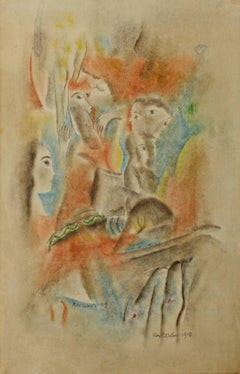
In 1925 the artist taught at the Art Students League, New York. From 1928 to 1933, he produced thirty-four black ink lithographs printed from zinc plates. Many of these works demonstrated Weber’s continuing interest in using figurative groupings to explore his Zen-like approach to what he described as “the problem of form, balance of volume and sculpturesque spacial values.”
In 1930 Weber began to receive institutional recognition for his innovative work. That year, the Museum of Modern Art mounted a retrospective exhibition of his work, and four years later, the Metropolitan Museum of Art in New York purchased a painting. This interest was sustained through several important exhibitions in the 1940s and 1950s.
Today Weber's work is included in every major American art museum, including The Art Institute of Chicago; Cleveland Museum of Art; Detroit Institute of Arts; Los Angeles County Museum of Art; Metropolitan Museum of Art; Museum of Fine Arts, Boston; Museum of Modern Art; National Gallery of Art; Philadelphia Museum of Art; Smithsonian American Art Museum; Solomon R. Guggenheim Museum; and Whitney Museum of American Art.