Want more images or videos?
Request additional images or videos from the seller.

Luigi Kasimir
Munichau (Austria)

1926

$850
£647.38
€775.81
CA$1,212.40
A$1,234.56
CHF 714.36
MX$16,279.51
NOK 7,987.79
SEK 8,504.73
DKK 5,798.20

About the Item

This artwork titled "Munichau (Austria)" 1926, is a color etching on paper by Austrian artist Luigi Kasimir, 1881-1962. It is hand signed in pencil by the artist's estate at the lower center. The plate mark (image) size is 11.5 x 11.5 inches, framed size is 21 x 20.75 inches. Custom framed in a wooden gold frame, with grey/green matting . It is in Excellent condition. About the artist. Luigi Kasimir was born in 1881 at Pettau, today Ptuj, Slovenia, then a part of the Austro-Hungarian monarchy. He inherited his talent from his ancestors; his grandfather was a painter and a poet, and his father an officer in the Habsburg army, who later became a professional painter. Kasimir attended the Vienna Academy of Art where he studied under Wilhelm Unger, who introduced him to the technique of the coloured etching, and also to his future wife, the artist Tanna Hoernes.[1] He died in 1962 in Grinzing, a suburb of Vienna.Kasimir was among the first to develop the technique of the coloured etching. Before this, prints were usually hand-coloured with the colour being applied in a casual, haphazard manner. Kasimir would first create a sketch usually in pastel, he then transferred the design on as many as four to six plates, printing one after the other and applying the colour on the plate, all done by hand. Kasimir is mainly famous for his etchings, but he also produced some oil painting, as well as some pastels. One of his favourite genres was the landscape, or veduta. He demonstrated a predisposition street scenes, and tourist landmarks. He depicted places from all over Europe, mainly Italy, Austria, and Germany. He also travelled to the United States to do a series of etchings of famous sights ranging from urban landmarks such as New York City skyscrapers, to natural wonders like Yosemite Valley. Luigi Kasimir’s etchings can be seen in many galleries and museums, from the New York Metropolitan Museum of Art to countless galleries and fine print collections around the world.
  • Creator:
    Luigi Kasimir (1881 - 1962, Austro-Hungarian)
  • Creation Year:
    1926
  • Dimensions:
    Height: 21 in (53.34 cm)Width: 20.75 in (52.71 cm)Depth: 0.75 in (1.91 cm)
  • Medium:
  • Movement & Style:
  • Period:
  • Condition:
  • Gallery Location:
    San Francisco, CA
  • Reference Number:
    Seller: Kas/mun/021stDibs: LU666312192332

More From This Seller

View All
Krumau

Krumau

By Josef Eidenberger

Located in San Francisco, CA

This artwork titled "Krumau" is an color etching by noted Austrian artist Josef Eidenberger, 1899-1991 It is hand signed in pencil. The plate mark (image) size is 13 x 10.15 inches, ...

Category

Mid-20th Century Realist Figurative Prints

Materials

Etching

Heiligen Bluts

Heiligen Bluts

By Luigi Kasimir

Located in San Francisco, CA

This artwork titled "Heiligen Bluts" 1948, is a color etching on Wove paper by Austrian artist Luigi Kasimir, 1881-1962. It is hand signed in pencil by the artist at the lower center...

Category

Early 20th Century Realist Figurative Prints

Materials

Etching

Himmelstrasse, Austria

Himmelstrasse, Austria

By Luigi Kasimir

Located in San Francisco, CA

This artwork titled "Himmelstrasse, Austria" c.1950 is an original color etching by Austrian artist Luigi Kasimir 1881-1962. It is hand signed in pencil at the lower center by the a...

Category

Early 20th Century Realist Figurative Prints

Materials

Etching

Turmgasschen

Turmgasschen

By Luigi Kasimir

Located in San Francisco, CA

This artwork titled "Turmgasschen" 1935 is an original color etching by Austrian artist Luigi Kasimir 1881-1962. It is hand signed in pencil at the lower center by the artist and titled in the plate. The plate mark (image) size is 15.5 x 10 inches, framed is 24.35 x 17.5 inches. It is custom framed in a dark wood frame, with light creme color matting and light brown filet. It is in very good condition, the frame have some scratches. Luigi Kasimir was born in 1881 at Pettau, today Ptuj, Slovenia, then a part of the Austro-Hungarian monarchy. He inherited his talent from his ancestors; his grandfather was a painter and a poet, and his father an officer in the Habsburg army, who later became a professional painter. Kasimir attended the Vienna Academy of Art where he studied under Wilhelm Unger, who introduced him to the technique of the coloured etching, and also to his future wife, the artist Tanna Hoernes.[1] He died in 1962 in Grinzing, a suburb of Vienna.Kasimir was among the first to develop the technique of the coloured etching. Before this, prints were usually hand-coloured with the colour being applied in a casual, haphazard manner. Kasimir would first create a sketch usually in pastel, he then transferred the design on as many as four to six plates, printing one after the other and applying the colour on the plate, all done by hand. Kasimir is mainly famous for his etchings, but he also produced some oil painting, as well as some pastels. One of his favourite genres was the landscape, or veduta. He demonstrated a predisposition street scenes, and tourist landmarks. He depicted places from all over Europe, mainly Italy, Austria, and Germany. He also travelled to the United States to do a series of etchings of famous sights ranging from urban landmarks such as New York City skyscrapers, to natural wonders like Yosemite Valley. Luigi Kasimir’s etchings...

Category

Early 20th Century Realist Figurative Prints

Materials

Etching

Heiligenblut, Austria

Heiligenblut, Austria

By Luigi Kasimir

Located in San Francisco, CA

This artwork titled "Heiligenblut, Austria" c.1950 is a color etching by Austrian artist Luigi Kasimir 1881-1962. It is hand signed by the artiste's estate in pencil at the lower center. The plate mark (image) size is 7.75 x 5.75 inches, framed is 17.85 x 15.15 inches. It is framed in a wooden antique silver frame. It is in very good condition. About the artist. Luigi Kasimir was born in 1881 at Pettau, today Ptuj, Slovenia, then a part of the Austro-Hungarian monarchy. He inherited his talent from his ancestors; his grandfather was a painter and a poet, and his father an officer in the Habsburg army, who later became a professional painter. Kasimir attended the Vienna Academy of Art where he studied under Wilhelm Unger, who introduced him to the technique of the coloured etching, and also to his future wife, the artist Tanna Hoernes.[1] He died in 1962 in Grinzing, a suburb of Vienna.Kasimir was among the first to develop the technique of the coloured etching. Before this, prints were usually hand-coloured with the colour being applied in a casual, haphazard manner. Kasimir would first create a sketch usually in pastel, he then transferred the design on as many as four to six plates, printing one after the other and applying the colour on the plate, all done by hand. Kasimir is mainly famous for his etchings, but he also produced some oil painting, as well as some pastels. One of his favourite genres was the landscape, or veduta. He demonstrated a predisposition street scenes, and tourist landmarks. He depicted places from all over Europe, mainly Italy, Austria, and Germany. He also travelled to the United States to do a series of etchings of famous sights ranging from urban landmarks such as New York City skyscrapers, to natural wonders like Yosemite Valley. Luigi Kasimir’s etchings...

Category

Early 20th Century Realist Figurative Prints

Materials

Etching

Diex, Carinthia, Austria

Diex, Carinthia, Austria

By Josef Eidenberger

Located in San Francisco, CA

This artwork titled "Diex, Carinthia, Austria" c.1950 is a color etching on Wove paper by noted Austrian artist Josef Eidenberger, 1899-1991. It is hand signed in pencil by the artist. Published/printed by Graphics International, Austria. The plate mark (image) size is 13.75 x 10.75 inches, sheet size is 20.5 x 16.15 inches. It is in excellent condition, has never been framed. About the artist. Josef Eidenberger was born in 1899 in the little town of Goisern, Austria,he began his artistic career as a landscape painter. In 1923 he enrolled in the famed Graphic Academy of Art in Vienna and studied under Professor Alfred Cossman. His recognized talent brought him many commissions from city officials and members of the business communities throughout Europe, especially in Austria and Germany. In 1973 after visiting the United States for the first time he created a series of California etchings...

Category

Mid-20th Century Realist Figurative Prints

Materials

Etching

You May Also Like

Vintage Photograph of a Painting by Beppe Guzzi - Mid-20th Century

Vintage Photograph of a Painting by Beppe Guzzi - Mid-20th Century

Located in Roma, IT

Photograph of Vintage Painting by Beppe Guzzi is a black and white vintage photo realized by an anonymous artist in the early 20th Century. Good conditions except for some minor fix...

Category

Mid-20th Century Modern Figurative Photography

Materials

Photographic Paper

Evening - The depth of the visible -

Evening - The depth of the visible -

Located in Berlin, DE

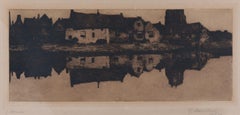
Max Clarenbach (1880 Neuss - Cologne 1952), Evening. Etching, 18 x 41 cm (platemark), 33.5 x 57 cm (frame), inscribed "Abend" in pencil at lower left, signed and dated "M. Clarenbach. 28.III.[19]09". Framed and mounted under glass. - Somewhat browned and slightly foxed. About the artwork The horizontally elongated etching depicts the panoramic view of a small town as seen from the other side of the river. There are gabled houses on the left and a mighty church spire on the right. The bourgeois houses and the large religious building indicate the urban character. These buildings are rendered in dark tones to emphasise the lighter row of houses in the centre of the picture, closer to the water. The chiaroscuro contrast creates two parallel planes that open up a space for the imagination of what the city could be. The imagination is stimulated by the almost entirely dark, barely recognisable buildings, while the arm of the river leading into the city further stimulates the imagination. However, as the silhouette of the city as a whole is reflected in the water, the parallel planes are perceived as a band of houses that stretches across the entire horizontality of the etching and seems to continue beyond the borders of the picture. The reflection has almost the same intensity as the houses themselves, so that the band of buildings merges with their reflection to form the dominant formal unit of the picture. Only the parallel horizontal hatching creates the convincing impression of seeing water, demonstrating Max Clarenbach's mastery of the etching needle. The water is completely motionless, the reflection unclouded by the slightest movement of the waves, creating a symmetry within the formal unity of the cityscape and its reflection that goes beyond the motif of a mere cityscape. A pictorial order is established that integrates everything in the picture and has a metaphysical character as a structure of order that transcends the individual things. This pictorial order is not only relevant in the pictorial world, but the picture itself reveals the order of the reality it depicts. Revealing the metaphysical order of reality in the structures of its visibility is what drives Clarenbach as an artist and motivates him to return to the same circle of motifs. The symmetry described is at the same time inherent an asymmetry that is a reflection on art: While the real cityscape is cut off at the top of the picture, two chimneys and above all the church tower are not visible, the reflection illustrates reality in its entirety. The reflection occupies a much larger space in the picture than reality itself. Since antiquity, art has been understood primarily as a reflection of reality, but here Clarenbach makes it clear that art is not a mere appearance, which can at best be a reflection of reality, but that art has the potential to reveal reality itself. The revealed structure of order is by no means purely formalistic; it appears at the same time as the mood of the landscape. The picture is filled with an almost sacred silence. Nothing in the picture evokes a sound, and there is complete stillness. There are no people in Clarenbach's landscape paintings to bring action into the picture. Not even we ourselves are assigned a viewing position in the picture, so that we do not become thematic subjects of action. Clarenbach also refrains from depicting technical achievements. The absence of man and technology creates an atmosphere of timelessness. Even if the specific date proves that Clarenbach is depicting something that happened before his eyes, without the date we would not be able to say which decade, or even which century, we are in. The motionless stillness, then, does not result in time being frozen in the picture, but rather in a timeless eternity that is nevertheless, as the title "Abend" (evening), added by Clarenbach himself, makes clear, a phenomenon of transition. The landscape of the stalls is about to be completely plunged into darkness, the buildings behind it only faintly discernible. The slightly darkened state of the sheet is in keeping with this transitional quality, which also lends the scene a sepia quality that underlines its timelessness. And yet the depiction is tied to a very specific time. Clarenbach dates the picture to the evening of 28 March 1909, which does not refer to the making of the etching, but to the capture of the landscape's essence in the landscape itself. If the real landscape is thus in a state of transition, and therefore something ephemeral, art reveals its true nature in that reality, subject to the flow of phenomena, is transferred to an eternal moment, subject to a supra-temporal structure of order - revealed by art. Despite this supratemporality, the picture also shows the harbingers of night as the coming darkening of the world, which gives the picture a deeply melancholy quality, enhanced by the browning of the leaf. It is the philosophical content and the lyrical-melancholic effect of the graphic that give it its enchanting power. Once we are immersed in the image, it literally takes a jerk to disengage from it. This etching, so characteristic of Max Clarenbach's art, is - not least because of its dimensions - a major work in his graphic oeuvre. About the artist Born into poverty and orphaned at an early age, the artistically gifted young Max Clarenbach was discovered by Andreas Achenbach and admitted to the Düsseldorf Art Academy at the age of 13. "Completely penniless, I worked for an uncle in a cardboard factory in the evenings to pay for my studies.” - Max Clarenbach At the academy he studied under Arthur Kampf, among others, and in 1897 was accepted into Eugen Dücker...

Category

Early 1900s Realist Landscape Prints

Materials

Etching

R.(Raymond) Goubert, (20th/21st. Century) Painting

R.(Raymond) Goubert, (20th/21st. Century) Painting

Located in West Palm Beach, FL

R.(Raymond) Goubert, (20th/21st. Century) Alpine Landscape signed R. Goubert, lower left, with signature plate, oil on canvas 16 by 20 in., overall, framed 24 by 28 in. Condition Rep...

Category

20th Century Decorative Art

Materials

Canvas

Rothenberg

Rothenberg

By Paul Geissler

Located in Middletown, NY

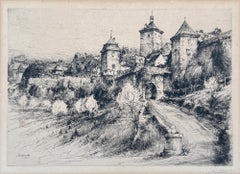
Etching with aquatint on cream wove paper, 6 11/16 x 9 15/16 inches (170 x 252 mm), full margins. Signed in pencil in the lower right margin. With significant toning and moderate mat...

Category

Early 20th Century Naturalistic Landscape Prints

Materials

Handmade Paper, Etching, Aquatint

Eduard Boehm - 19th Century Oil, Partie aus Niederösterreich

Eduard Boehm - 19th Century Oil, Partie aus Niederösterreich

Located in Corsham, GB

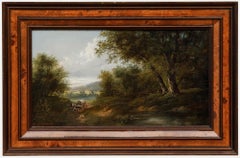
A peaceful pool rests beneath the dappled shade of a forest. A horse-drawn cart travels along a rugged track, leading the viewer's eye into the distance, where the minute spire of a ...

Category

19th Century Landscape Paintings

Materials

Oil