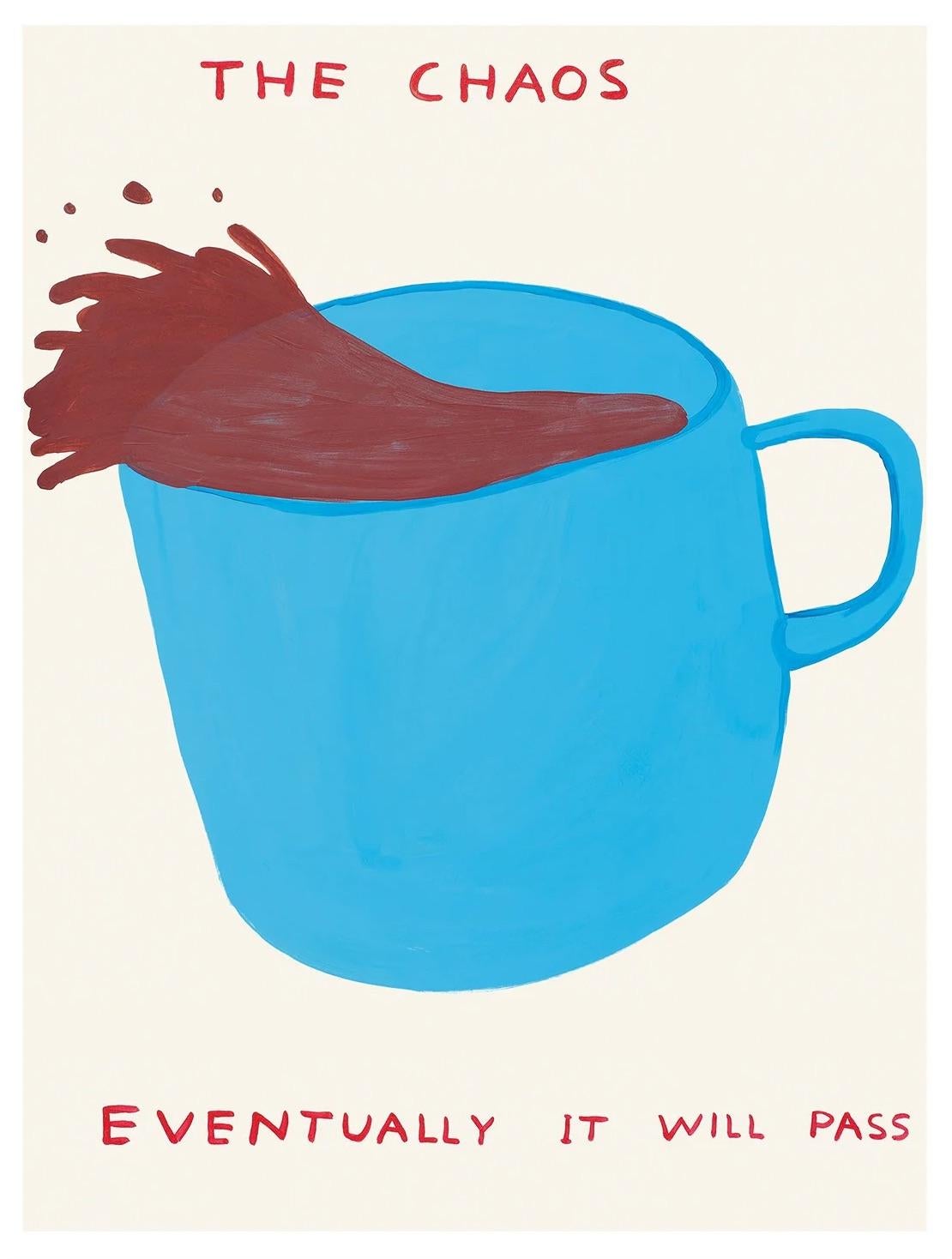
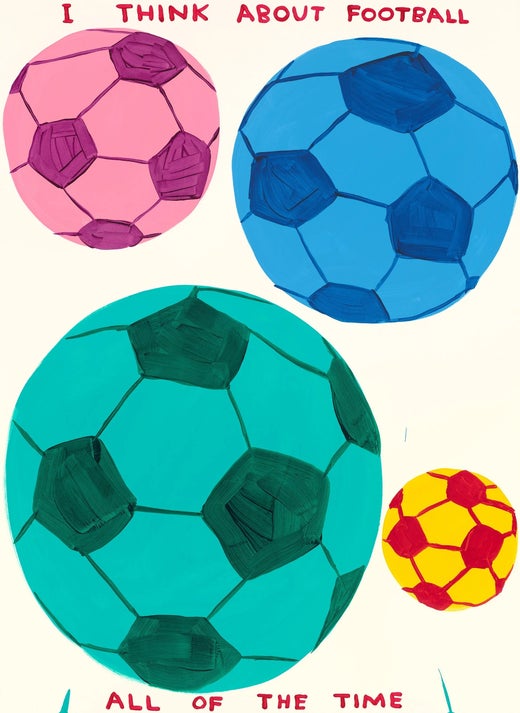
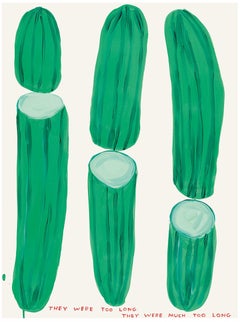
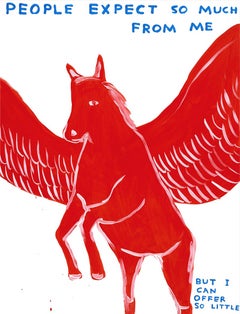
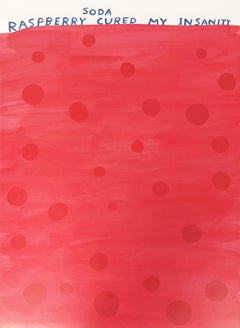
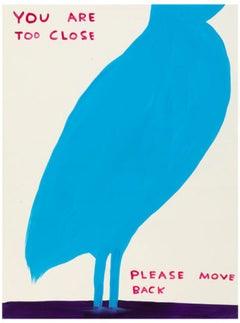
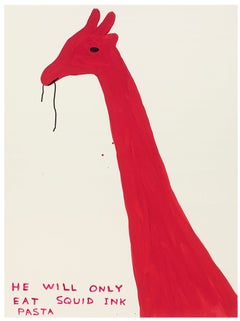
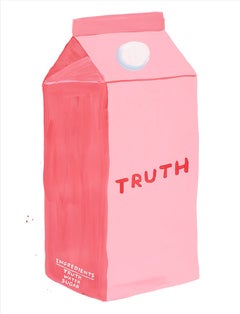
Artist: David Shrigley (1968)
Title: Foolish Hearts
Year: 2023
Medium: Offset lithograph in colors on 200g Munken Lynx paper
Size: 31.50 x 23.63 inches (80.01 x 60.01 cm)
Condition: Well preserved, consistent with age and medium
Inscription: Unsigned and unnumbered as issued
Publisher: Shrig Shop, Copenhagen
Printer: Narayana Press, Denmark
DAVID SHRIGLEY (1968) is a British contemporary artist, draughtsman, printmaker, sculptor, photographer, filmmaker, and conceptual provocateur whose irreverent humor, deliberately awkward drawings, absurdist narratives, and psychologically revealing observations of everyday life have established him as one of the most recognizable and internationally celebrated figures in contemporary British art. Born in Macclesfield, Cheshire, England, and raised in Leicester, Shrigley studied at Leicester Polytechnic before attending the Glasgow School of Art, where he developed the unconventional artistic language that would become his signature contribution to contemporary visual culture. His work is immediately recognizable for its deceptively simple black-and-white drawings, handwritten text, strange animals, distorted human figures, unexpected statements, and combinations of visual innocence with dark humor, transforming ordinary situations into absurd, unsettling, and frequently philosophical reflections on modern existence. Associated with contemporary conceptual art, absurdism, satirical illustration, and the continuing traditions of Dada and Surrealism, Shrigley has consistently challenged conventional distinctions between fine art, cartoons, graphic design, popular culture, and everyday communication, creating works that are simultaneously accessible, intellectually provocative, and psychologically complex. His artistic practice developed within the broader modernist legacy established by Pablo Picasso, Alexander Calder, Alberto Giacometti, Salvador Dali, Joan Miro, Wassily Kandinsky, Marcel Duchamp, and Man Ray, whose revolutionary investigations into form, abstraction, Surrealism, sculpture, conceptual experimentation, and the relationship between art and ordinary experience fundamentally transformed twentieth-century visual culture. Picasso’s expressive distortion of the human figure, Calder’s playful sculptural experimentation, Giacometti’s existential investigations into human presence, Dali’s dreamlike manipulation of reality, Miro’s poetic symbolism, Kandinsky’s liberation of form and color, and the conceptual provocations of Duchamp and Man Ray provide important historical reference points for understanding the avant-garde traditions against which Shrigley developed his distinctive artistic identity. Particularly relevant to his work are the irreverent strategies of Dada, the psychological absurdities of Surrealism, the conceptual challenges introduced by Marcel Duchamp, and the unconventional imagery associated with artists such as René Magritte, Jean Dubuffet, Paul Klee, and Philip Guston, whose investigations into language, humor, apparent simplicity, and the instability of meaning offer significant historical parallels for Shrigley’s approach. His artistic vocabulary also reflects the broader influence of British comic illustration, satirical drawing, underground cartoons, and the tradition of deadpan humor, combining these sources with contemporary philosophical inquiry and the visual language of everyday communication. Unlike artists who emphasize technical virtuosity or elaborate pictorial construction, Shrigley deliberately embraces awkwardness, imperfection, and apparent naivety, creating drawings whose crude outlines, uneven lettering, and simplified forms conceal sophisticated observations about human behavior, social convention, anxiety, mortality, and the absurdity of existence. His works frequently feature animals engaged in human activities, distorted bodies, talking objects, ambiguous instructions, and contradictory statements that disrupt ordinary expectations and invite viewers to reconsider the relationship between language, image, and meaning. The humor of these compositions often arises from the collision between familiar visual forms and unexpected textual declarations, producing images that appear immediately amusing but reveal increasingly complex psychological and philosophical implications through sustained observation. Shrigley’s use of handwritten text is particularly significant, as words function not merely as captions but as integral components of the artwork, frequently contradicting, complicating, or transforming the meaning of the accompanying image. This relationship between language and visual form connects his practice to the broader history of conceptual art and text-based painting, including the work of artists such as Lawrence Weiner, Jenny Holzer, Barbara Kruger, and Ed Ruscha, although Shrigley’s approach remains distinguished by its intimacy, absurdity, and apparent spontaneity. His drawings often resemble fragments of private thoughts, overheard conversations, peculiar instructions, or irrational observations, creating an atmosphere in which the boundaries between personal psychology and collective social behavior become deliberately unstable. This ambiguity gives his work an unusual capacity to communicate across cultural and linguistic boundaries, as the simplicity of his imagery allows viewers to engage immediately with its humor while discovering deeper layers of meaning. Shrigley’s artistic career developed during a period when British contemporary art achieved increasing international recognition, particularly through the emergence of the Young British Artists and the growing prominence of conceptual, installation, and multimedia practices. Although his work shares certain irreverent and provocative qualities with artists associated with this generation, including Damien Hirst, Sarah Lucas, Tracey Emin, and Gavin Turk, Shrigley maintained an independent artistic identity rooted in drawing, humor, and the expressive possibilities of deliberately unconventional imagery. His peers and contemporaries also include artists such as Martin Creed, Jeremy Deller, and other British practitioners who explore the relationship between everyday experience, conceptual experimentation, and public participation. Shrigley’s work occupies a distinctive position within this broader environment because it combines the accessibility of cartoons with the intellectual concerns of contemporary conceptual art, challenging the assumption that artistic seriousness necessarily requires technical refinement, monumental scale, or obscure theoretical language. His artistic achievement lies in his ability to transform the apparently trivial into the philosophically significant, using humor as a means of examining vulnerability, social anxiety, institutional authority, personal identity, and the contradictions of modern life. Throughout his career, Shrigley has developed an extensive multidisciplinary practice encompassing drawing, painting, sculpture, photography, animation, film, music-related projects, installations, publications, and original fine-art prints. His sculptures frequently translate the absurdity of his drawings into three-dimensional form, creating strange animals, oversized objects, distorted figures, and unexpected constructions that challenge conventional relationships between scale, function, and representation. These works often employ deliberately simplified forms and unusual materials, reinforcing his fascination with the tension between familiar objects and irrational transformations. His photographic works similarly explore the absurdity of everyday environments, frequently presenting ordinary situations or objects in ways that reveal unexpected humor, contradiction, or psychological unease. His animations and films extend his graphic vocabulary into moving images, allowing his distinctive characters and handwritten narratives to unfold through deliberately awkward movement, unexpected sound, and absurdist storytelling. These projects demonstrate the adaptability of his artistic language across different media while preserving the immediately recognizable qualities that define his drawings. Shrigley’s printmaking has become an especially important component of his international collecting market, with original screenprints, lithographs, woodcuts, and other graphic works introducing his imagery to a broad audience of collectors interested in contemporary British art, conceptual drawing, satirical illustration, and text-based imagery. His prints frequently feature brightly colored backgrounds, simplified animals, handwritten declarations, and humorous observations that combine visual immediacy with conceptual ambiguity. The apparent simplicity of these compositions makes them particularly accessible, yet their humor often conceals more complex reflections on human behavior, mortality, desire, frustration, and the instability of meaning. His graphic editions have contributed significantly to the international visibility of his work, allowing his distinctive artistic vocabulary to circulate beyond conventional gallery exhibitions and into contemporary interiors, private collections, and broader visual culture. Shrigley’s books and publications similarly occupy an important position within his practice, bringing together drawings, text, and absurdist narratives in formats that encourage intimate engagement with his artistic imagination. These publications reflect his interest in the relationship between art and everyday communication, demonstrating that the boundaries separating a drawing, a written statement, a cartoon, and a conceptual artwork can be deliberately fluid. His artistic identity has also been shaped by collaborations with musicians, designers, publishers, and cultural organizations, reinforcing his position within the increasingly interdisciplinary environment of contemporary art. His work has appeared in music-related projects, public commissions, and unconventional exhibition contexts, demonstrating his willingness to engage audiences outside traditional museum and gallery settings. Shrigley’s international reputation expanded significantly during the 2000s and 2010s as his drawings, sculptures, and installations attracted increasing attention from museums, collectors, critics, and the general public. In 2013, he was nominated for the Turner Prize, one of the most prestigious awards in British contemporary art, recognizing his distinctive contribution to contemporary drawing, sculpture, and conceptual practice. His nomination reflected the growing institutional recognition of an artist whose deliberately unpolished imagery had challenged conventional expectations of artistic accomplishment. In 2016, Shrigley created Really Good, a monumental bronze sculpture of an elongated thumbs-up gesture installed on the Fourth Plinth in London’s Trafalgar Square, transforming a familiar symbol of approval into an absurdly exaggerated public monument. The sculpture became one of his most widely recognized public works, combining humor, optimism, ambiguity, and social commentary within a form that was immediately accessible to a broad international audience. Its exaggerated proportions and deliberately awkward appearance exemplify Shrigley’s ability to transform ordinary gestures into psychologically and culturally resonant artistic statements. His public projects also demonstrate the capacity of his visual language to engage directly with contemporary social experience, inviting viewers to participate in the interpretation of familiar symbols and everyday expressions. Shrigley’s influence on subsequent generations of artists has been substantial, particularly among contemporary illustrators, conceptual artists, cartoonists, graphic designers, and practitioners who combine text, humor, and deliberately simplified imagery to explore psychological and social concerns. His work provides an important historical precedent for younger artists who embrace awkward drawing, absurdist narrative, and the collision between visual innocence and unsettling content, while his international visibility has contributed to the broader acceptance of humor and cartoon-like imagery within contemporary fine art. His practice also resonates with artists working in contemporary Neo-Pop, conceptual illustration, and satirical painting, where the relationship between accessible imagery and complex meaning remains a central concern. Although specific younger artists who have publicly identified Shrigley as a direct influence are not uniformly documented, his distinctive visual language has become an important reference point within contemporary graphic culture, particularly for artists who seek to challenge traditional hierarchies between fine art and popular illustration. His work demonstrates that humor can function as a serious artistic strategy, revealing contradictions and vulnerabilities that might remain concealed within more conventional forms of representation. Shrigley’s artistic philosophy emphasizes the productive possibilities of uncertainty, imperfection, and irrationality, treating apparent mistakes and unconventional forms as opportunities for creative discovery rather than deficiencies to be corrected. This approach has particular relevance within contemporary discussions surrounding artistic authenticity, institutional authority, and the relationship between professional expertise and spontaneous expression. His drawings frequently challenge the viewer’s expectations of what constitutes artistic skill, demonstrating that the expressive power of an image can depend as much upon conceptual invention and psychological insight as upon technical refinement. For collectors, David Shrigley occupies an important position within the international market for contemporary British art, conceptual drawing, satirical illustration, Neo-Pop, and original fine-art prints, with his paintings, drawings, sculptures, screenprints, and limited-edition works offering a distinctive combination of visual humor, conceptual sophistication, and immediately recognizable artistic identity. His works are particularly relevant to collectors interested in Ed Ruscha, Keith Haring, Jean-Michel Basquiat, Philip Guston, Martin Creed, Damien Hirst, and other artists whose practices challenge conventional distinctions between artistic seriousness, popular imagery, and conceptual experimentation. His original drawings and graphic editions remain especially recognizable for their handwritten text, strange animals, deliberately awkward figures, and unexpected philosophical observations, while his sculptures and installations extend these qualities into physical space through humorous transformations of familiar objects and gestures. Today, David Shrigley continues to maintain an internationally recognized multidisciplinary practice, exhibiting in major galleries and museums while producing works that engage with the absurdities, anxieties, and contradictions of contemporary life. His artistic achievement lies in his ability to transform the simplest forms of visual communication into sophisticated conceptual experiences, demonstrating that humor, awkwardness, and apparent naivety can become powerful instruments of psychological observation and artistic expression. His enduring appeal reflects the extraordinary accessibility of his imagery and its capacity to communicate complex ideas through direct, humorous, and often unsettling encounters, securing his position among the most distinctive figures in contemporary British art. The highest auction record for David Shrigley is $165,100 USD for his 2016 sculpture Memorial, sold at Sotheby’s New York in February 2023.