(after) René Magritte
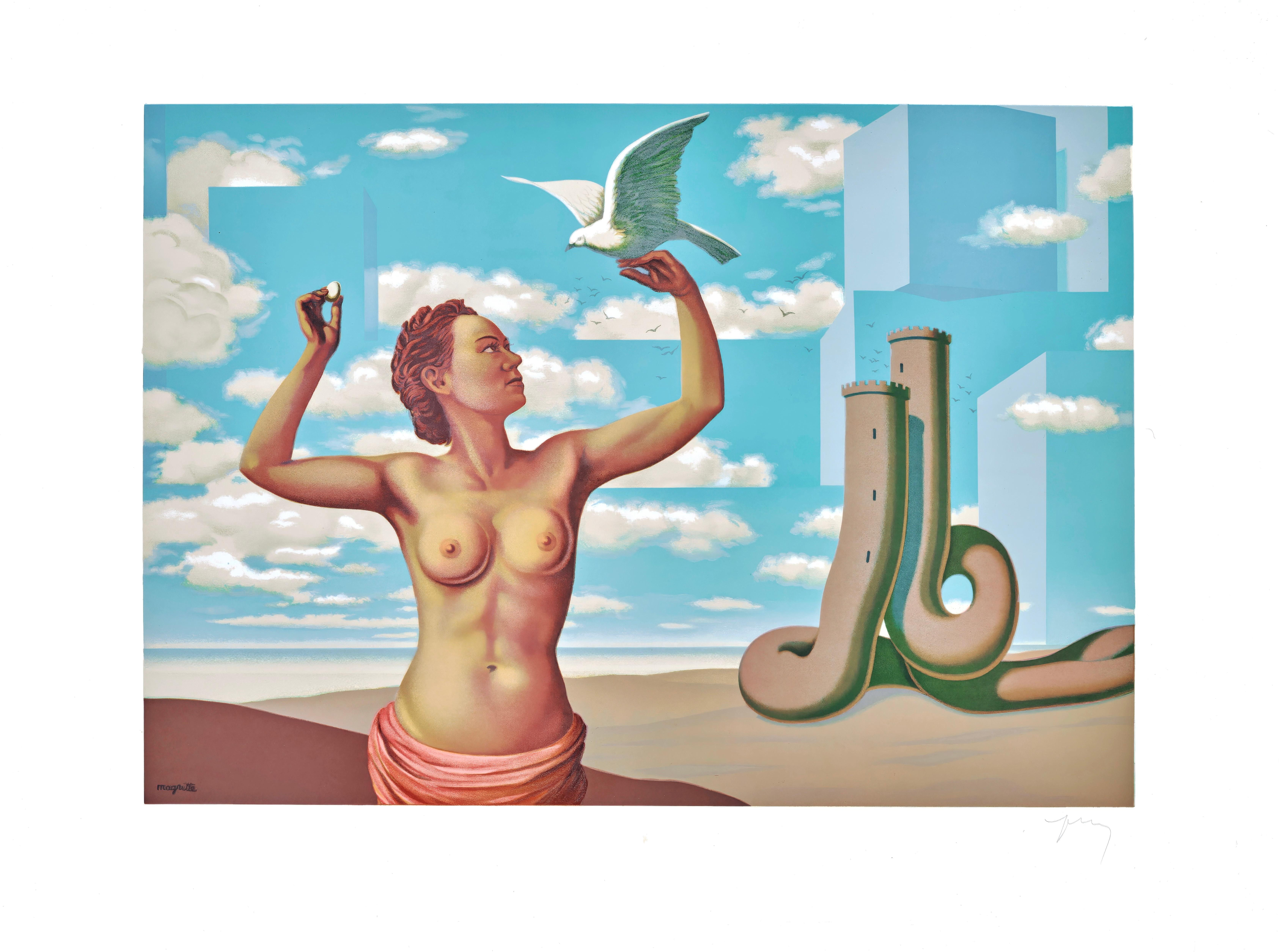
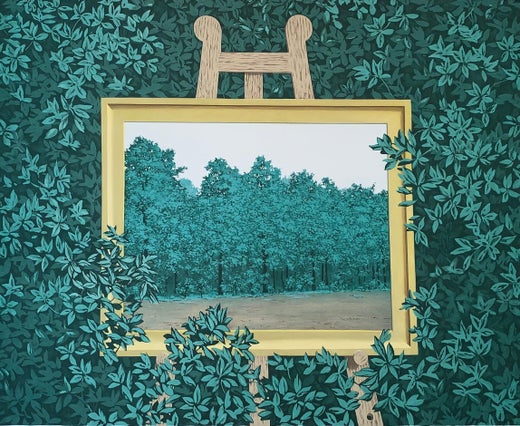
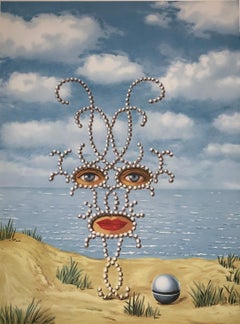
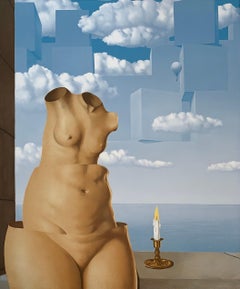
Rene Magritte was born in Lessines, in 1898. Magritte's earliest oil paintings, which date from about 1915, were Impressionistic in style. From 1916 to 1918 he studied at the Academie Royale des Beaux-Arts in Brussels, under Constant Montald, but found the instruction uninspiring. The oil paintings he produced during the years 1918-1924 were influenced by Futurism and by the offshoot of Cubism practiced by Metzinger. Most of his works of this period are female nudes. In 1922 Magritte married Georgette Berger, whom he had met as a child in 1913. From December 1920 until September 1921, Magritte served in the Belgian infantry in the Flemish town of Beverlo near Leopoldsburg. In 1922-1923, he worked as a draughtsman in a wallpaper factory, and was a poster and advertisement designer until 1926, when a contract with Galerie la Centaure in Brussels made it possible for him to paint full-time. In 1926, Magritte produced his first surreal oil painting, The Lost Jockey (Le jockey perdu), and held his first exhibition in Brussels in 1927. Critics heaped abuse on the exhibition. Depressed by the failure, he moved to Paris where he became friends with Andre Breton, and became involved in the surrealist group. During the German occupation of Belgium in World War II he remained in Brussels, which led to a break with Breton. He briefly adopted a colorful, painterly style in 1943-44, an interlude known as his "Renoir Period", as a reaction to his feelings of alienation and abandonment that came with living in German occupied Belgium. In 1946, renouncing the violence and pessimism of his earlier work, he joined several other Belgian artists in signing the manifesto Surrealism in Full Sunlight. During 1947-48-Magritte's "Vache Period"-he painted in a provocative and crude Fauve style. During this time, Magritte supported himself through the production of fake painting of Picasso, van Gogh, Manet and Paul Cezanne - a fraudulent repertoire he was later to expand into the printing of forged banknotes during the lean postwar period. This venture was undertaken alongside his brother Paul Magritte and fellow Surrealist and 'surrogate son' Marcel Marien, to whom had fallen the task of selling the forgeries. At the end of 1948, he returned to the style and themes of his prewar surrealistic art. Magritte wished to cultivate an approach that avoided the stylistic distractions of most modern painting. While French Surrealists experimented with new techniques, Magritte settled on a deadpan, illustrative technique that clearly articulated the content of his pictures. Repetition was an important strategy for Magritte, informing not only his handling of motifs within individual pictures, but also encouraging him to produce multiple copies of some of his greatest works. His interest in the idea may have come in part from Freudian psychoanalysis, for which repetition is a sign of trauma. But his work in commercial art may have also played a role in prompting him to question the conventional modernist belief in the unique, original work of art.