Want more images or videos?
Request additional images or videos from the seller.

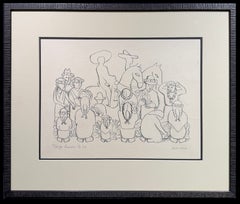
(after) Diego Rivera
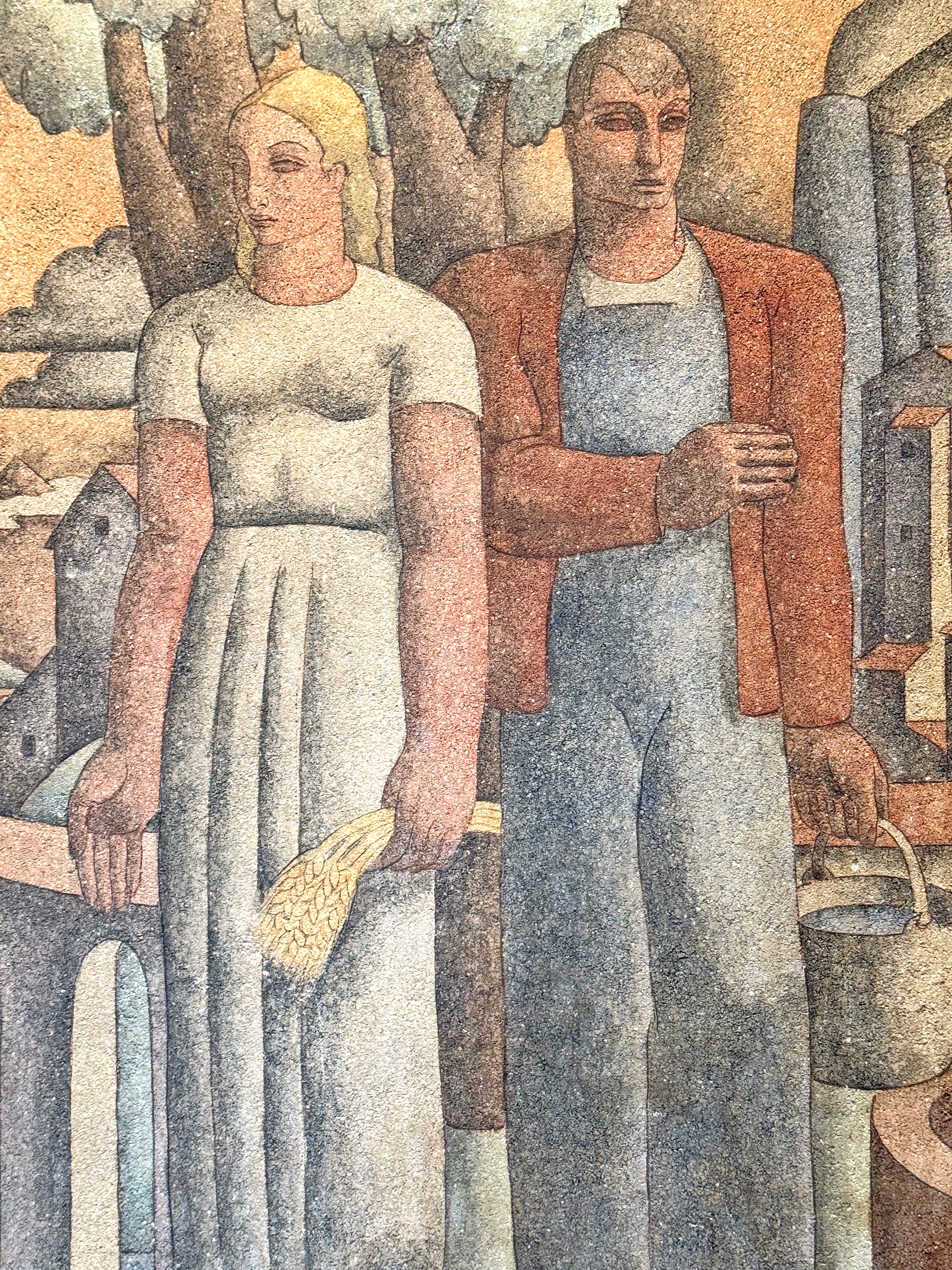
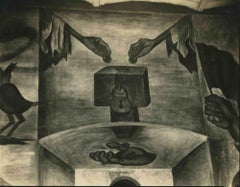
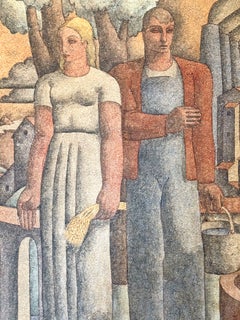
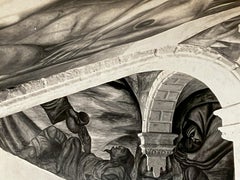
Chapel of the Agricultural School, Chapingo (Ceiling Detail, Workers)

1933

$1,500
£1,139.01
€1,366.18
CA$2,148.25
A$2,217.50
CHF 1,249.89
MX$28,689.29
NOK 14,259.91
SEK 15,043.57
DKK 10,211.32

About the Item

(after) Diego Rivera "Chapel of the Agricultural School, Chapingo" (Ceiling Detail, Workers) 1933 from the portfolio "Frescoes of Diego Rivera" Published by the Museum of Modern Art, NY Size with the Matt: 18.5 x 13.5 inches Hand-Signed by the Artist Diego Rivera was born on December 13, 1886 in the mountain town of Guanajuato in Mexico. His mother was an ardent Catholic and his father was a rich and aristocratic revolutionary fighter and an atheist. Little Diego decided in favor of atheism. He swore his family had to leave Guanajuato when he was six because of his diatribes against the Church. When he was eleven he attended the San Carlos Academy of Fine Arts; his real teacher was Jose Posada, whose printmaking shop stood near the school. At the age of twenty he won a traveling scholarship and spent the next three years in museums and painting in Europe, expressing little of what he felt. In 1910 he returned to Mexico and became involved in the revolution that ended with the forcing out of office the aging dictator Diaz. In 1911 his scholarship was renewed and he sailed for Europe again, this time for a period of ten years. In Paris, he set up housekeeping with a pretty Russian blonde named Angeline Beloff, his first common-law wife; from her he learned the Russian language and from her friends he learned all about Marxism. He also learned about Cubism and Picasso. A trip to Italy gave him a chance to study Giotto, Uccello and Andrea del Castagno. In 1922 he returned again to Mexico and joined forces with two other revolutionaries, Siqueiros and Orozco. They formed a government-backed syndicate of artists who changed from easel painting to working on murals. In the next decade he did what was probably his greatest work: frescoes in Cuernavaca and in Chapingo, where his favorite model was Guadalupe Marin, a tempestuous olive-skinned beauty. They married and she bore him two daughters. He proved to be a master of figure composition, of space and light, of crowds of farm workers and battle scenes, etc. In 1927 Rivera decided it was time for a visit of homage to Moscow; he met and sketched Stalin for which he was very honored. Later he did a complete reversal about Stalin. When he got home from Moscow he met and married a pretty art student named Frida Kahlo. They moved into her home in Coyoacan, a Mexico City suburb. Among their many guests was Leon Trotsky who lived with them for two years while he wrote a biography of Stalin, his enemy. Kahlo died in 1954 and not long after, Rivera married again; this time he married Emma Hurtado, a magazine publisher who also had a gallery dealing in Rivera paintings. Rivera was notorious for his murals in which he openly expressed his opinions on many controversial subjects of the day. The most notorious of these was the one in Rockefeller Center which was reduced to dust by the Rockefeller family after Rivera refused to remove the painting of Lenin uniting the workers. Rivera also worked hard at painting society portraits by the dozen; he did very popular flower paintings, sexy nudes and typical Mexican scenes. He painted the beautiful Dolores Del Rio and Paulette Goddard, the movie actress who posed for him at least twelve times. He made a lot of money which he got rid of as fast as he could make it. He was known as the softest touch in all of Mexico, giving away money to friends, guests and street beggars. He died in Mexico City on November 24, 1957.
  • Creator:
    (after) Diego Rivera (1886 - 1957, Mexican)
  • Creation Year:
    1933
  • Dimensions:
    Height: 13.5 in (34.29 cm)Width: 18.5 in (46.99 cm)
  • Medium:
  • Movement & Style:
  • Period:
  • Condition:
  • Gallery Location:
    Missouri, MO
  • Reference Number:
    1stDibs: LU74732828073

More From This Seller

View All
Chapel, Agriculture School, Chapingo

Chapel, Agriculture School, Chapingo

By (after) Diego Rivera

Located in Missouri, MO

(after) Diego Rivera "Chapel, Agriculture School, Chapingo" 1933 from the portfolio "Frescoes of Diego Rivera" Published by the Museum of Modern Art, NY Approx. 18.5 x 13.5 with Matting Hand-Signed by the Artist Diego Rivera was born on December 13, 1886 in the mountain town of Guanajuato in Mexico. His mother was an ardent Catholic and his father was a rich and aristocratic revolutionary fighter and an atheist. Little Diego decided in favor of atheism. He swore his family had to leave Guanajuato when he was six because of his diatribes against the Church. When he was eleven he attended the San Carlos Academy of Fine Arts; his real teacher was Jose Posada...

Category

1930s Modern Interior Prints

Materials

Lithograph

Chapel of the Agriculture School, Chapingo (Forces Under the Earth)

Chapel of the Agriculture School, Chapingo (Forces Under the Earth)

By (after) Diego Rivera

Located in Missouri, MO

(after) Diego Rivera "Chapel, Agriculture School, Chapingo" (Forces Under the Earth) 1933 from the portfolio "Frescoes of Diego Rivera" Published by the Museum of Modern Art, NY Approx. 18.5 x 13.5 with Matting Hand-Signed by the Artist Diego Rivera was born on December 13, 1886 in the mountain town of Guanajuato in Mexico. His mother was an ardent Catholic and his father was a rich and aristocratic revolutionary fighter and an atheist. Little Diego decided in favor of atheism. He swore his family had to leave Guanajuato when he was six because of his diatribes against the Church. When he was eleven he attended the San Carlos Academy of Fine Arts; his real teacher was Jose Posada...

Category

1930s Modern Figurative Prints

Materials

Lithograph

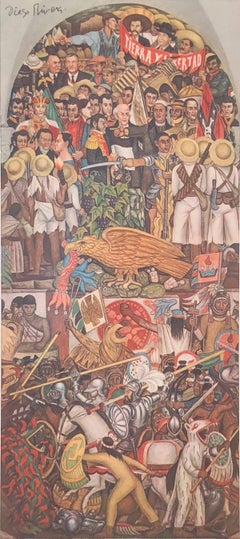
National Palace Mexico City, Persecution of the Indian, Revolution, Independence

National Palace Mexico City, Persecution of the Indian, Revolution, Independence

By (after) Diego Rivera

Located in Missouri, MO

(after) Diego Rivera "National Palace Mexico City, Central Stairway" (Persecution of the Indian, Revolution, Independence) 1933 from the portfolio "Frescoes of Diego Rivera" Published by the Museum of Modern Art, NY Hand-Signed by the Artist Diego Rivera was born on December 13, 1886 in the mountain town of Guanajuato in Mexico. His mother was an ardent Catholic and his father was a rich and aristocratic revolutionary fighter and an atheist. Little Diego decided in favor of atheism. He swore his family had to leave Guanajuato when he was six because of his diatribes against the Church. When he was eleven he attended the San Carlos Academy of Fine Arts; his real teacher was Jose Posada...

Category

1930s Realist Figurative Prints

Materials

Lithograph

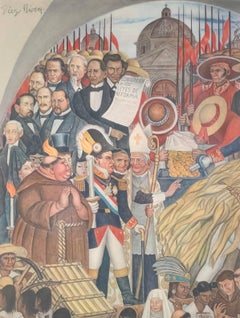
National Palace, Mexico City (Juarez and the Reform Laws)

National Palace, Mexico City (Juarez and the Reform Laws)

By (after) Diego Rivera

Located in Missouri, MO

(after) Diego Rivera "National Palace, Mexico City (Juarez and the Reform Laws) 1933 from the portfolio "Frescoes of Diego Rivera" Published by the Museum of Modern Art, NY Hand-Signed by the Artist Diego Rivera was born on December 13, 1886 in the mountain town of Guanajuato in Mexico. His mother was an ardent Catholic and his father was a rich and aristocratic revolutionary fighter and an atheist. Little Diego decided in favor of atheism. He swore his family had to leave Guanajuato when he was six because of his diatribes against the Church. When he was eleven he attended the San Carlos Academy of Fine Arts; his real teacher was Jose Posada...

Category

1930s Modern Figurative Prints

Materials

Lithograph

Mercado de Flores

Mercado de Flores

By Diego Rivera

Located in Missouri, MO

MERCADO DE FLORES Diego Maria Rivera 1886-1957 1930 Lithograph Site: 10 3/4 x 15 1/2 in. (27.3 x 39.4 cm) Framed: 22.5 x 26.5 inches Signed and Dated Lower Left Ed. 100/100 A mark...

Category

1930s Modern Figurative Prints

Materials

Lithograph

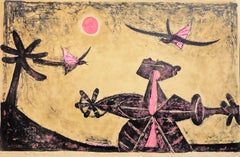
Observador de Pajaros

Observador de Pajaros

By Rufino Tamayo

Located in Missouri, MO

"Observador de Pajaros" 1950 By. Rufino Tamayo (Mexican, 1899-1991) Edition 83/200 Lower Right Signed Lower Left Unframed: 15.5" x 22.5" Framed: 21.75" x 28.25" Rufino Tamayo (August 26, 1899- June 24, 1991) A native of Oaxaca in Southern Mexico, Rufino Tamayo's father was a shoemaker, and his mother a seamstress. Some accounts state that he was descended from Zapotec Indians, but he was actually 'mestizo' - of mixed indigenous/European ancestry. (Santa Barbara Museum of Art). He began painting at age 11. Orphaned at the age of 12, Tamayo moved to Mexico City, where he was raised by his maternal aunt who owned a wholesale fruit business. In 1917, he entered the San Carlos Academy of Fine Arts, but left soon after to pursue independent study. Four years later, Tamayo was appointed the head designer of the department of ethnographic drawings at the National Museum of Archaeology in Mexico City. There he was surrounded by pre-Colombian objects, an aesthetic inspiration that would play a pivotal role in his life. In his own work, Tamayo integrated the forms and tones of pre-Columbian ceramics into his early still lives and portraits of Mexican men and women. In the early 1920s he also taught art classes in Mexico City's public schools. Despite his involvement in Mexican history, he did not subscribe to the idea of art as nationalistic propaganda. Modern Mexican art at that time was dominated by 'The Three Great Ones' : Diego Rivera, Jose Clemente Orozco, and David Alfaro Siqueros, but Tamayo began to be noted as someone 'new' and different' for his blending of the aesthetics of post Revolutionary Mexico with the vanguard artists of Europe and the United States. After the Mexican Revolution, he focused on creating his own identity in his work, expressing what he thought was the traditional Mexico, and refusing to follow the political trends of his contemporary artists. This caused some to see him as a 'traitor' to the political cause, and he felt it difficult to freely express himself in his art. As a result, he decided to leave Mexico in 1926 and move to New York, along with his friend, the composer Carlos Chavez. The first exhibition of Tamayo's work in the United States was held at the Weyhe Gallery, New York, in that same year. The show was successful, and Tamayo was praised for his 'authentic' status as a Mexican of 'indigenous heritage', and for his internationally appealing Modernist aesthetic. (Santa Barbara Museum of Art). Throughout the late thirties and early forties New York's Valentine Gallery gave him shows. For nine years, beginning in 1938, he taught at the Dalton School in New York. In 1929, some health problems led him to return to Mexico for treatment. While there he took a series of teaching jobs. During this period he became romantically involved with the artist Maria...

Category

20th Century Abstract Abstract Prints

Materials

Lithograph

You May Also Like

1920's Gelatin Silver Print by Tina Modotti of a Mural Fresco by Diego Rivera

1920's Gelatin Silver Print by Tina Modotti of a Mural Fresco by Diego Rivera

By Tina Modotti

Located in Chicago, IL

Original, vintage gelatin silver print by famed photographer Tina Modotti of a mural fresco by Diego Rivera. "Negative Side of the Church" from the fresco in the Preparatory School ...

Category

1920s Modern Black and White Photography

Materials

Silver Gelatin, Paper

Battle Dance Offset Print by Diego Rivera, 1995, Unframed, 28x22 in

Battle Dance Offset Print by Diego Rivera, 1995, Unframed, 28x22 in

By Diego Rivera

Located in Brooklyn, NY

The poster for Battle Dance by Diego Rivera captures the dynamic energy of his mural style, depicting powerful, muscular indigenous dancers in rhythmic movement that blends ritual an...

Category

1990s Prints and Multiples

Materials

Offset

"Industry and Agriculture", Allegorical Art Deco Fresco, 1934 Chicago Art Inst.

"Industry and Agriculture", Allegorical Art Deco Fresco, 1934 Chicago Art Inst.

Located in Philadelphia, PA

This superb example of WPA-period allegorical painting by Edwin Boyd Johnson is both classic and highly unusual. Unlike most WPA paintings and studies, which are oil on canvas or go...

Category

Vintage 1930s American Art Deco Paintings

Materials

Paint

1920s Gelatin Silver Print by Tina Modotti of Clemente Orozco Fresco

1920s Gelatin Silver Print by Tina Modotti of Clemente Orozco Fresco

By Tina Modotti

Located in Chicago, IL

An original 1920s gelatin silver print by famed photographer Tina Modotti, depicting a detail of an image of St. Francis in a mural fresco in a prep school in Mexico City by Clement...

Category

1920s Modern Black and White Photography

Materials

Silver Gelatin, Paper

2011 Diego Rivera Metropolitan Museum Show Poster

2011 Diego Rivera Metropolitan Museum Show Poster

Located in West Palm Beach, FL

A fabulous vintage Boho original show poster. From the 2011 show at the Metropolitan Museum in NYC. Newly framed in a clean white frame. Acquired ...

Category

21st Century and Contemporary American Bohemian Posters

Materials

Wood, Paper