Geoffrey Robinson
Geoffrey Robinson is an inventive image maker who, using still life as the main vehicle of expression, introduces imagination and a colourful verve into a well-trodden area of modern painting. "I yearn to be able to really tap into the present even though the language I tend to use belongs to the fifties and beyond," he explained. But that language DOES have a contemporary ring to it. The eclecticism of post modern culture is present in a distinctive stylistic composite, which has the look of originality as well as of retro familiarity. However much Robinson's art pays homage to the 1950s it reflects both the subsequent era of popular culture and design in which he grew up and the years he spent as a commercial artist, musician and composer before he was able finally to paint full time.
The fact that his full time painting career roughly aligned with the Millennium is perhaps no coincidence. And his advocacy of the enduring artistic pleasure principle in which colour and graphic playfulness holds the upper hand in a celebration of the simple sensual joys of life comes at a timely moment when so much cynicism and bogus avant-gardery, in short aesthetic despair and nihilism, erodes the integrity, meaning and value of art.
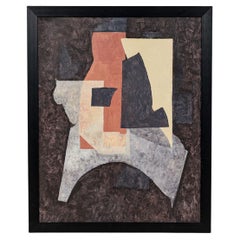
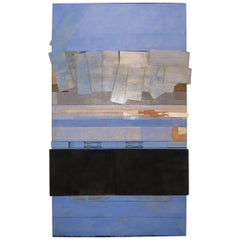
Robinson is unusual in moving from the abstract back towards decorative or mimetic imagery of an evocative or recognisable kind and says, "I am doing something akin to arranging found objects within a rectangle ... I never work my abstract composition back from a found collection of objects." The hard-edged reliefs that Robinson has made – ordered along intuitive rather than systematic or concrete lines – therefore provides an almost syntactic base. Like Helion and Leger in France or Nicholson and Caulfield in England Robinson then introduces imagery all the more sophisticated and cogent and stark within its abstract volume. Colour plays a primary visual role, single hues forming a situation where, as Vivienne Light described in 2002, "… areas of space between the objects are as important as the objects themselves. Both from a practical and ideological standpoint Robinson works directly within the rich legacy of modernism, adapting and transforming images seen, imagined or recycled with graphic precision, intelligence and feeling for style. Perhaps the designer's natural inventiveness allows him to 'get inside' the work of revered masters like Nicholson or Scott, but once there his highly individual sense of colour and ability, as he puts it "… to introduce convergences and little discoveries that are quite definitely me," take over. A Robinson is quite clearly and recognisably a Robinson and for those still not familiar with his work, his uncanny and almost idiosyncratic mix of styles – and within it of multifarious still life objects – will assuredly make its mark.