Salvador Aulestia
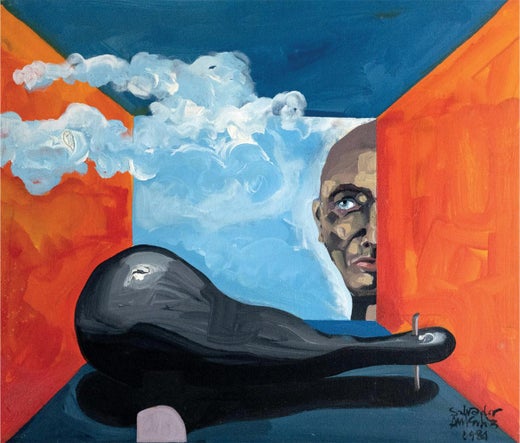
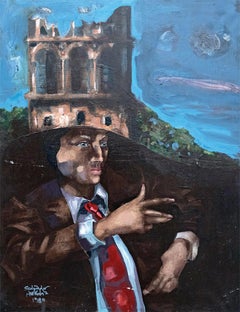
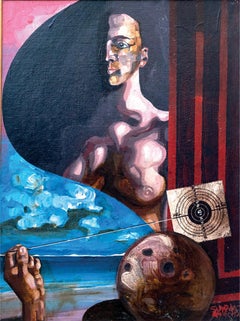
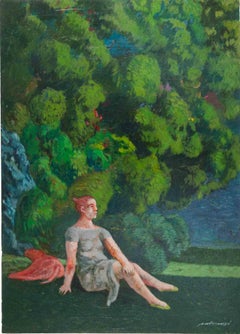
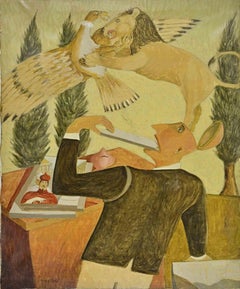
Salvador Aulestia (Barcelona, 1915 - Milan, 1994) belongs with Pablo Picasso, Juan Mirò, Salvador Dali, Antoni Tapies and a few others, to that small group of Spanish authors who have won a leading place in the history of twentieth-century art. His ever-evolving pictorial iter has taken him from classical figurative to pure abstract, figurative abstraction, fauvisme, postcubism, expressionism, and surrealist abstraction, before founding, in 1963, his own current: Apotism, publishing the Manifesto of Apotelesmatic Art. This is an artistic experience that goes beyond the aesthetic, historical and sociological concept of the work of art, as it tends to communicate to the viewer the world of mystery behind ordinary reality. Salvador Aulestia has applied Apotism not only in his work as a painter, draftsman and sculptor, but also in his work as an architect, musician and poet. Exhibitions. After his first exhibition, in 1936, in Barcelona, he held more than 70 solo shows around the world, including, in the 1950s, eight in the United States, between New York and Los Angeles. In Italy, he held, in 1980, a solo show, in Milan, at the Palazzo Reale. He participated in events with the leading artists of his generation. Biennials. Aulestia has been invited to major biennials around the world. Among them, the one in São Paulo ( Brazil), the Spanish-American ones in Barcelona, New York and Paris, as well, of course, as the one in Venice, where, he also represented Spain, in 1968, with a solo room. His works can be found in several museums, including the Museums of Contemporary Art in Barcelona, Madrid and Las Palmas, the Museums of Modern Art in Paris and Bern, the Kunstakademie in Düsseldorf and the Pinacoteca di Brera in Milan. The world's largest iron sculpture. Appreciated as a sculptor, Aulestia created, between 1963 and 1965, what is still the world's largest iron sculpture, "El Sideroploide," 65 meters long and 17 meters high, placed in the port of Barcelona. It should be noted that, unlike most artists, Aulestia did not limit himself to drawing, but forged, with the help of workers at the Port of Barcelona, the work himself. Not only a painter and sculptor, Salvador Aulestia, an architect, designed several public and private buildings in Barcelona and the rest of Catalonia. These include the Infanta Isabel building, a 400-apartment palace with 10 entrances, in which are as many of his two-meter-tall sculptures. He has created sets for the following plays: his friend Eugene Ionesco's Amadeus, de Capmany's Vent de Garbi, and Ibsen's The Idiot. He has published several books in Spain and Italy. Others include "Tauromaquia," the Teraphim and "The Magic of Football," Chiavari Prize in 1982. Appointed Universal Catalan by King Juan Carlos of Spain, Salvador Aulestia has lived in Milan since 1972 where we remember the great exhibition at Palazzo Reale.