Friedrich Wilhelm Ternite
Friedrich Ternite, painter Prussian Classicism Biedermeier portrait painting Portrait of Queen Luise 19th-century historical lithograph Prussian court painter Friedrich Wilhelm Ternite painter 19th-century Prussian portraitist Neoclassical German art Queen Louise of Prussia portrait Antique German lithograph 1800s Royal Prussian court painter
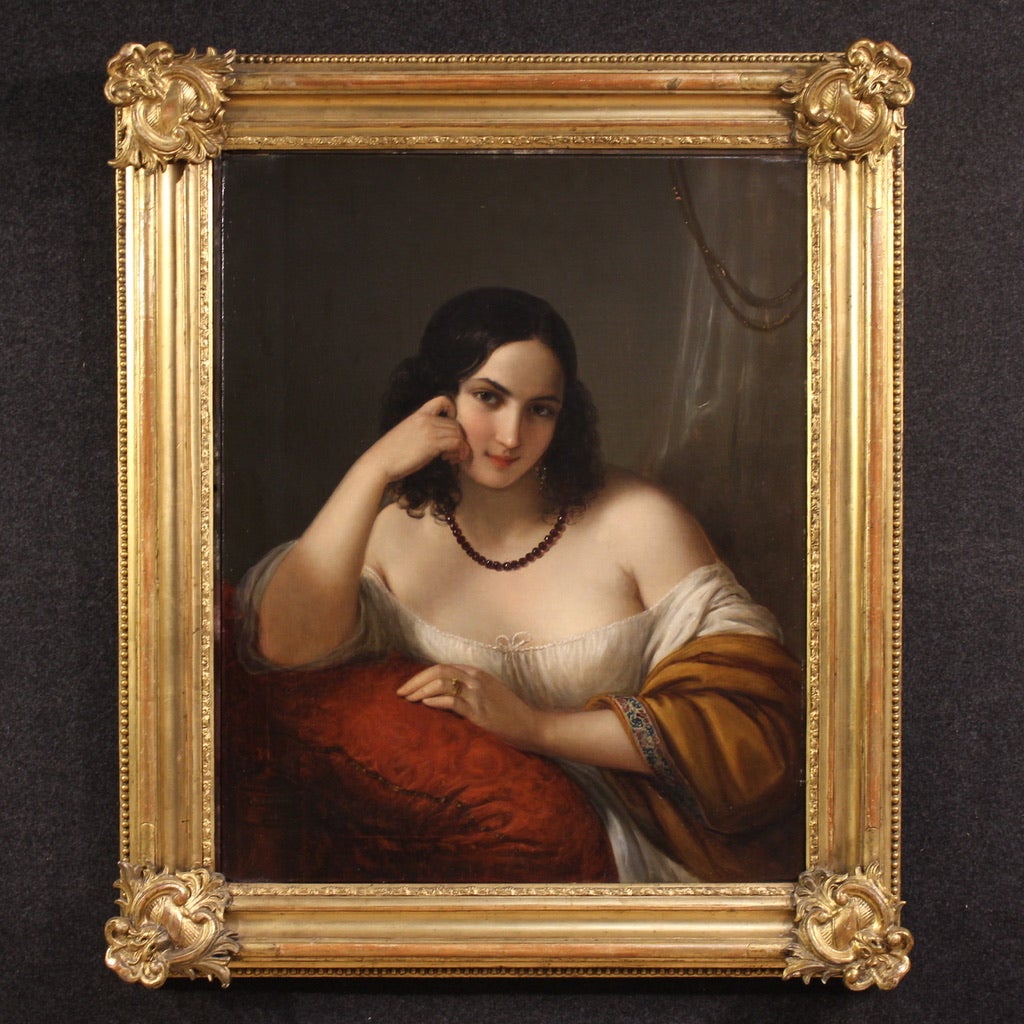
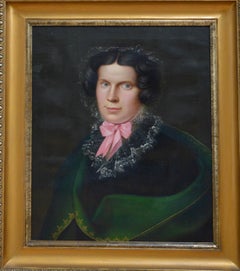
The picture is oil on canvas.
The picture is signed.
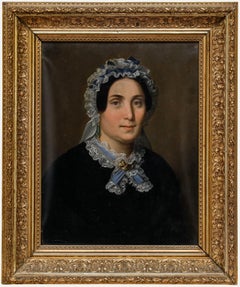
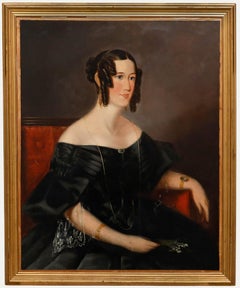
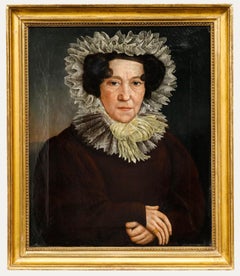
Friedrich Wilhelm Ternite (1786-1871), the portrait of Henriette Charlotte Plantier, 1821, oil on canvas
Friedrich Wilhelm Ternite (1786 Neustrelitz – 1871 Berlin) was a German portrait painter, lithographer, and curator of the royal art collections in Berlin. He is considered a significant representative of Prussian Classicism and Biedermeier-era painting.
Signed on the shoulder 'W. Ternite, Pinx 1821'. The back of the canvas with the identification of the portrayed: 'Henriette Charlotte Plantier, geb. Fick * 26 Juli 1791 + 28 Nov. 1842'.
56 x 46 cm. (22.0 x 18.1 in.), Frame: 84 x 76 cm. (33.0 x 29.9 in.)
Biographical Highlights & Training
Training: Studied at the Berlin Academy of the Arts under Carl Friedrich Fechhelm. Later, he pursued further training in Paris, within the circle of Jacques-Louis David and Jean-Baptiste Regnault.
Stay in Italy (1823–1826): Commissioned by the Prussian royal family, he documented the wall paintings of Pompeii and Herculaneum, as well as the Raphael tapestries in the Vatican. His preliminary drawings served as the basis for extensive series of engravings.
Museum Work: Upon his return, he assumed the position of inspector—or curator—of the painting gallery at the Royal Museum in Berlin (Altes Museum).
Artistic Oeuvre & Reception
Court Portraitist: Ternite produced numerous portraits of the Prussian royal family and the nobility, including well-known depictions of Queen Louise of Prussia and King Frederick William III.
Friedrich Wilhelm Ternite ""court painter""
Friedrich Wilhelm Ternite (1786-1871) was a German portrait and miniature painter, as well as a lithographer. He held significant positions in the Prussian royal court, serving as a court painter and later as an inspector of the Royal Art Gallery.
Here are some key details about his life and career:
Early Life and Education: Born in Neustrelitz, Ternite began his artistic training at the Royal Academy of Fine Arts in Berlin in 1803, studying under Friedrich Georg Weitsch.
Military Service: He served as a volunteer officer in the Napoleonic Wars. After the wars, he returned to his artistic pursuits.
""Royal Service and Commissions: In 1810, King Friedrich Wilhelm III of Prussia "" appointed him as a portrait painter. After the fall of Napoleon, Ternite was sent to Paris as a Prussian art commissioner to reclaim artworks plundered by the French and to acquire new pieces for the royal collection.
Time in Paris: He spent several years in Paris, where he continued his artistic development under the guidance of Baron Antoine-Jean Gros. During this time, he created drawings based on a painting attributed to Fra Angelico, which were later published.
Later Career: After returning to Berlin, Ternite was appointed "Master of the Royal Works of Art" (inspector of the Royal Collection) in Potsdam in 1826, a position he held until his retirement in 1864. He was awarded the Order of the Red Eagle in 1860.
Notable Works: Ternite is known for his portraits, including those of members of the royal family. A famous work is his pastel portrait of Queen Louise of Prussia in a riding habit, created around 1810. He also created copies of well-known paintings, such as a copy of Anton von Maron's portrait of Johann Joachim Winckelmann. He also produced a series of drawings of murals from Pompeii and Herculaneum, which were published as a book.
Standard Reference Works & Biographical Dictionaries
Robert Skwirblies: Ternite, (Friedrich) Wilhelm. In: Bénédicte Savoy, France Nerlich (eds.): *Pariser Lehrjahre. Ein Lexikon zur Ausbildung deutscher Maler in der französischen Hauptstadt* [Parisian Apprenticeships: A Biographical Dictionary of German Painters Trained in the French Capital]. Vol. 1: 1793–1843, De Gruyter, Berlin/Boston 2013, pp. 281–285. (A well-researched, modern analysis of his period of study in Paris and his professional network).
Hermann Arthur Lier: Ternite, Wilhelm. In: *Allgemeine Deutsche Biographie* (ADB). Vol. 37, Duncker & Humblot, Leipzig 1894, pp. 574–576. (A standard historical biography, focusing on his work at the Berlin court and the Berlin Gemäldegalerie).
Atanazy Raczyński: *Geschichte der neueren deutschen Kunst* [History of Modern German Art]. Vol. 3, Berlin 1841, pp. 134–135. (A contemporary source regarding the reception of Ternite during the Biedermeier period).
3. Specialized Literature on Specific Aspects & Collections
Friedrich Furchheim: *Bibliografia di Pompei*. 2nd edition, Naples 1891, p. 91. (Documentation of his archaeological recording work in Southern Italy).
Uta Motschmann: *Handbuch der Berliner Vereine und Gesellschaften 1786–1815* [Handbook of Berlin Associations and Societies 1786–1815]. De Gruyter, Berlin 2015, p. 395. (Evidence of his involvement in Berlin’s cultural and associational life, including the *Berlinischer Künstler-Verein* [Berlin Artists’ Association]).
Prussian Palaces and Gardens Foundation Berlin-Brandenburg (SPSG): Collection catalogues covering 19th-century portraits and the holdings at Charlottenburg Palace and the palaces in Potsdam.