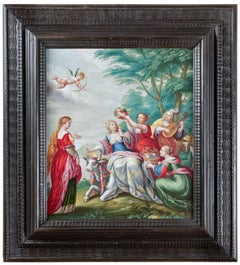
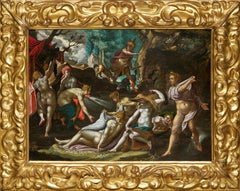
Artist: (after) Peter Paul Rubens (Flemish, 1577-1640)
Manufacturer: Königliche Porzellan-Manufaktur (KPM), (Founded 1763, Berlin, Germany)
Title: "The Rape of the Daughters of Leucippus"
Circa: 1880
Medium: Original Painting on Rectangular Porcelain Plaque
Framing: Framed in a gold Louis XV style frame
Framed size: 23.25" x 20.38"
Plaque size: 15.13" x 12.25"
Condition: Some faint surface abrasions and light surface marks at its edges. Moderate wear to frame with some repairs. The finely executed painted plaque is otherwise in very good condition
Notes:
Provenance: private collection - Ponte Vedra, FL; acquired from a private collection - New York, NY about 1990. Impressed Sceptre mark, "K.P.M." monogram, and the letter "H" upper left on verso. "15-12" incised upper center on verso. Various dealer and or collector's reference numbers crayon inscribed upper left and lower right on verso.
"The Rape of the Daughters of Leucippus", c. 1618 is an 88" x 82" oil painting on canvas by Peter Paul Rubens and Jan Wildens. It is displayed at the Alte Pinakothek in Munich. The painting was bought in Antwerp in 1716 by Johann Wilhelm, Elector Palatine. Initially sent to Mannheim, by 1805/06 it had reached Munich. The landscape specialist Jan Wildens painted the landscape.
The painting depicts the mortal Castor and the immortal Pollux abducting Phoebe and Hilaeira, daughters of Leucippus of Messenia. Castor the horse-tamer is recognizable from his armor, whilst Pollux the boxer is shown with a bare and free upper body. They are also distinguished by their horses - Castor's is well-behaved and supported by a putto, whereas Pollux's is rearing. The putto's black wing shows the twins' ultimate fate. In the painting, Phoebe and Hilaeira do not have distinguishing attributes. From the literature on Greek myths, however, we learn that Phoebe bore a son, Mnesleos, to Pollux, and Hilaeira bore a son, Anogon, to Castor. It would seem therefore, from the directions of the twins' fixed stares, that the daughter in the lower position, with her back to us, is Phoebe, and the daughter in the upper position, displaying a frontal view, is Hilaeira.
Biography:
Sir Peter Paul Rubens (Dutch: 28 June 1577 - 30 May 1640) was a Flemish artist and diplomat. He is considered the most influential artist of the Flemish Baroque tradition. Rubens' highly charged compositions reference erudite aspects of classical and Christian history. His unique and immensely popular Baroque style emphasized movement, color, and sensuality, which followed the immediate, dramatic artistic style promoted in the Counter-Reformation. Rubens was a painter producing altarpieces, portraits, landscapes, and history paintings of mythological and allegorical subjects. He was also a prolific designer of cartoons for the Flemish tapestry workshops and of frontispieces for the publishers in Antwerp.
The Konigliche Porzellan-Manufaktur, or KPM, also known in English as the Royal Porcelain Manufactory Berlin, was one of Europe’s foremost producers of hard-paste porcelain in the late 18th and 19th Centuries, and still operates in the present day. KPM was founded in 1763 by Frederick the Great of Prussia, after two previous attempts to found a porcelain manufactory in Berlin had failed. After the second attempt had ended with the manager, Johann Ernst Gotzkowsky, unable to pay his staff, Frederick intervened directly to take over the factory himself. Even to this day all KPM porcelain bears the distinctive sceptre mark of Frederick I. Under the leadership of Frederick the Great, KPM began gradually to rival the renowned Meissen manufactory in the Electorate of Saxony in both the output and the quality of its fine porcelain wares. KPM even began to employ several important artisans from Meissen to work in their porcelain painting and modelling department. As KPM grew in stature, it produced a number of important works for the Prussian nobility and royalty. Frederick the Great described himself as his own ‘best customer’, buying vast quantities of dinner services, tableware and vases from the factory. In addition, all of Frederick’s diplomatic gifts were produced in the manufactory. Consequently, KPM porcelain was soon found in the palaces of European royalty all over the continent. These pieces were largely produced in the flamboyant Rococo style, owing to Frederick’s tastes. In the 19th Century, the Rococo style gradually gave way to the newer Neoclassical style, which could be seen in the new dinner services and tableware which were being produced in KPM’s factory. Aside from tableware, KPM was renowned for its beautiful porcelain vases, sculptures, and plaques, including designs by famous Prussian artists of the time, such as Karl Friedrich Schinkel and Johann Gottfried Schadow. By the end of the 19th Century, chemists at KPM were experimenting with new techniques and glazes which could produce new colors. This coincided with the Art Nouveau period in Europe, known in Germany as Jugendstil. KPM produced many important and beautiful Art Nouveau style pieces at the turn of the 20th Century. KPM in the 20th Century was largely at the mercy of Germany's turbulent history, through two World Wars, and its postwar partition and occupation. Nevertheless, it still produced some exquisite items influenced by the Bauhaus style of art and architecture. Today KPM remains an important manufacturer of luxury porcelain, and its pieces are highly sought after by collectors, museum curators and designers alike.