Want more images or videos?
Request additional images or videos from the seller.

Unknown
Late 17th-Century Hessian School, Crucifixion With Donors, Lutheran Painting

1696

$8,855.69
£6,500
€7,944.88
CA$12,501.14
A$12,888.50
CHF 7,260.11
MX$164,924.34
NOK 83,773.96
SEK 87,622.65
DKK 59,408.41

About the Item

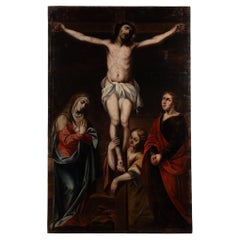
This late 17th-century German oil painting depicts the Crucifixion of Christ with kneeling donors, conceived as a complete memorial ensemble within its original inscribed frame. At the centre, Christ hangs upon the cross beneath a sky of roiling dark clouds, his pale body illuminated against an opening of golden light. Blood falls in deliberate crimson drops from his hands, feet, and side, descending through the composition. Below, a man and woman kneel in prayer at the foot of the cross, their hands clasped, their expressions solemn and steadfast. Behind them rises an idealised walled city, its towers and domes rendered not as distant Jerusalem in any archaeological sense, but as a sacred city translated into the visual language of late 17th-century Germany. The picture possesses an austere directness. Nothing here is ornamental for its own sake. The man, dressed in black with a white neckcloth, carries the gravity of office and literacy; while the woman, clothed in luminous white, kneels beside him in equal devotion. Their scale is small in relation to the cross, yet spiritually they are at its heart, receiving in paint what the inscription declares in words: the redeeming blood of Christ made efficacious for the faithful. One of the work’s greatest strengths lies in the integration of text and image. The inscription beside Christ states that the blood of the Lord Jesus Christ, the Son of God, makes us clean from all sins. It is Lutheran piety in its most characteristic form: scripture made visible, belief made immediate. The frame continues this union of word and image, surrounding the canvas with painted memorial inscriptions in gilt script on a black ground. In candlelight, these letters would once have shimmered around the scene, so that the whole object functioned not simply as a devotional utterance. To find such a piece with its original inscribed frame is exceedingly rare. Research into the inscription identifies the male donor as Herr Georg Stumpff, described as a 'Gewesener Forstschreiber', or 'forest administrator', serving within a princely forest jurisdiction. This suggests a man of responsibility and standing. The inscription records his death in 1696 at the age of 46, while also referring to his wife, who had died earlier, on 8 January 1681. The painting belongs to the world of late 17th-century Lutheran Germany, probably within the Hessian or central German sphere. Its sober appearance, Gothic script, and original black-and-gold frame all place it firmly within the tradition of church memorial paintings and devotional commissions. Such works were often produced by local 'Kirchenmaler', painters whose role extended beyond easel pictures to the furnishing of churches through epitaphs, inscription boards, and decorative liturgical objects. What gives this example particular force is its completeness. The original frame is an essential part of the object’s meaning. Its black-painted surface creates a mourning ground, while the gilded inscriptions transform the border into a sermon in itself. The date Ao 1696 anchors the painting to a precise historical moment, and the survival of both painting and frame together preserves the work as it was meant to be encountered. Seen today, it remains a striking testament to a deeply human strain of Protestant devotion. Unsigned. Held in its original late 17th-century black-painted architectural frame with gilt inscriptions along the frieze and mouldings, the whole forming an integral devotional ensemble dated 1696. Medium: Oil on canvas Overall size: 33” x 42½” / 84cm x 108cm Year of creation: c. 1696 Labels & Inscriptions: Inscribed extensively. Provenance: Private collection, Germany / Private Collection, Italy. Our reference: BRV2219
  • Creation Year:
    1696
  • Dimensions:
    Height: 42.5 in (107.95 cm)Width: 33 in (83.82 cm)
  • Medium:
  • Period:
    1690-1699
  • Condition:
    Cleaned. Revarnished. Faint stretcher marks. Later stretcher. Craquelure throughout. The paint layer is stable. Frame with various marks and showing its age.
  • Gallery Location:
    Cheltenham, GB
  • Reference Number:
    1stDibs: LU2328217838252

More From This Seller

View All
Early 19th-Century Central European School, Christ The Saviour, Oil Painting

Early 19th-Century Central European School, Christ The Saviour, Oil Painting

Located in Cheltenham, GB

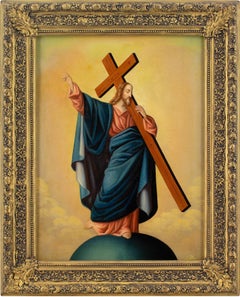
US buyers pay no import tariffs on this item. This early 19th-century central European oil painting depicts Christ The Saviour standing atop an orb and carrying a cross over his left shoulder. An unusual composition, Christ’s rather striking posture is perhaps more ‘Saturday Night Fever’ than it is sacramental. However, the iconography is archaic and derived ultimately from New Testament illustrations dating to the Middle Ages. Depictions of orbs are usually symbolic of the universe, while the cross alludes to redemption. Hence, it’s a visual representation of Christ as the Saviour of humanity. Francisco de Zurbarán...

Category

1830s Portrait Paintings

Materials

Canvas, Oil

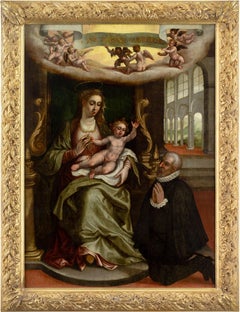
Virgin & Child With Kneeling Donor, 16th-Century Antique Oil Painting

Virgin & Child With Kneeling Donor, 16th-Century Antique Oil Painting

Located in Cheltenham, GB

This extraordinary late 16th-century panel by an artist working in the circle of Spanish painter Miguel Barroso (1538-1590) depicts the Virgin Mary seated upon a raised throne. She g...

Category

16th Century Old Masters Figurative Paintings

Materials

Oil, Panel

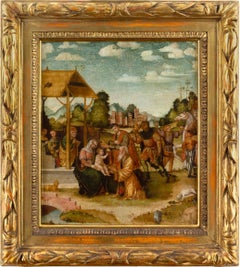
Mid-16th-Century Romagnola School The Adoration Of The Magi, Nativity

Mid-16th-Century Romagnola School The Adoration Of The Magi, Nativity

Located in Cheltenham, GB

This exquisite early 16th-century Italian panel captures one of Christianity’s most cherished moments - the Adoration of the Magi. Painted around 1530, this panel belongs to a moment...

Category

16th Century Renaissance Figurative Paintings

Materials

Oil, Panel

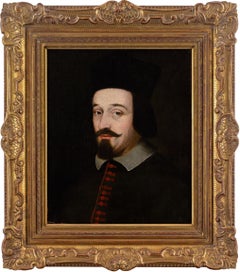
Mid-17th-Century Spanish School Oil Painting, Portrait Of A Theologian

Mid-17th-Century Spanish School Oil Painting, Portrait Of A Theologian

Located in Cheltenham, GB

This mid-17th-century Spanish oil on canvas depicts a dignified man of learning - a theologian, or perhaps a cathedral canon. Dressed in a black cassock, marked by a vertical row of...

Category

Mid-17th Century Baroque Portrait Paintings

Materials

Canvas, Oil

You May Also Like

Crucifixion, Bruges school, Flemish, mid 16th century

Crucifixion, Bruges school, Flemish, mid 16th century

Located in PARIS, FR

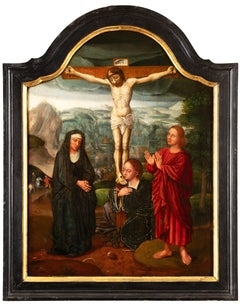
Crucifixion, cercle of Adriaen Isenbrandt, mid 16th century School of Bruges, cercle of Adriaen Isenbrandt (actif 1510-1551) Oil on oak panel with its original ebonized frame Dimensi...

Category

16th Century Old Masters Figurative Paintings

Materials

Oak, Oil, Wood Panel

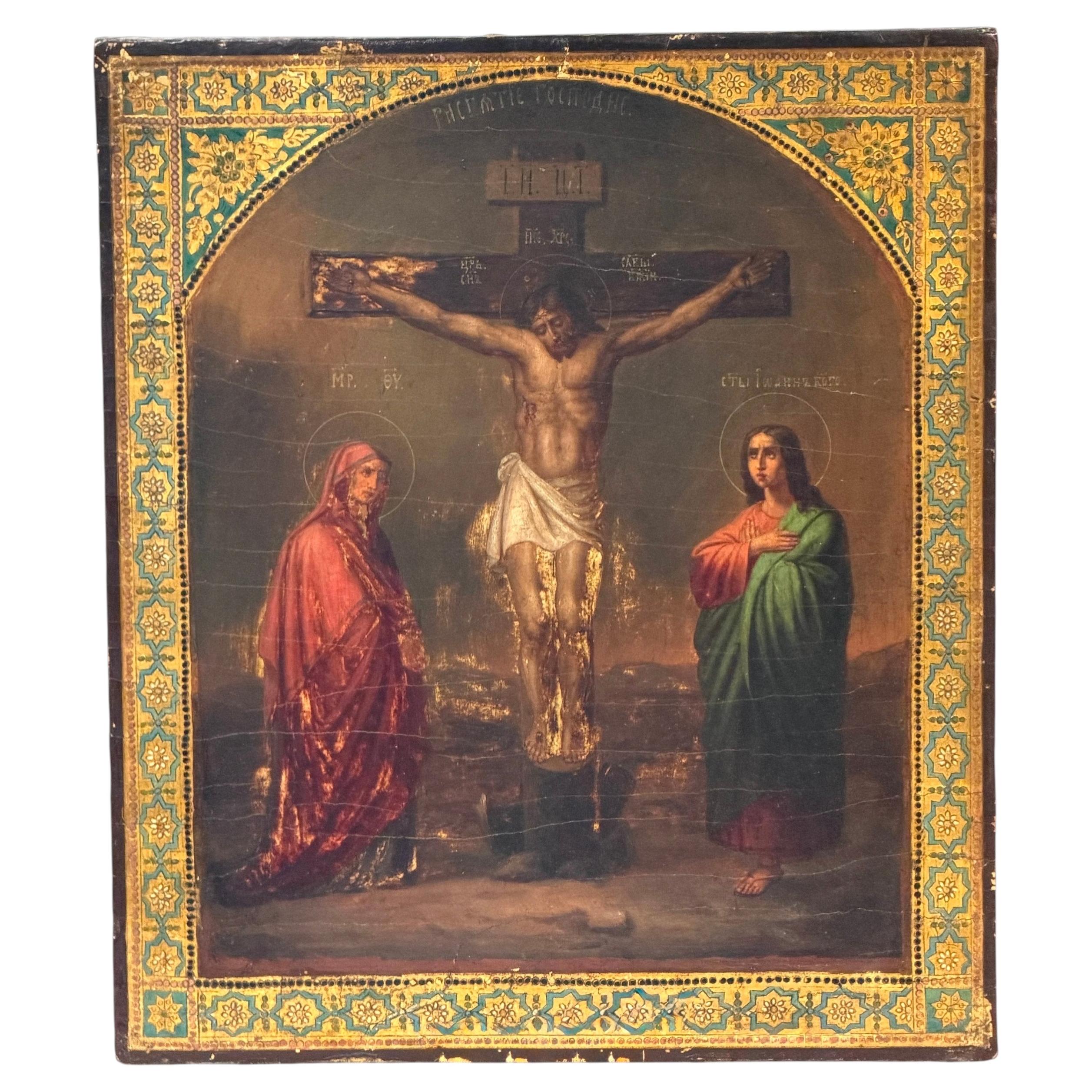
Religious 19th Century Oil Painting on Board Icon Titled "The Crucifixion"

Religious 19th Century Oil Painting on Board Icon Titled "The Crucifixion"

Located in Los Angeles, CA

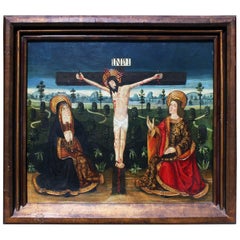
A Rare Hispano-Portuguese 19th century oil on board depiction of "The Crucifixion". The baroque icon style painting depicting the Crucifixion of Jesus Christ outside the city walls of Jerusalem, north of Mount Zion...

Category

Antique 19th Century Spanish Baroque Revival Paintings

Materials

Wood

Crucifixion, Antwerp, Flemish 16th century, oil on panel

Crucifixion, Antwerp, Flemish 16th century, oil on panel

Located in PARIS, FR

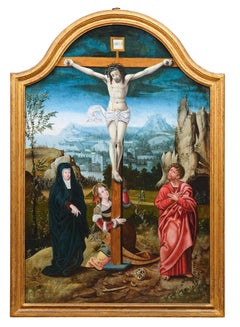
Crucifixion, studio of the Master of the Half-Figures (Antwerp, active 1500-1550), not signed Antwerp School, mid-16th century Oil on oak panel , h. 88 cm, w. 59 cm Original frame, framed: h. 98 cm, w. 68 cm A rare example of Antwerp painting from the first half of the 16th century, our Crucifixion captivates as much by the quality of its expansive river landscape as by the delicacy of its figures and the brilliance of its palette. The richness of the colors, the balance between devotion and narrative, and the subtlety of the atmospheric effects make it a particularly representative work of the artistic refinement developed in the workshop of the Master of the Half-Figures. Through its remarkable synthesis of the world-landscape inherited from Patinir and the expressive gentleness characteristic of the Master of the Half-Figures, this composition stands out as a particularly accomplished example of the Antwerp Flemish Renaissance. Our painting of the Crucifixion is organized around the central figure of Christ nailed to a high cross erected atop Golgotha. His slender, pale body stands out against a blue-green sky that lightens towards the horizon, creating an atmospheric depth characteristic of Flemish painting of this period. The bowed head, encircled by the crown of thorns, expresses agony in a restrained pose. The white loincloth, tied at the front according to a recurring motif in the work of the Master of the Half-Figures, has one end drawn between the legs before billowing outwards in a movement lifted by the wind, subtly animating Christ's silhouette. At the foot of the cross, a skull and a few bones evoke Adam and the redemption of humanity through Christ's sacrifice. To the left stands the Virgin Mary, enveloped in a flowing blue-green mantle whose heavy folds accentuate her contemplative posture. Her pale face, framed by a white veil, expresses silent sorrow. Kneeling at the center of the composition, Mary Magdalene embraces the cross in a gesture of fervent devotion, while to the right, Saint John, clad in a richly textured red cloak, gazes up at Christ, his hands folded across his chest. Contrary to the iconography typically found in 16th-century Antwerp workshops, he appears here as a bearded, middle-aged man. This relatively rare characteristic, however, is found in several works by the Master of the Half-Figures. The Virgin's face displays the typical characteristics of the Master of Half-Figures' repertoire : a high forehead, full cheeks, a rounded chin, and a gentle expression tinged with restrained melancholy. This youthful, feminine physiognomy is found in numerous depictions of Virgins, Magdalenes, and other saints from his workshop. The figures are also distinguished by their smooth complexions, elegant proportions, and attention to the richness of the fabrics, favoring formal refinement over dramatic expressiveness. The background unfolds according to the world-landscape formula inherited from Joachim Patinir. A vast panorama, blending a fortified city, estuary, winding paths, rocky outcrops, and bluish hills, stretches behind the sacred figures. At the heart of this lively river landscape, a small port, quays, and several boats also appear, their silhouettes punctuating the waterway and testifying to the attention paid by Antwerp painters to the commercial and maritime activities that ensured the city's prosperity. The composition is structured by a succession of narrative planes that invite the viewer's eye to move through the image as a continuous story, a technique characteristic of Antwerp painting in the first half of the 16th century. Behind the main scene appears the episode of the Carrying of the Cross, depicted by a group of soldiers and horsemen, with Golgotha rising on the mountain to the left, while to the right, in a grotto carved into the rocks, unfolds the Entombment of Christ. This multifaceted narrative, integrated into the landscape, enriches the meditative dimension of the work while highlighting its kinship with the inventions of Patinir. The attribution to the workshop of the Master of the Half-Figures seems all the more plausible given that several art historians, notably Robert Koch and Walter Gibson...

Category

16th Century Old Masters Figurative Paintings
Materials

Wood Panel, Oil

17th Century by Scipione Compagno Crucifixion Oil On Canvas

17th Century by Scipione Compagno Crucifixion Oil On Canvas

Located in Milano, Lombardia

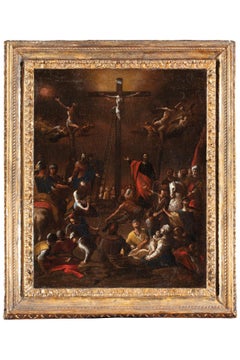
Scipione Compagno (active in Naples in XVII century) Title: Crucifixion Medium: Oil on canvas Dimensions: without frame 64 x 52.5 cm - with frame 80 x 67 cm Antique wooden cassetta frame carved, sculpted and gilded by Mecca technique Not signed Expertise by Nicola Spinosa, art historian Publications: Bozzetti, modelletti, sketches: dalla collezione di Giorgio Baratti...

Category

Late 17th Century Italian School Landscape Paintings

Materials

Canvas, Cotton Canvas, Oil

18th Century Oil on Canvas Painting of Crucifixion of Christ with Mother Mary

18th Century Oil on Canvas Painting of Crucifixion of Christ with Mother Mary

Located in Round Top, TX

Large original oil on canvas painting of the crucifixion of Christ hanging on the cross, with his Mother Mary and two other female figures. Unframed, just over 4.5' tall. Beautifully...

Category

Antique Early 18th Century Spanish Paintings

Materials

Canvas, Wood, Paint