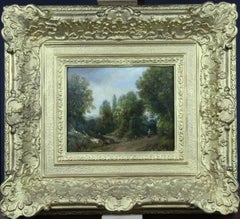
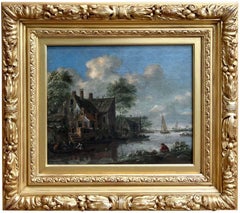
James Stark 1794-1859, was an English landscape painter, exhibited at the Royal Academy, the British Institution, and the Norwich School of Artists. Stark studied under John Crome, who influenced his work, and was considered his best pupil, his preoccupation with wooded landscape and trees is displayed here with a shooting party within the composition. This picture may have been painted prior to him moving to live in Windsor where this setting is depicted. The picture is unsigned.
I have included an alternative short biography of the painter.
James Stark (19 November 1794 – 24 March 1859) was an influential English landscape artist and a leading second-generation member of the Norwich School of painters. Celebrated for his tranquil, meticulously detailed oil paintings of the East Anglian countryside, Stark successfully bridged the gap between provincial artistry and the competitive London art market. James Stark was born in Norwich, Norfolk, as the youngest of eight siblings. His father, Michael Stark, was a Scottish-born dyer famous for inventing the chemical formula for "Norwich red" dye. Stark showed an innate artistic talent from childhood and attended the Norwich School. There, he befriended John Berney Crome, which led to a pivotal three-year apprenticeship under the boy's father—the legendary landscape master and founder of the Norwich Society of Artists, John Crome. Stark's career accelerated rapidly; he exhibited his first work at the Royal Academy in London at just 17 years old. By 1812, he was elected a full member of the Norwich Society of Artists. In 1814, Stark moved to London to expand his career, where he befriended painter William Collins and enrolled in the Royal Academy Schools in 1817. He began receiving lucrative commissions from high-profile patrons, but severe, chronic health issues (believed to be kidney and bladder stones) forced him to abandon London and return to Norwich in 1819. Despite his illness, Stark remained highly productive during his twenty-year return to Norfolk. He married Elizabeth Dinmore in 1821, with whom he had three children. In 1827, he began his major topographical project, Scenery of the Rivers of Norfolk, a series of 36 high-quality engravings completed in 1834. He served as Vice-President (1828) and subsequently President (1829) of the Norwich Society of Artists. Stark moved back to London in 1830. Following the tragic death of his wife in 1834, he relocated to Windsor in 1840, drawing fresh inspiration from the Thames Valley landscape. He returned to London for the final time in 1849 to oversee the artistic education of his son, Arthur James Stark, who also became a well-known painter. Stark worked predominantly in oils, though he was also a skilled watercolourist and etcher. His style was deeply influenced by John Crome and 17th-century Dutch masters like Meindert Hobbema. While he lacked the broad, robust power of Crome, Stark’s paintings are universally praised for their "gentle truth," quiet execution, and intimate depictions of rural life, such as haymaking and sheep washing. Stark died in Camden, London, in 1859 at the age of 64. His body was returned to his hometown, where he is buried in the Rosary Cemetery. Today, his masterpieces are preserved in major public collections, including the Tate, the Ashmolean Museum, and the Norwich Castle Museum.