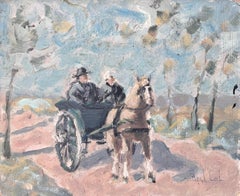
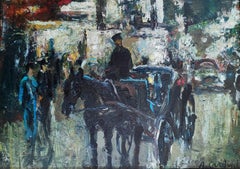
This elegant, impressionist and compositionally daring painting, attributed to the French School of the early 20th century, presents a carriage drawn by a horse, seen from an unusual and striking top-down perspective. Executed in oil on canvas with confident, modernist flair, the work reflects the shifting aesthetic values of the time—bridging late Impressionist sensibilities with the bold experimentation of early modernism.
The viewer is positioned directly above the scene, looking down on the horse and carriage as they travel along a city street or rural path. The aerial viewpoint is both innovative and disorienting, abstracting the familiar form of the horse and cart into rhythmic patterns of movement, shape, and shadow. The horse’s muscular back, the arch of the harness, and the geometric shapes of the carriage are rendered with a lively and expressive brushwork, suggesting motion and immediacy. The color palette is both earthy and refined, with soft greys, muted browns, and subtle blues giving the composition a harmonious atmosphere.
On the reverse of the canvas, a period exhibition label is affixed, indicating that this work was included in the 1926 Salon des Indépendants, held at the Grand Palais, Champs-Élysées, Paris. This particular edition of the Salon commemorated 30 years of independent art, a significant milestone for a movement that championed creative freedom and resistance to academic constraints. Participation in this historic event places the painting within the context of a vibrant and progressive artistic moment in interwar France.
The handling of paint is both fluid and confident, showing a clear awareness of avant-garde tendencies, perhaps influenced by Post-Impressionism, Fauvism, or early Cubist spatial experimentation. While the subject is traditional—a horse and carriage, long a symbol of European urban life—the treatment is thoroughly modern, prioritizing perspective, energy, and surface over detail.
This work stands as a compelling example of French modern painting in transition: rooted in the real world but increasingly concerned with perception, form, and movement. The documented exhibition history at the Grand Palais enhances its historical and cultural value, linking the work to a celebrated chapter in modern French art history.