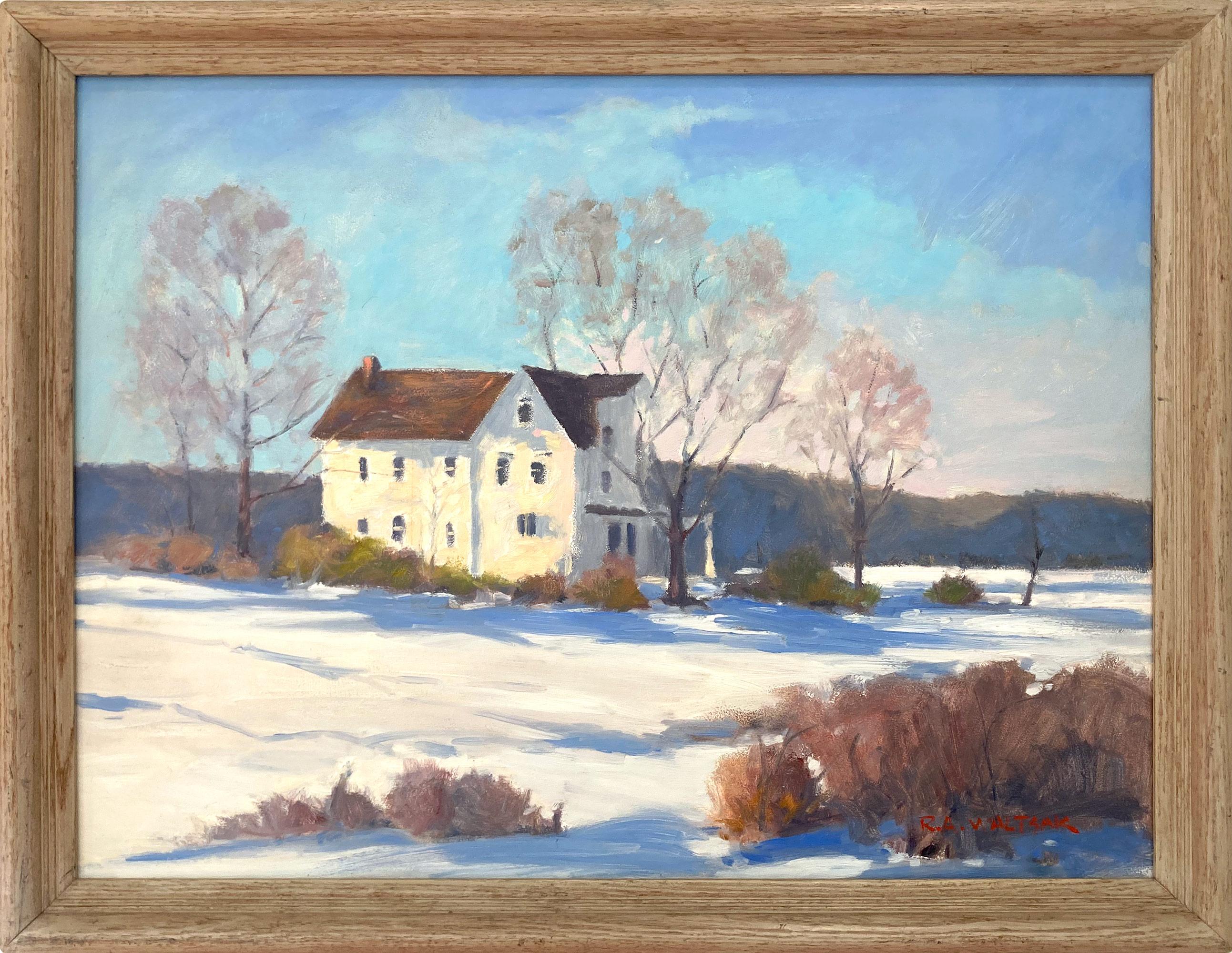
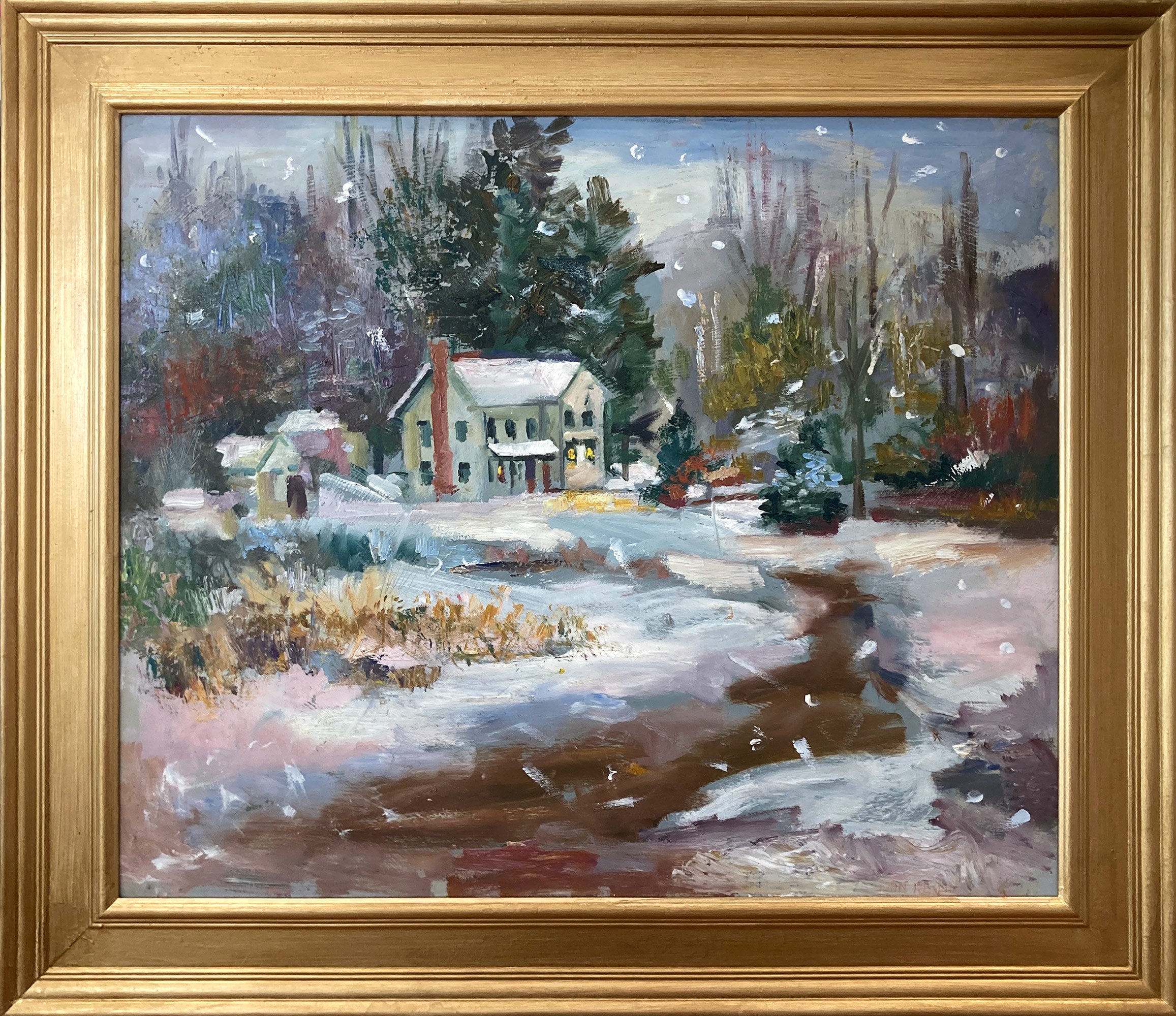
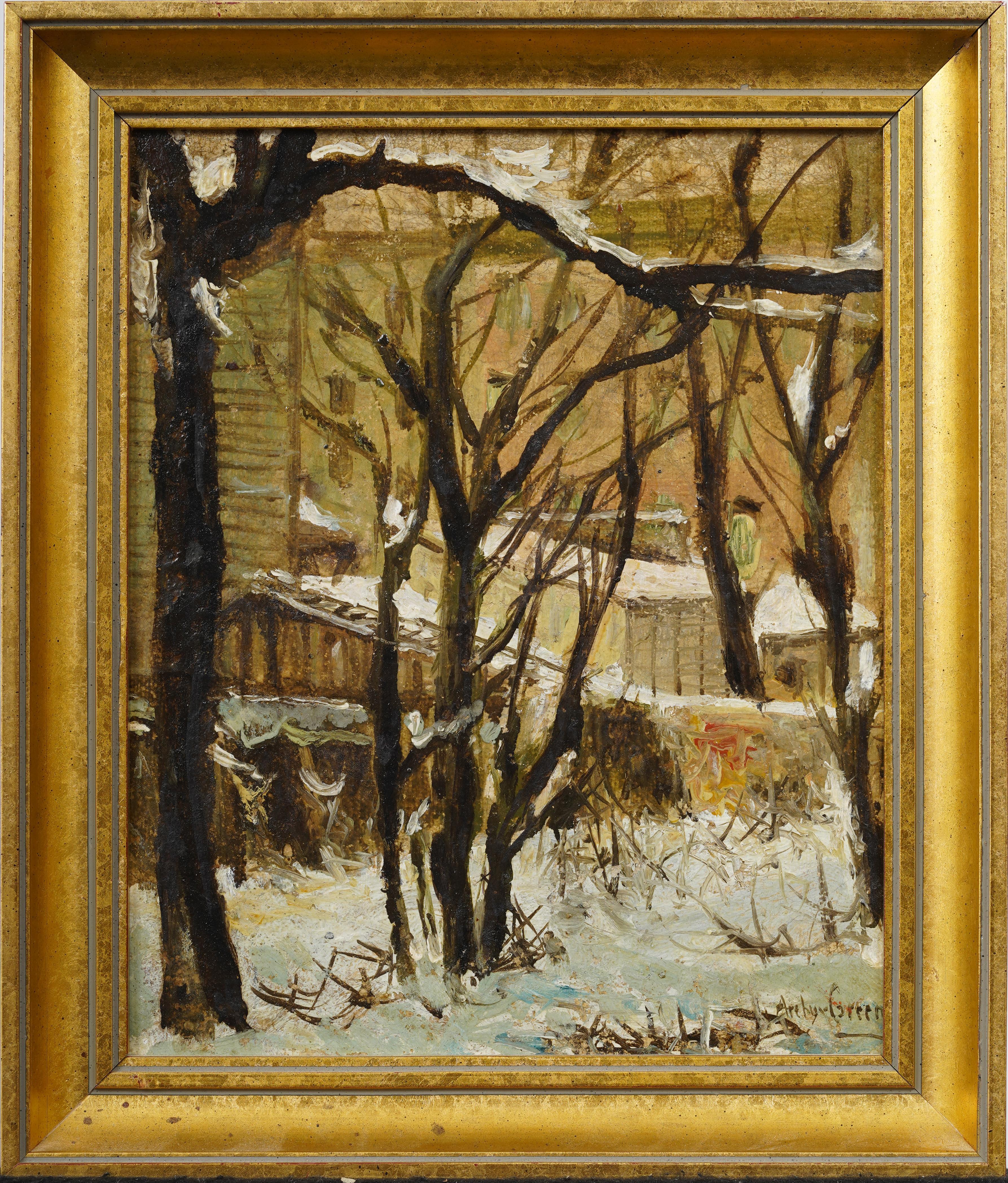
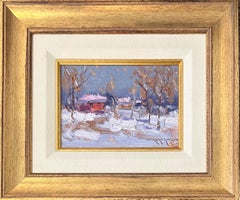
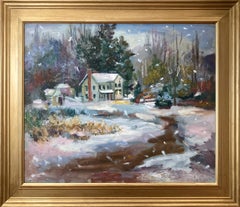
Idyllic depiction of a house by a stream in winter by Frederick A. Pawla (British, 1876-1964). Signed "F. Pawla" in the lower right corner. Presented in a wood frame with gilded edges. Artist info written on verso. Image size: 12"H x 16W; Frame size: 15.13"H x 19.13"W
Frederick Alexander Pawla was active/lived in England, Australia, New York, Florida, and California. He is known for marine painting, murals and camouflage.
Frederick A(lexander) Pawla was born in Wimbledon, England, in 1876 (another source claims Scotland), but left home at age 14 to become a sailor. Various sources make differing claims: Some say that he left home to join the US Navy, but a news article from 1952 states that he left London not for the US but for Sydney AU, where he worked on Australian government ships. He eventually turned to painting and studied there with Australian marine painter William Lister Lister. But “the wanderlust seized him and he came to the United States.” Others claim that he was a scout in the Boer War, that he participated in the first Chino-Japanese war (1894-95), and that he served in the US Merchant Marine.
In that 1952 news article, when he and his wife had recently moved to Santa Cruz CA, Pawla was said to have previously lived on the French Riviera, in Hawaii, Tahiti, and Australia, as well as in various regions of the US.
Pawla’s surname rhymes with Paula and is easily misspelled. Most likely that’s one of the reasons why his substantial contributions to World War I ship camouflage are rarely acknowledged. According to one source, Pawla was a “highly important” marine camoufleur for the US during World War I, but is now “largely forgotten.” There are US government documents in the NARA (National Archives and Records Administration), in which Pawla is listed as having originated the “dazzle” camouflage designs for various ships, but is insufficiently credited because he is mistakenly listed as Paula.
His wartime contributions to camouflage service are confirmed by a news article from 1922, when he and his wife had resettled from New York to Tampa FL. It is also stated that he had made a painting of the USS Leviathan, which “earned for the artist an official commendation of the highest kind.”
In 1921, US Assistant Secretary of War Benedict Crowell openly applauded Pawla’s camouflage efforts, in a published overview of the war. Crowell noted that dazzle-painting was officially adopted in 1917 as standard practice for American ship camouflage, made possible by a consensus among the US Navy, the Shipping Board, and the Embarkation Service of the AEF (American Expeditionary Forces, which at the time was the title for the US Army). It was Pawla who was placed in charge of ship camouflage for the AEF Embarkation Service.
This means that Pawla oversaw the camouflage of “many of the army transports, particularly cargo carriers,” and was, according to Crowell, “one of the most valuable men in the government for this sort of work.” Aryeh Wetherhorn has said that Pawla’s duties “involved the scheduling, coordination, and supervision of ships that carried the US Army Expeditionary Force to France. It also meant [that] he managed to schedule the painting of camouflage patterns on all types of ships that were involved. It was Lieutenant Pawla [who] arranged time at the various shipyards for painting camouflage while the vessels were waiting to embark troops or load cargo before joining a convoy to cross the Atlantic.”
It has also been confirmed that he not only supervised the painting of camouflage schemes on ships, but that he himself designed some of the patterns. As proof, a number of full-color diagrams for WWI ship camouflage schemes (hand-colored in gouache in some cases, or more often as lithographic prints) have been scanned and posted on US government websites. The artists who designed the schemes are sometimes noted in red pencil, and Pawla’s name is clearly written on several of those.
Memberships:
Royal Art Society (New So. Wales)
Santa Barbara Art Association
San Diego Artists Society
Exhibitions:
Santa Cruz Art League, 1929
Golden Gate International Exposition, 1939
Murals:
Burlingame (CA) High School
Rainbow Room, Rockefeller Center (NYC)
War Dept (Washington, DC)
Cloister Hotel (Sea Island, GA)
Surfside Hotel (Miami Beach)
Dept. of Public Markets (NYC)