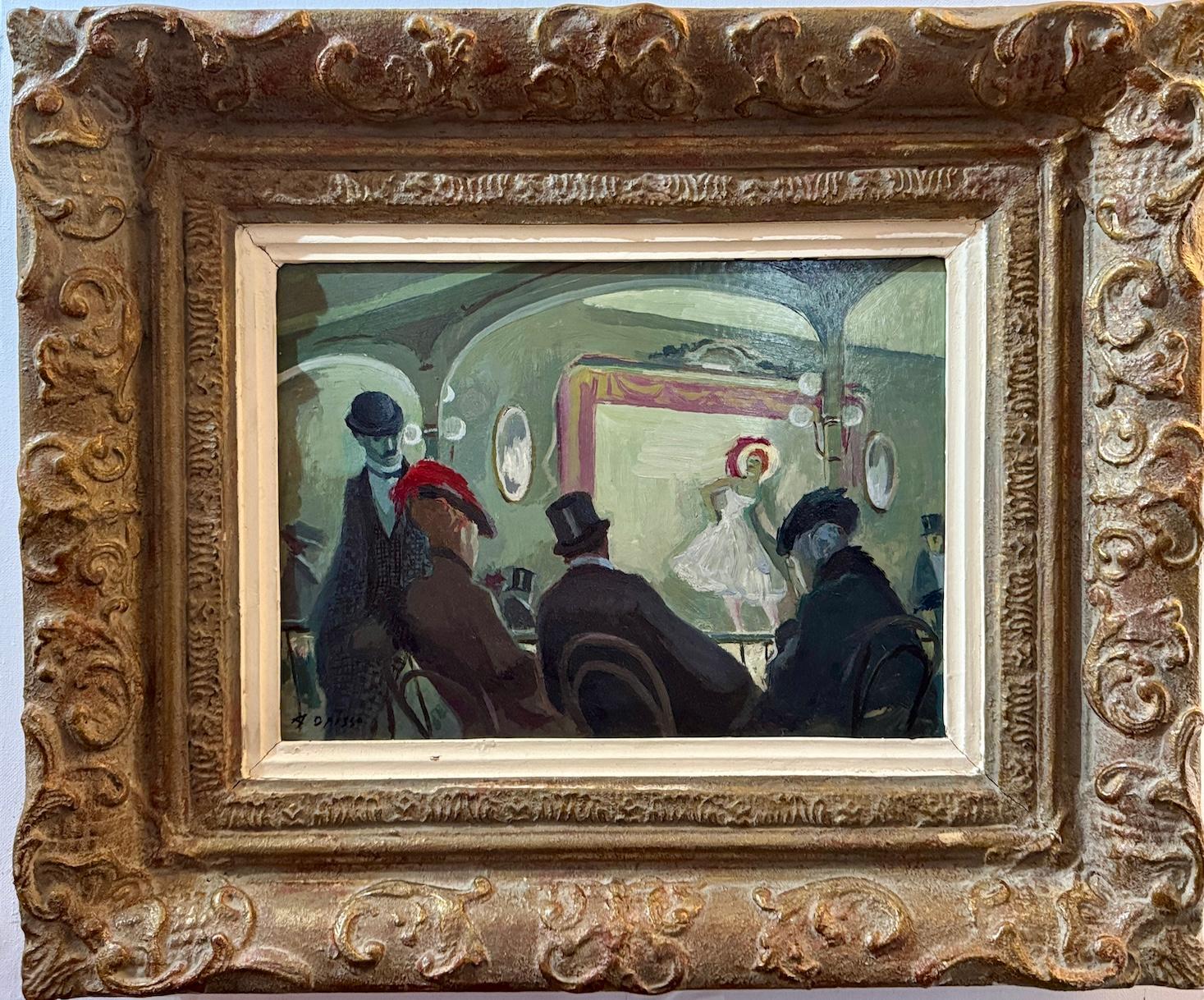
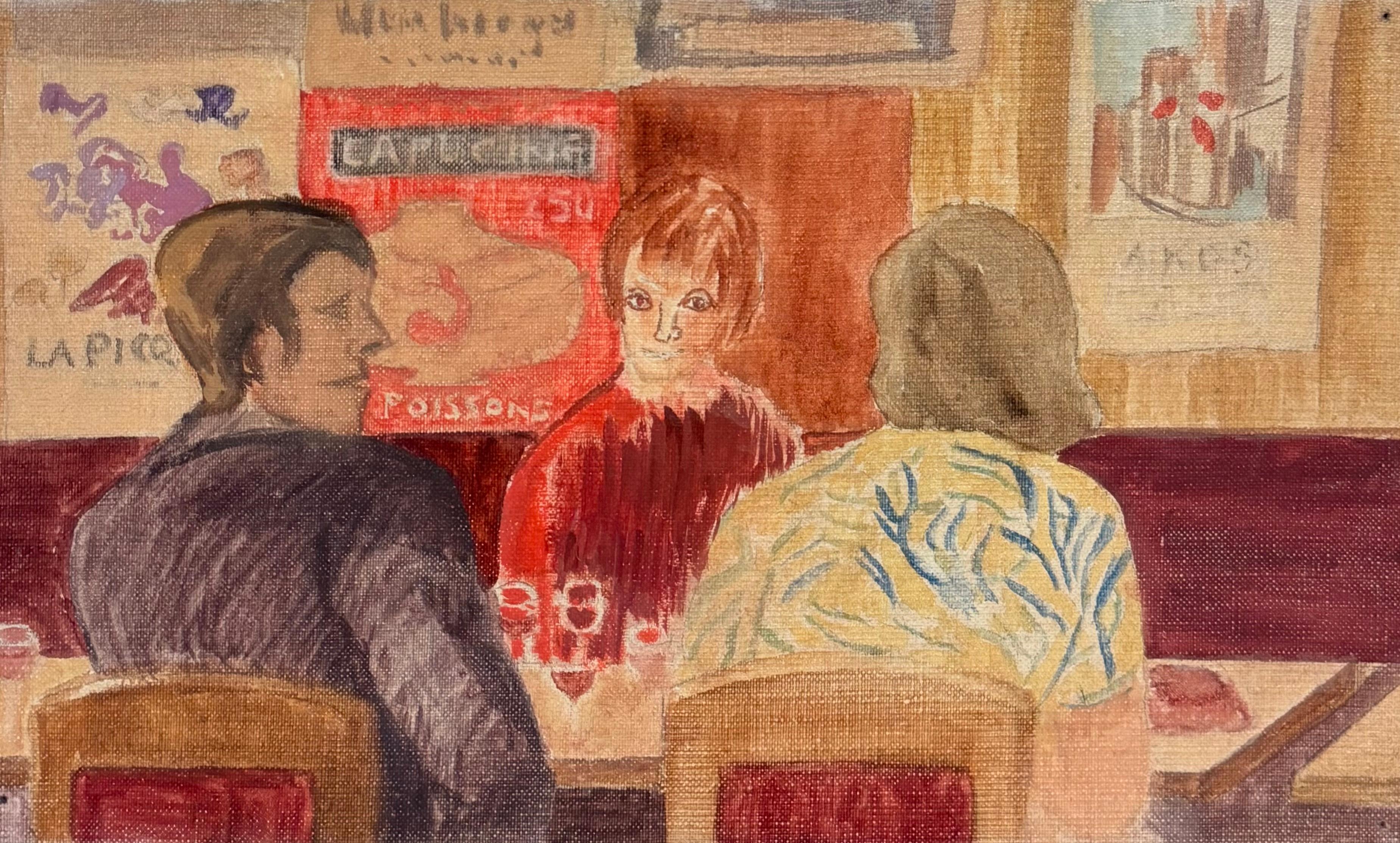
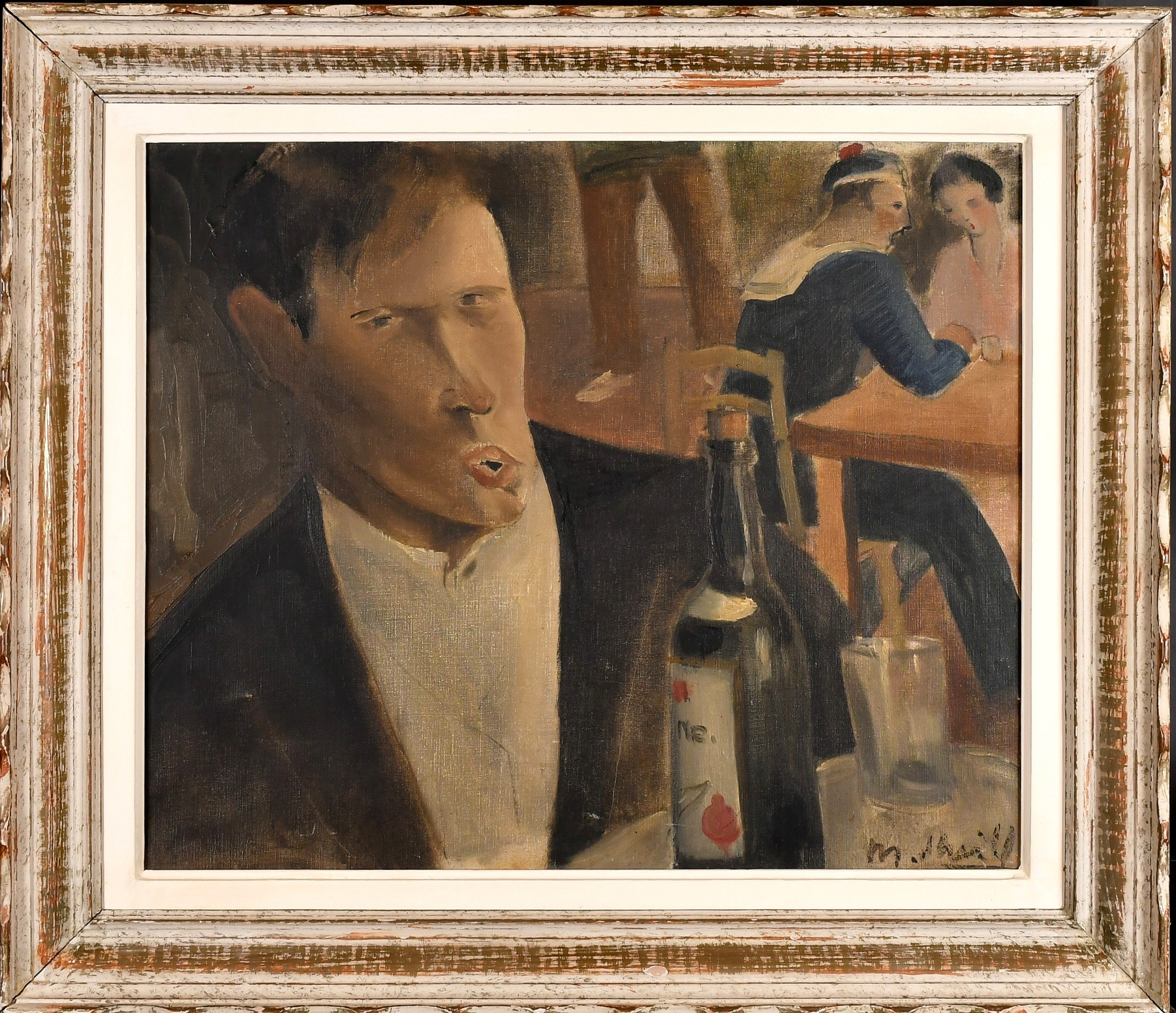
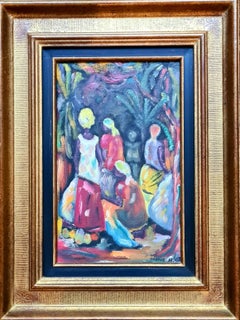
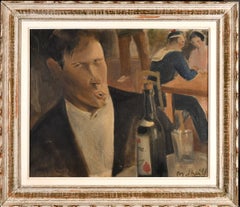
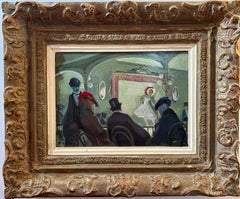
Early 20th Century oil on board interior bar scene by Simon Joseph Simon-Auguste. The painting is signed bottom right and presented in a fine gilt carved wood Montparnasse frame. There is the outline of another drawing to the back board.
This evocative painting captures a woman seated at a café, her profile turned away in contemplative thought. Rendered with an Impressionistic flair, the painting employs a muted palette of blues, browns, and soft reds, and various glazes evoking a sense of introspection. The brushstrokes are loose yet deliberate, adding a dynamic texture to the woman's form and the bustling background figures. Unique to this piece is the juxtaposition of the serene subject against the lively café setting, which is conveyed through blurred figures in the backdrop, suggesting movement and chatter. The woman's red dress stands out, drawing the viewer’s eye and indicating an inner warmth amidst the cool tones of her surroundings. This contrast between subject and setting explores themes of solitude and reflection within a social environment, making the artwork profoundly engaging and thematically rich.
Simon Joseph Simon-Auguste (20 April, 1909 – May, 1987) was a French artist, known for his intimate paintings, mainly portraits, nudes, and still lifes. His production is characterized by a calm, intimate feel and the effective use of glaze.[a]
In 1931, Simon-Auguste finished his studies at the École des Beaux-Arts and won the Stanislas-Torrents award. He was commissioned to execute the mural decorations of the town hall in Allauch. He began exhibiting in Marseille where doctors and lawyers purchased his paintings.
In 1932, he invested into a 6-month stay in Paris, where he frequented the Louvre Museum and became specially interested in the Camondo Collection. At the invitation of art dealer Adolphe Basler, he took part in the Moins de trente ans exhibition, at the Galerie de Sèvres, along with Jacques Despierre, André Hambourg, Louis Dideron, Léon Couturier, among others. He presented a nude, a still life, and a view of the Jardin du Luxembourg. He also started dealing with Georges Petit and the Galerie Vildrac.
In 1933, Simon-Auguste had his first solo exhibition at the Galerie Detailles, at the Canebière in Marseille which contributed to his success. He displayed 40 pieces (paintings, watercolours, and sketches), mostly nudes and genre scenes.
Simon-Auguste returned to Paris after the Liberation in 1944, to take part for the first time in the Nationale with La Fillette aux Pommes.
In 1950, he was appointed member at the Salon d’Automne. This year he submitted Le Café du Commerce to the Grand Prix de la Peinture Contemporaine, at the Marsan Pavilion (Louvre Museum). He was amongst the 100 painters selected by the jury.
Also in 1950, the city of Paris acquired his Marine de La Rochelle. The Musée du Château de Sceaux acquired Paysage de l'Ille-de-France. The French state acquired La Fillette à la lampe in 1952, Nature morte aux Bleuets in 1953, and Comme un Poisson dans l’Eau in 1955.
In 1951, he contributed to an itinerant exhibition around Switzerland (Bern, Lausanne and Geneva) about Les fleurs et les fruits.
His works can be found in private collections and museums, such as the Musée des Beaux-Arts de Marseille, the Musée Cantini in Marseille, the Musée Carnavalet in Paris, and Musée d'Art Moderne de Paris.